Wels catfish
Silurus glanis · Siluridae
- Freshwater
- Catfish
- Hard
- Size
120–273 cm
- Weight
10–130 kg
- Lifespan
80 years
- Water temp.
4–20 °C
- Depth
0–30 m
Where to fish
- River
- Lake
- Canal
Habitat icons: Flaticon
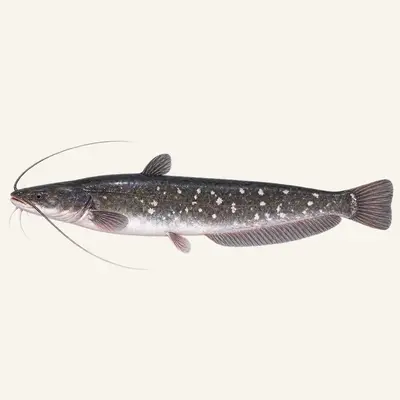
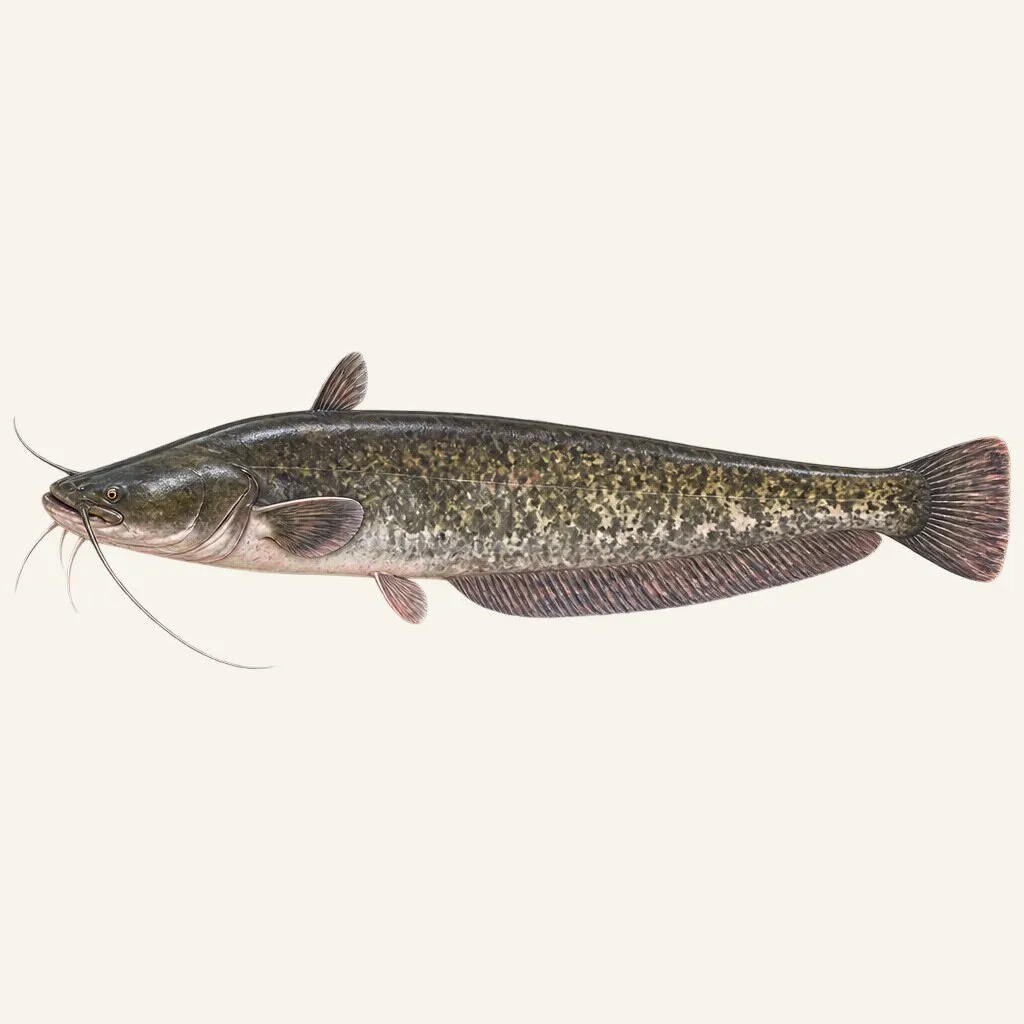
The wels catfish is the largest freshwater fish in Europe, with a scaleless, dark, mucus-covered elongated body, a broad flat head, a wide gaping mouth and long sensory barbels. It can exceed two metres and weigh over a hundred kilograms in large European and Asian rivers.
Calendar
Spawning: fish are vulnerable. Check local rules — closed seasons vary by country.
Recorded in 19 countries
Austria · Belgium · Czechia · Denmark · France · Germany · Hungary · Italy · Luxembourg · Netherlands · Poland · Portugal · Romania · Russia · Spain · Sweden · Switzerland · Ukraine · United Kingdom
GBIF occurrence records — native and introduced populations combined.
Its range
The native basins are the North Sea, Baltic, Black, Caspian and Aral, reaching north as far as southern Sweden and Finland, with an eastern Mediterranean extension through the Maritza, the drainages between the Struma and the Sperchios, and Turkey. The rest of the Mediterranean basin had none.
That outline has been comprehensively overwritten. The species has been introduced and moved around across most of Europe, and as far east as the Balkhash basin in Kazakhstan. Its advance through the rivers of western Europe over the past few decades belongs to that history rather than to any natural spread, and a number of countries record damage to resident fish communities where it has taken hold.
One population sits oddly against the freshwater label: spawning has been recorded in the salt water of the Aral Sea, at Kulandy. A fish that breeds in the sea at one edge of its range and nowhere else says something about how much latitude the species actually has.
Identifying it
Six barbels: two long ones trailing from the upper jaw and four short ones under the chin. That arrangement belongs to no other freshwater fish in Europe, and it ends the question on sight.
The anal fin is the character to fall back on when the fish is in a net and the barbels are folded. It carries 83 to 95 rays, runs almost to the tail and takes up more than half the underside of the animal. At the other end of the body the dorsal is almost comically small, a handful of rays on a fish that can weigh as much as a person, and there is no adipose fin behind it.
Everything else follows from a life spent on the bottom in the dark. The body is naked, without a single scale, and sheathed in heavy mucus. The head is broad and pressed flat, the mouth enormous, the tail rounded or squared off rather than forked. Colour runs from marbled olive to deep brown, and big river fish out of deep water are often close to black.
Breeding
The male holds a small patch of the spawning ground and builds on it. He hollows a shallow scrape or scrubs a support clean, willow roots and drowned vegetation being the usual choice, and the eggs go down on that prepared surface. Spawning is done in pairs, not in a mass.
The eggs are large for a freshwater fish at 3 mm, and each is wrapped in a sticky mucous coat that glues it to the substrate rather than letting it roll away. Development is quick: about 50 hours of incubation at 24 degrees, hatching in two or three days. The larvae come out at 8.5 mm and stay in the nest a further two to four days while the yolk sac is used up. The male is over them the whole time and does not leave until they do.
The growth figures that follow are the striking part. Maturity arrives at two or three years of age, at a length somewhere between 86 and 108 cm. Reaching a metre in three seasons puts this among the fastest-growing fish in European fresh water, and it explains how a stocked population becomes a population of large predators inside a decade.
The water it needs
Large and medium lowland rivers, backwaters and well-vegetated lakes hold the bulk of the population, and the deep water behind dams on the lower reaches of rivers suits it particularly well. Volume matters more than any other single factor: this is a fish of big water.
Brackish conditions are tolerated occasionally, in the Baltic and the Black Sea, but the animal remains freshwater in every practical sense. Depth runs from the surface down to 30 m, across a temperature band of 4 to 20 degrees.
What it looks for is depth combined with obstruction. Scoured holes, bridge foundations, sunken trees, anything that breaks up a deep bed. The species does not migrate, and that non-migratory habit has a direct consequence on the water: a hole holding one this season will be holding one next season, and the map of good spots on a river changes very slowly.
Areas
- Deep holes
- submerged obstacles
- calm zones
Techniques
- Live bait
- Deadbait
- XXL lures
- Meat boilies
Baits
- Giant soft lures
- Glide bait
- Giant squid
- Pellets
What it eats
A nocturnal hunter that works close to the bottom and also up through the column. Larvae and juveniles stay benthic and take a wide spread of invertebrates along with small fish; adults live on fish and on other aquatic vertebrates.
The barbels are the reason it can do this in the dark. They are sensory organs reading vibration and dissolved traces, which lets the fish locate something it has neither seen nor chased. Sight is largely irrelevant to the way it feeds, which is exactly why it is at home in water where nothing else can hunt visually, and why its activity peaks after sunset.
How to catch it
Two things carry this fishery: darkness and scent. A predator that finds its food by chemistry and pressure waves responds to bait that smells strongly or to a lure that shifts a lot of water. Finesse and visual subtlety buy nothing here, and a small quiet presentation is simply not detected.
Finding the hole is most of the work. Given the fidelity of these fish to deep lies, a swim that has been properly sounded and understood will produce season after season, so time spent mapping a bed beats time spent walking a bank. Three known holes are worth more than a kilometre of unknown river.
Size dictates the tackle, and under-gunning here does not fail gracefully. The maxima repeated for generations, five metres and 306 kg, came from misidentifications and confused units, and the verified records fall well short of them. What is left is still an animal that will destroy ordinary predator tackle and take the rig away in its mouth given the chance.
The fight is a matter of force and angle. The fish drives for the bottom and for the nearest obstruction, and conceding the first run usually means conceding the fish.
Conservation
The spawning ground is where this species is losing, even as it wins everywhere else. Breeding needs shallow, structured margins with roots and vegetation to build on, and river regulation removes exactly that. Local populations inside the native range are reported as threatened for that reason alone, in the same decades that introduced populations elsewhere are expanding.
The introductions are the other half of the argument, and it is a live one. A predator this large, dropped into a river that never held one, restructures the fish community over a period of years, and the debate turns sharpest on rivers carrying migratory species. Several countries list the fish among those whose spread they intend to limit.
Age is the fact that should govern what happens to a big one. The maximum reported is 80 years. A very large individual has lived through several decades of a river's history and is not a replaceable unit of stock, whatever the population as a whole is doing. Handling follows from the same point: the whole body is supported, and the animal is never hung by the jaw, which its own weight makes an injury rather than a grip.
Regulations
Min. size 60-80 cm depending on area / Bag limits in some areas
For guidance only. Legal sizes, quotas and open seasons vary by location and season: always check the local regulations in force before fishing.
Other names
Wels is the name in ordinary use, often stretched to wels catfish; sheatfish and European catfish appear in older and in translated texts and mean the same animal.
Catfish on its own is the word that causes trouble. In North America it means the ictalurids, the channel cat, the blues and the bullheads, a separate family on a separate continent with no bearing on this fish at all. On a British fish counter, catfish is generally the wolffish, a marine species from another order entirely. A recipe, a regulation or a record list that says only catfish has not identified anything.
Both halves of the scientific name are ancient words for large freshwater catfishes, one Latin and one Greek, which is a reminder that this animal has been conspicuous enough to name for as long as anyone has been writing things down.
Sources: fishbase.se · api.gbif.org