Wallago catfish
Wallago attu · Siluridae
- Freshwater
- Catfish
- Medium
- Size
75–240 cm
- Weight
2.3 kg
- Water temp.
22–25 °C
Where to fish
- Estuary
- Lake
- River
Habitat icons: Flaticon
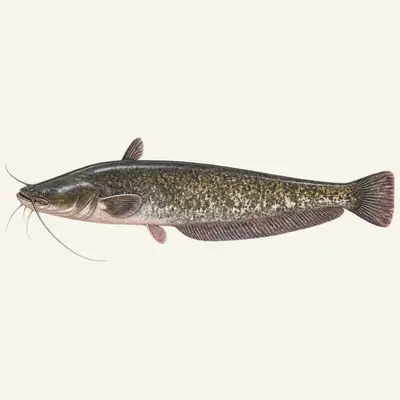
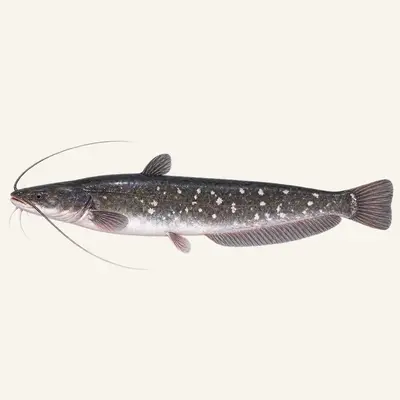
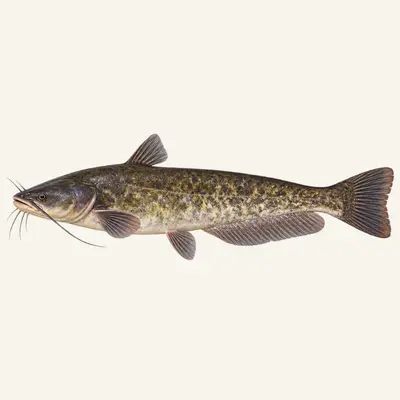
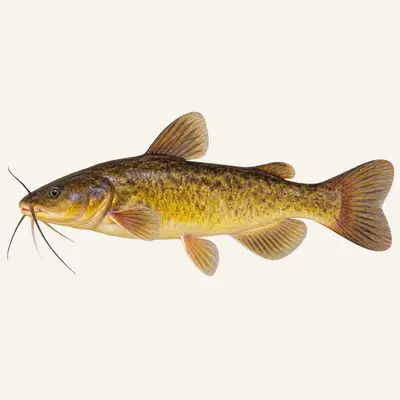
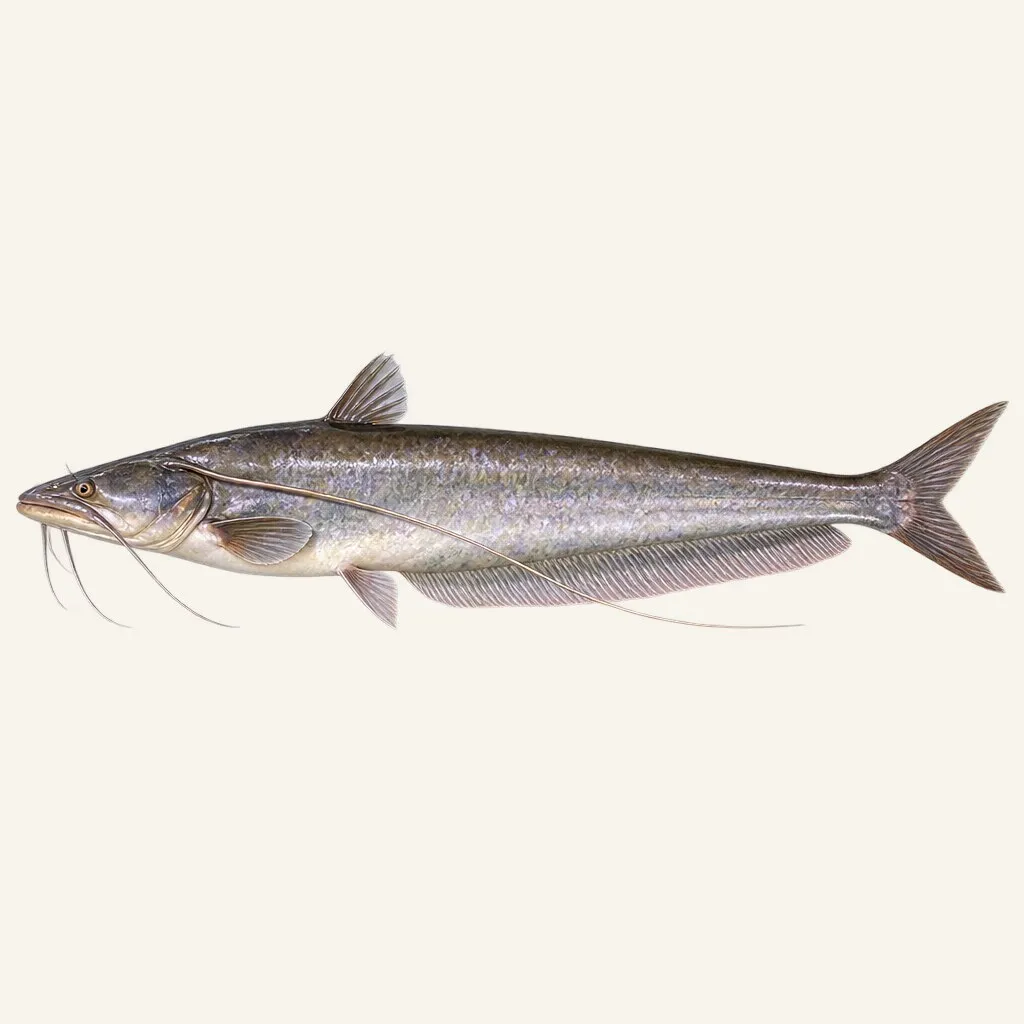
The wallago catfish is a large predator with an elongated, strongly compressed body and a wide mouth extending to the eyes, with a silvery bluish sheen.
Calendar
Recorded in 4 countries
Bangladesh · India · Myanmar (Burma) · Thailand
GBIF occurrence records — native and introduced populations combined.
Its range
Pakistan east to Viet Nam and south into Indonesia, with a record from Afghanistan. The band runs from 38°N to 10°S, across a working temperature range of 22 to 25 degrees, and the fish moves within fresh water and into brackish at the bottom end of it.
That is a very wide spread for a species tied as tightly as this one is to a particular kind of bank. It follows the great river systems of southern Asia rather than belonging to any single basin.
Identifying it
The maxillary barbels reach back as far as the anal fin. On a fish built like this one that means a pair of sensors trailing over more than half the animal's length, which is an extreme even among catfishes. The mandibular pair, in contrast, stops at the corner of the mouth.
The mouth then does the rest. Its cleft runs so far back that the corner sits well behind the eye — the description states the relation the other way round, placing the eye in front of a vertical dropped through the corner of the mouth — and the jaws carry teeth in broad bands, with two small patches on the vomer.
Head broad, snout flattened, body long and strongly compressed from side to side. The eyes are small and have a free orbital margin. The anal fin carries 77 to 97 rays and the dorsal five. There are 24 to 30 rakers on the first gill arch, a count worth having on an animal whose feeding is otherwise recorded only as lists.
Breeding
Spawning happens before the monsoon, in the hot part of the year, and the species is most abundant through the warm season.
Beyond that, the file is careful with its wording. It is oviparous, and distinct pairing is recorded as possible, on the pattern of other members of the family, rather than as observed in this one. That is a borrowed detail and should be read as one.
The water it needs
Holes in the banks of rivers and canals. That is the specific address, and the file gives it plainly: the species does well where the margins are grassy, and hides mostly in bank cavities.
Around those holes it wants deep, still or slow water over mud or silt. Its own behaviour is described as sluggish — it stays on the soft bottom looking for food rather than ranging — which is the account of an animal waiting at a doorway, not one on patrol.
Areas
- Main channels of large rivers
- Deep holes
- Open lakes and reservoirs
- Confluences and tributary mouths
Techniques
- Live bait mid-water
- Dead bait on floating rig
- Large soft lure
- Bottom fishing in deep river
Baits
- Large live fish
- Whole dead fish
- Forage carp
- River eels
What it eats
Juveniles live mainly on insects. Adults take smaller fish, crustaceans and molluscs.
The shift is not simply one of size class. Insects are picked off; fish, crabs and shellfish are engulfed or crushed, and the gape that makes the adult list possible is the character the whole page turns on. Small eyes, enormous barbels and a mouth opening behind them describe a fish that detects at short range and then takes in a volume of water with whatever happens to be inside it.
How to catch it
The seasonal movement is the most useful thing known about this species, and in the Mekong it has been followed through a full cycle. During the flood it leaves the main river for smaller streams, canals and the floodplain. When the level drops and the flood pulls back, it returns to the mainstem or to large tributaries and settles into deep pools, where it stays until the next inundation.
That is two entirely different fisheries. In high water the fish is dispersed across a flooded landscape and can turn up almost anywhere in it. In low water it is concentrated into a known and countable set of holes. The second condition is the one to work, and the falling limb of the hydrograph is what delivers it.
Inside a pool, the bank cavity is the station. A bait laid on the mud within reach of the hole plays to the animal's habits; a bait cast into open water does not, since nothing in the account suggests this predator goes looking. Common length is 75 cm, so the ordinary fish is not the giant of the photographs, and the gape allows a large bait well before the fish is large itself.
Then the warning, and it belongs on a page of this kind. Handled, this species bites hard, with a very large mouth, powerful jaws and a band of conical teeth. It is entered in the file as capable of injuring a person, which is not said of most catfishes in this catalogue. Unhooking is done with tools and with the head under control, never with a hand inside the gape.
Conservation · Vulnerable (IUCN) — This species is threatened with extinction. Always release it (no-kill), handle it with the utmost care and check local rules — fishing for it may be prohibited.
Conservation
The species carries two reputations at once and they pull in opposite directions.
The older one is written into the file itself: destructive to other and more valuable food fishes. That is a fisheries judgement rather than an ecological finding, and it is the kind of line that has historically justified clearing a predator out of water managed for something else.
The newer one is decline, attributed to over-harvesting. A large, slow, bank-dwelling ambusher that gathers into a known set of pools every dry season is exceptionally easy to fish out, and the concentration that makes the angling good is the same concentration that makes a net efficient.
The habitat side compounds it. This fish needs undercut, cavity-bearing banks and soft-bottomed pools. Both go when a channel is straightened or a bank is armoured, and neither loss shows from the surface the way the loss of a weed bed does.
Regulations
Check the local regulations in force (legal size limits, closed seasons, bag limits).
For guidance only. Legal sizes, quotas and open seasons vary by location and season: always check the local regulations in force before fishing.
Other names
English has no name of its own for this fish. Wallago catfish repeats the genus and adds the family word, which leaves it saying nothing that the classification did not already say — and the genus holds more than one species, so an English text that gives only wallago has not identified an animal.
Every other language in the catalogue does exactly the same thing. Silure wallago, siluro wallago, Wallago-Wels, bagre-wallago: local family term, plus the genus, in all of them. That unanimity is a symptom. It is what happens when a fish enters a language through a scientific list rather than through a market, and it means the names that carry real information about this animal are the ones used along the rivers where it is landed, in languages this catalogue does not print.
Sources: fishbase.se · api.gbif.org