Barred sorubim
Pseudoplatystoma fasciatum · Pimelodidae
- Freshwater
- Catfish
- Medium
- Size
105 cm
- Weight
70 kg
- Water temp.
24–28 °C
Where to fish
- River
Habitat icons: Flaticon
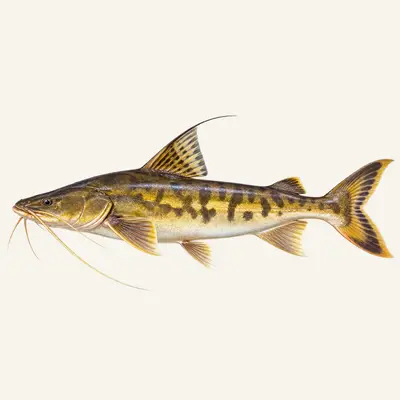
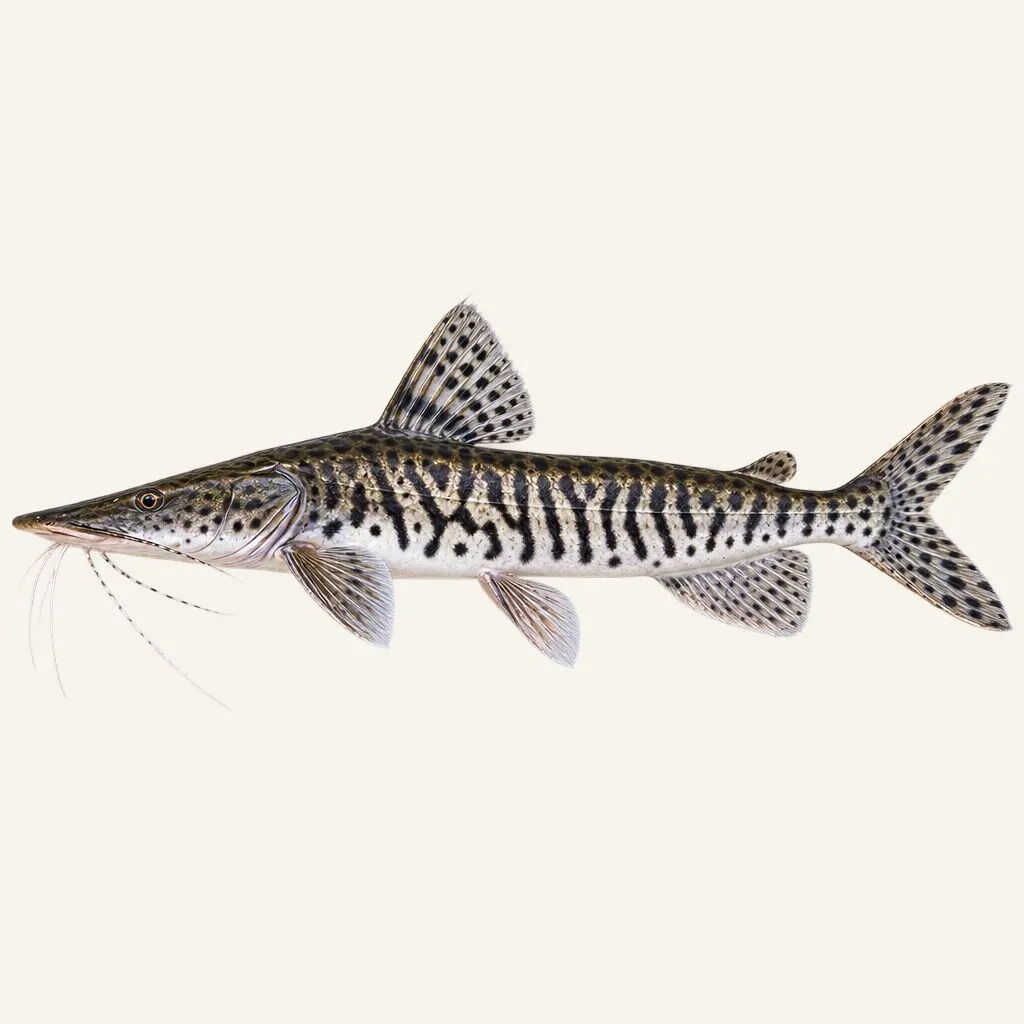
The tiger shovelnose catfish is a large South American catfish from the Pimelodidae family, with a slender body marked by dark vertical stripes on a silvery grey background reminiscent of a tiger. Its long, shovel-shaped flattened head with long barbels is highly distinctive.
Calendar
Identifying it
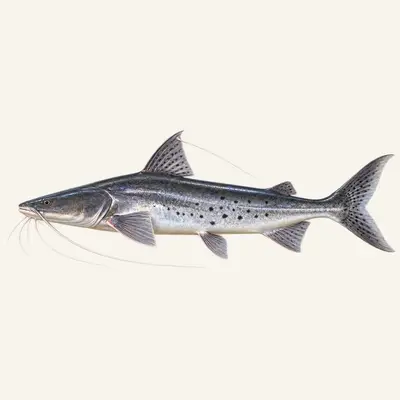
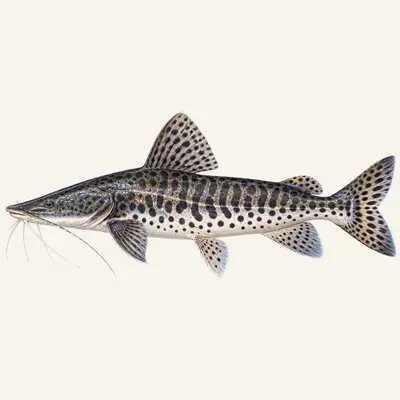
Dark vertical bars on a silvery grey flank, carried on a long head flattened into a shovel. The bars are the character the epithet records, and they are what the catalogue uses to separate this fish from the pintado, which it describes the other way round, as spotted. Barred against spotted settles the two at arm's length.
Breeding
Eleven centimetres separate the sexes at maturity: 45 cm for males, 56 for females. The gap does not close afterwards, since females go on to reach sizes males do not.
Fecundity is given per unit of mass — eight million eggs per kilogram of fish. That unit is the correct one, because production scales with weight rather than with the number of spawners, and it means the egg output of a reach rests on its heaviest females far more than on its head count.
A large cachara is consequently a female, carrying a share of the reach's whole reproduction on its own. The same source also gives 53 cm as a general maturity threshold with no separation of the sexes; both figures sit in the literature side by side and both are worth knowing.
The species is potamodromous: the entire cycle plays out inside the river network.
The water it needs
The main riverbed is the domain, and the qualification that follows is the most useful sentence in the whole file. Adults occupy the principal channels and go into flooded forest at times — but foraging stays confined to the riverbed.
Presence and feeding are therefore dissociated, which is rarely established so plainly for an Amazonian fish. During the flood the animal may well be among the trees. It eats in the channel.
One preference is stated by comparison rather than on its own: set beside its close relative, this species appears more attached to shaded streams. The chemical envelope is wide by contrast — pH from 6 to 8, hardness from 4 to 30 — which covers acid blackwater and silt-loaded white water alike. Depth begins at 5 m. The thermal band is narrow, 24 to 28 degrees, and the latitudes it occupies run from 8 north to 11 south, entirely inside the warm belt.
Areas
- Main channels of large rivers
- Deep holes with moderate current
- Tributary confluences
- Underwater sandy beaches
Techniques
- Live bait mid-water
- Dead bait on sliding rig
- Swimbait soft lure
- River bottom fishing
Baits
- Live Amazonian fish
- Whole dead fish
- River sardines
- Whole piranhas
What it eats
Hunting is nocturnal, and the prey list repays reading: loricariids, cichlids, characoids, plus crabs.
The first name is the informative one. Loricariids are the armoured catfishes, plated with bone from head to tail. Swallowing them requires a mouth wide enough to take the shape and a gut prepared to process the armour, and a predator that includes them is not selecting prey on convenience.
The crabs place part of the hunting on the bed itself, which agrees with a demersal way of life.
How to catch it
Channel, night, bottom. Three of the four decisions come out of a single line of the published biology, and the fourth comes from the qualification about foraging.
That qualification is the instruction. When the water is up it is tempting to follow it into the flooded forest, where the fish does go; but it returns to the channel to feed, and the channel is where a bait belongs. Depth starting at 5 m says the same thing in another way — this is not a margin fishery.
The prey list chooses the bait. Fish rather than anything else, and bottom-living fish rather than open-water ones. A plated body is no obstacle to this predator, and neither is a crab.
The flesh is yellowish and described as free of bones, which turned the species into a market fish across its whole range. That is worth knowing before assessing pressure: the rod is not what removes most of these animals.
Conservation
What presses here is not a label, it is the shape of the spawning effort. Eight million eggs per kilogram means each female's contribution rises with her mass. Removing the heaviest removes a disproportionate share of the reproduction, and any fishery that selects on size removes them first — the large fish being precisely the females.
The river itself is the second point. A potamodromous species whose feeding is confined to the riverbed depends on that bed staying continuous. A structure across the channel takes away more than a migration route: it takes away the larder.
The preference for shaded streams adds a quieter dependence, on the trees along the bank. Shade over a channel comes from riparian forest, and nothing substitutes for it once the bank is cleared.
Regulations
Check the local regulations in force (legal size limits, closed seasons, bag limits).
For guidance only. Legal sizes, quotas and open seasons vary by location and season: always check the local regulations in force before fishing.
Other names
Two industries have given this fish two English names and they rarely appear in the same document. Fisheries reporting says barred sorubim. The aquarium trade says tiger shovelnose, and the trade name has the wider currency, so an English text about a live fish and an English text about a landed one can be describing the same animal without a word in common.
South American usage is older and more precise: cachara in Brazil, surubí atigrado in the Spanish-speaking countries.
Pseudoplatystoma reads as false broad snout, and fasciatum points at the bands on the flank. The binomial names the head first and the pattern second, in that order.
Sources: fishbase.se · api.gbif.org