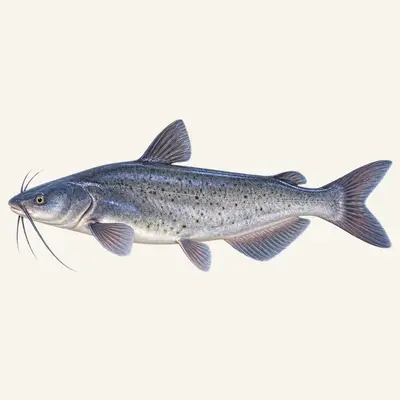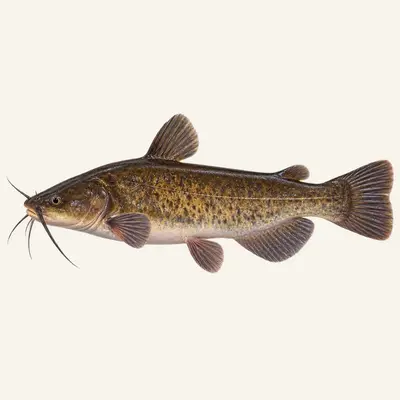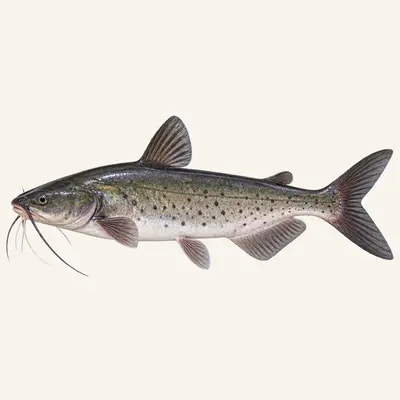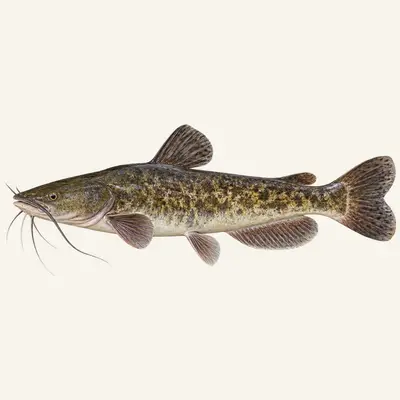
Black devil catfish
Hemibagrus wyckii · Bagridae
- Freshwater
- Catfish
- Medium
- Size
90 cm
- Water temp.
22–25 °C
Where to fish
- River
Habitat icons: Flaticon
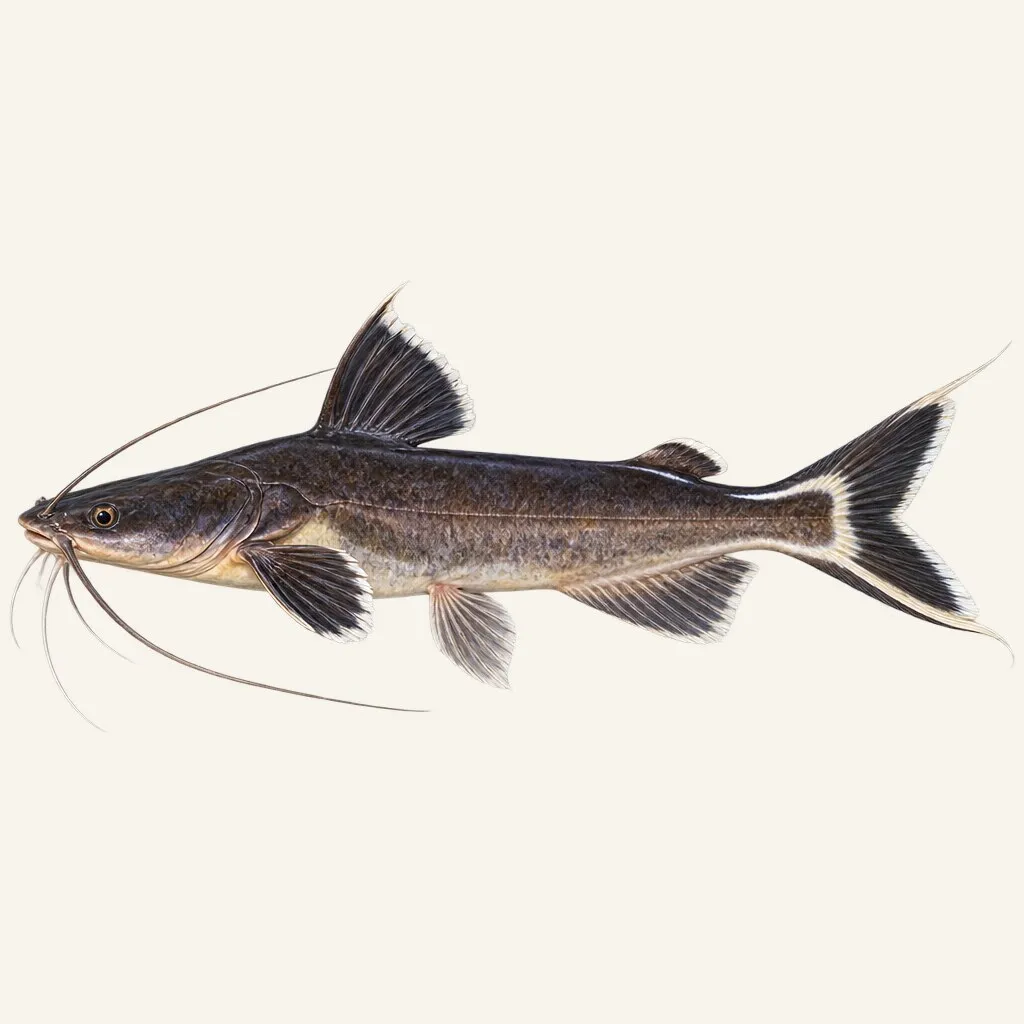
The black devil catfish is a large bagrid with a robust, elongated and very dark body, identified by its dark grey caudal fin with cream-coloured rays, the white marks at the tips of its fins, and its long maxillary barbels. An aggressive predator, it inhabits fast-flowing rivers and streams of Southeast Asia.
Calendar
Recorded in 5 countries
Cambodia · Indonesia · Laos · Malaysia · Thailand
GBIF occurrence records — native and introduced populations combined.
Identifying it
A dark fish outlined in cream at every point where it ends. The published diagnosis lists white markings on the tips of the pectoral and dorsal fins, on the leading edge of the adipose, and along the upper and lower margins of the caudal peduncle and of the tail itself, filaments included. The coracoid region underneath is cream; the tail is dark grey with cream on its outer and first principal rays. Nothing in that pattern is bright. It is a pale outline drawn on a dark animal.
Stating it precisely matters, because the species description rendered elsewhere on this page gives a red-tipped tail. The diagnosis consulted here records no red anywhere on the fish. Which of the two is describing this animal is a question for whoever has one in the hand.
The head supplies the second half of the identification. It is extremely broad and pressed flat, the skull roof smooth and level, and the occipital process reaches back far enough to meet the basal bone of the dorsal fin. Three statements about one architecture, read from above and then from the side.
The dorsal spine is heavily ossified and long — 11.9 to 14.8 per cent of standard length — and its trailing edge carries 10 to 12 serrations. The maxillary barbels reach the middle of the dorsal-fin base, half again to twice the length of the head.
Counts: one spine and seven soft rays in the dorsal, 10 to 13 in the anal, 10 or 11 in the pectoral, 50 or 51 vertebrae. No stripe along the body.
The author of the diagnosis says outright that none of this works on its own. The species is separated by the combination, which is the only honest way to use the list.
The water it needs
Fast-flowing water over a muddy bed, in large rivers, and only in their middle course.
The first half of that is an odd pairing. Current strong enough to be called fast normally carries fine sediment away and leaves gravel or stone behind; a mud bottom under moving water therefore means particular places — the inside of a bend, the tail of a pool, the lee of a boulder field — rather than a class of river.
The second half narrows it further. The species appears restricted to the middle reaches: not the headwaters, not the lower river, but a band between the two. That is an unusually tight statement for a file this short, and it is the most useful line in it.
Areas
- Rapids and strong-current areas
- Underwater rocky zones
- Banks with submerged roots
- Torrent river beds
Techniques
- Bottom fishing with live bait
- Nocturnal bottom line
- Dead bait near shelters
Baits
- Live small shrimp
- River worms
- Small live fish
- Aquatic insects
What it eats
Insects, prawns and fish.
The span runs from a few millimetres to a whole fish, which describes an opportunist rather than a specialist. In moving water it also implies feeding out of the drift, since holding a position and taking what the current delivers is the cheapest way for a bottom fish to eat insects in a river that will not let it chase them.
How to catch it
Find the mud under the current and the rest follows. In a river of the right size that means reading the bed rather than the surface: fine deposits collect where flow slackens without stopping, and the middle course is where a large river still does both those things within a few metres of each other.
Bait tracks the diet. A live prawn or a small live fish released upstream of a rock shelter or a root mass reaches the animal along the route its food already takes, and it does so without needing to be worked.
Then the spine. Ten to twelve serrations on a well-ossified dorsal spine catch in net mesh and in skin, and they catch in one direction only. Anything hooked on them comes free along the axis of the spine and never across it. That is a decision to have made before the fish is in the boat rather than after.
Conservation
Nothing in the file records a decline, and two of its lines still deserve to be held together.
The first is the restriction to the middle reaches. A species confined to a band of river is exposed to whatever changes that band, and it has no refuge upstream or downstream inside its own system.
The second is that the fish is sold fresh in markets, which puts a steady commercial draw on it. Neither fact is alarming alone. Together they describe an animal whose entire supply comes out of one section of each river it occupies.
Regulations
Check the local regulations in force (legal size limits, closed seasons, bag limits).
For guidance only. Legal sizes, quotas and open seasons vary by location and season: always check the local regulations in force before fishing.
Other names
Black devil catfish is the name six languages have agreed on, and it is a verdict rather than a description. The diagnosis it is attached to gives a dark fish edged in cream, and no more than that.
The instructive trouble lies elsewhere. Hemibagrus is a large genus whose English names are unstable, with the same trade words drifting between species — Asian redtail catfish among them, which is the name that has attached itself to the description on this page for a fish whose own diagnosis reports no red at all. In a genus keyed on serration counts and barbel proportions, common names are not a way in.
The epithet is a dedication rather than a character. It records who was being honoured and tells you nothing about the animal.
Sources: fishbase.se · api.gbif.org