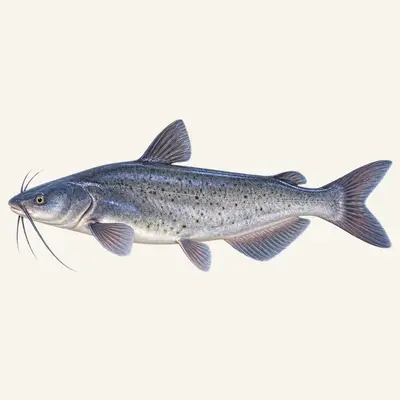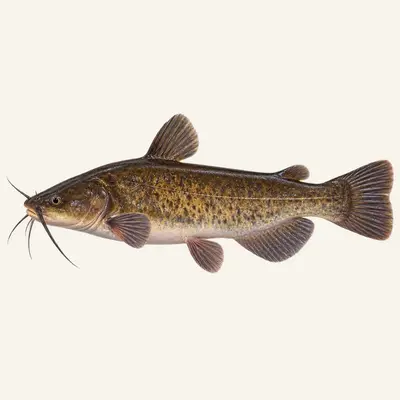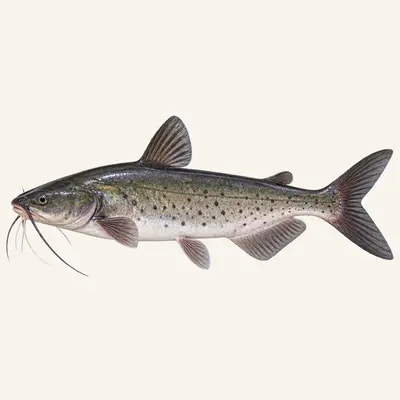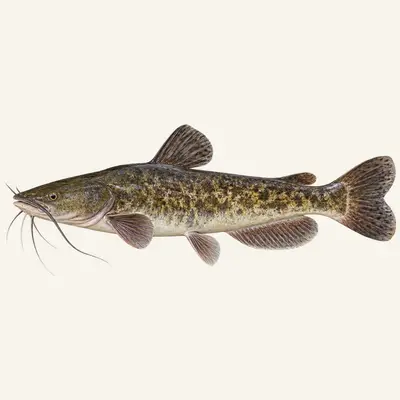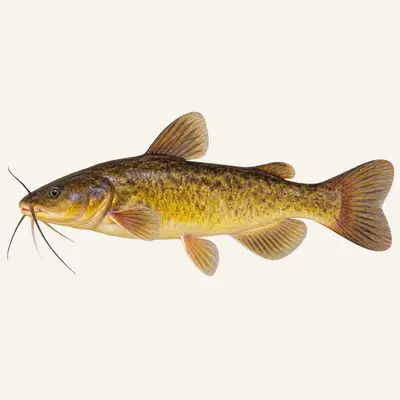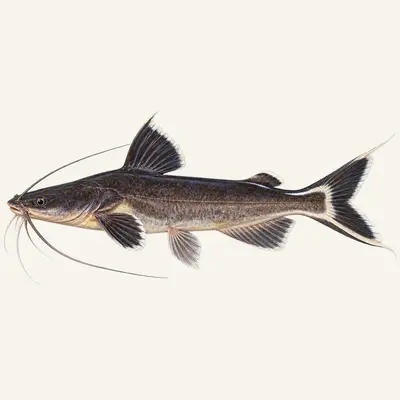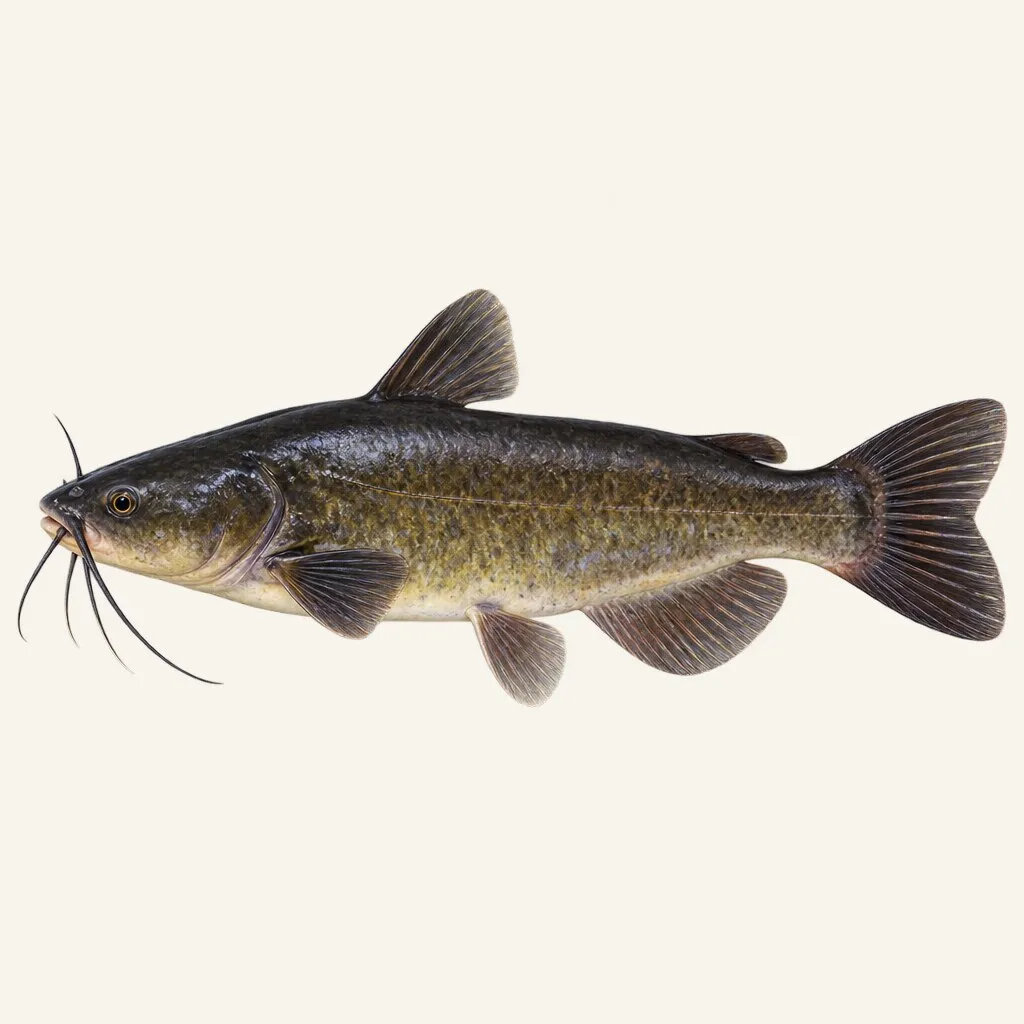
Black bullhead
Ameiurus melas · Ictaluridae
- Freshwater
- Catfish
- Easy
- Size
27–66 cm
- Weight
0.3–3.6 kg
- Lifespan
10 years
- Water temp.
8–30 °C
Where to fish
- Canal
- Pond
- River
Habitat icons: Flaticon
Invasive species classified as a pest - 8 barbels - Painful venomous spines
Calendar
Recorded in 14 countries
Belgium · Canada · Croatia · France · Germany · Hungary · Italy · Netherlands · Portugal · Romania · Serbia · Spain · Switzerland · United States
GBIF occurrence records — native and introduced populations combined.
Its range
The native range extends from the Great Lakes to northern Mexico. What has changed is Europe.
The species now maintains self-sustaining populations in the Ebro and Tagus drainages, in most French drainages, and locally in Italy, the Netherlands and Germany — with the caveat that the real range is probably wider than the known one, since the confusion with its close relative blurs national inventories.
Several countries have recorded ecological damage following its arrival, and it is treated as unwanted. The mechanism is not that of a large predator; it is density. In Europe this fish forms very numerous populations of stunted individuals which stop growing for want of room and food, occupy all the available space and are of no interest to anybody. A pond that has tipped into that state does not come out of it on its own.
Identifying it
Eight barbels, not six. Two long ones on the upper jaw, two short ones at the nostrils and four under the chin: that is the North American ictalurid count, and it parts these fish at a glance from the wels of Europe, which carries six. The two belong to different families, and the resemblance goes no further than being naked, whiskered and nocturnal.
The real difficulty lies elsewhere, and it is serious. This species is constantly confused with the brown bullhead, to the point that the reference literature reports not knowing which of the two occupies certain countries. A bullhead lifted out of a European canal is therefore identified by default rather than by examination, and the question is not settled from a photograph.
The body is stocky and scaleless, the skin smooth and slippery, the tail barely notched or not at all.
The spines of the pectoral fins and of the dorsal lock in the raised position and sting. They carry venom, which is why the wound hurts out of all proportion to how deep it is. Mastering them is the first thing to learn about the animal: the grip is from above, immobilising the fish with the fingers kept behind the pectorals.
Breeding
The female builds and the male closes. She prepares the nest by clearing debris, gravel and silt off the bottom, after which the pair works through a routine of mutual butting and strokes its barbels over the other's body.
Then comes a movement no other freshwater fish in Europe performs: the male wraps his caudal fin around the female's head, and it is at that moment that she releases her eggs. The pair repeats the whole thing, as often as five times within the same hour, and between releases she fans what is already down.
Both parents then guard and fan the clutch. That shared care is the quiet engine of everything else on this page. Two adults of hand length posted over a nest defend it against very nearly everything that lives in a pond, and the survival rate that results bears no relation to that of a species which abandons its eggs.
The water it needs
It looks for a soft bed and water that does not move. Pools, backwaters, sluggish runs in creeks as in large rivers, impoundments, cut-off meanders, ponds: anywhere the substrate is loose and the current weak.
Its tolerance range explains that ubiquity. From 8 to 30 degrees, in water that is acid or frankly calcareous, soft or hard, almost no physical or chemical parameter stops it. A water body that a demanding cyprinid refuses suits this one perfectly.
Areas
- Muddy bottoms
- warm waters
- calm zones
Techniques
- Bottom dead bait
- Night float
Baits
- Worms
- Meat
- Tripe
- Deadbait
What it eats
It feeds at night and eats more or less everything. The young take immature insects, leeches and crustaceans; adults add clams, snails, plant material and fish.
That complete omnivory is the second reason for its success. A species which accepts vegetable matter has no ceiling set by the abundance of animal prey, so a population can keep growing long after a strict predator would have stopped breeding for lack of forage. It is what produces stunted populations rather than an equilibrium.
How to catch it
Mostly it is caught by people who were not fishing for it. Where it is abundant it comes up on baits meant for other species — bottom baits, pastes, worms, boilies — and the number of accidental captures is the first symptom of a water that has tipped.
For anyone genuinely after it, three settings cover the whole thing. A soft bed and no current rather than the flow; night or the end of the day rather than broad daylight; a bait that smells, animal or meat-based, rather than a lure. Detection is done by barbel and by chemical trace, and sight plays almost no part in it.
Unhooking calls for a fixed method. The venomous spines come up the moment the fish is gripped, the bare skin is slippery, and a fish allowed to turn in the hand puts its spine into the palm. Pliers, a cloth and a hold from above settle the matter once and for all.
Conservation
What is at stake here is not the future of the species but that of the waters it has been put into.
The tipping point always arrives in the same order. Two parents guard a clutch efficiently, the fish eats animal and plant matter indifferently, it tolerates warm and poorly oxygenated water, and nothing regulates its density. Within a few seasons a pond holds thousands of hand-sized individuals, the benthic resource is exhausted and the species that depended on the bed have gone. This fish does not eliminate its competitors by eating them. It starves them.
The administrative classification that follows from that situation varies from one country and one region to the next, and it covers transport as much as the return of a fish that has been caught. Those rules are checked with the authority responsible for the water before any decision is taken on the bank — one of the few cases where the fate of a catch is not left to the angler's judgement.
Regulations
Must be destroyed - Returning it to the water is prohibited
For guidance only. Legal sizes, quotas and open seasons vary by location and season: always check the local regulations in force before fishing.
Other names
Black bullhead in English, and bullhead is the word that causes trouble. The collision is squarely an English one: in Britain a bullhead is Cottus gobio, a small spiny sculpin of clean streams belonging to another order entirely, while in North America the name belongs to Ameiurus. A British text and an American one using that single word are describing unrelated animals.
The epithet melas is the Greek for black, and colour is the least dependable character in this genus: these fish darken and pale with the water they grew up in, and a pale individual of this species can be taken for its congener on that basis alone.
France, where the fish is widespread and the only member of its family to be so, simply calls it poisson-chat. Canadian French keeps barbotte for the whole group, so one animal is a poisson-chat on one side of the Atlantic and a barbotte on the other.
Sources: fishbase.se · api.gbif.org