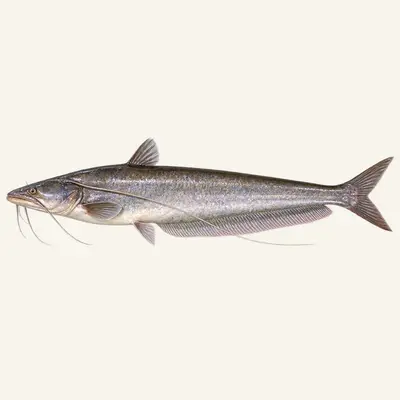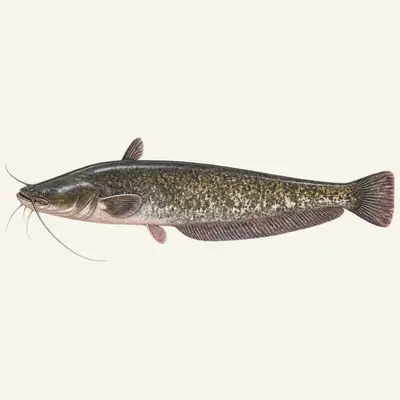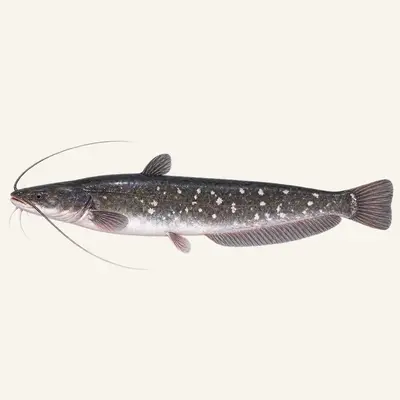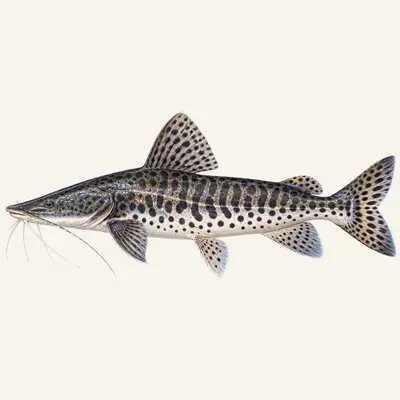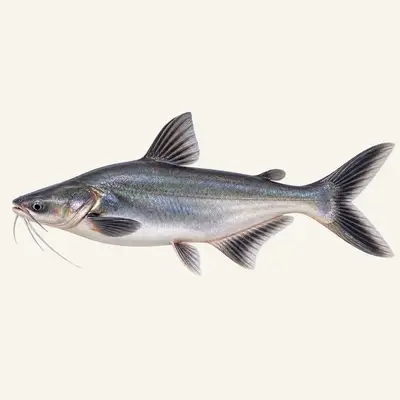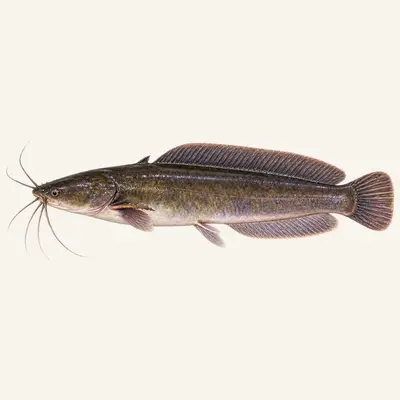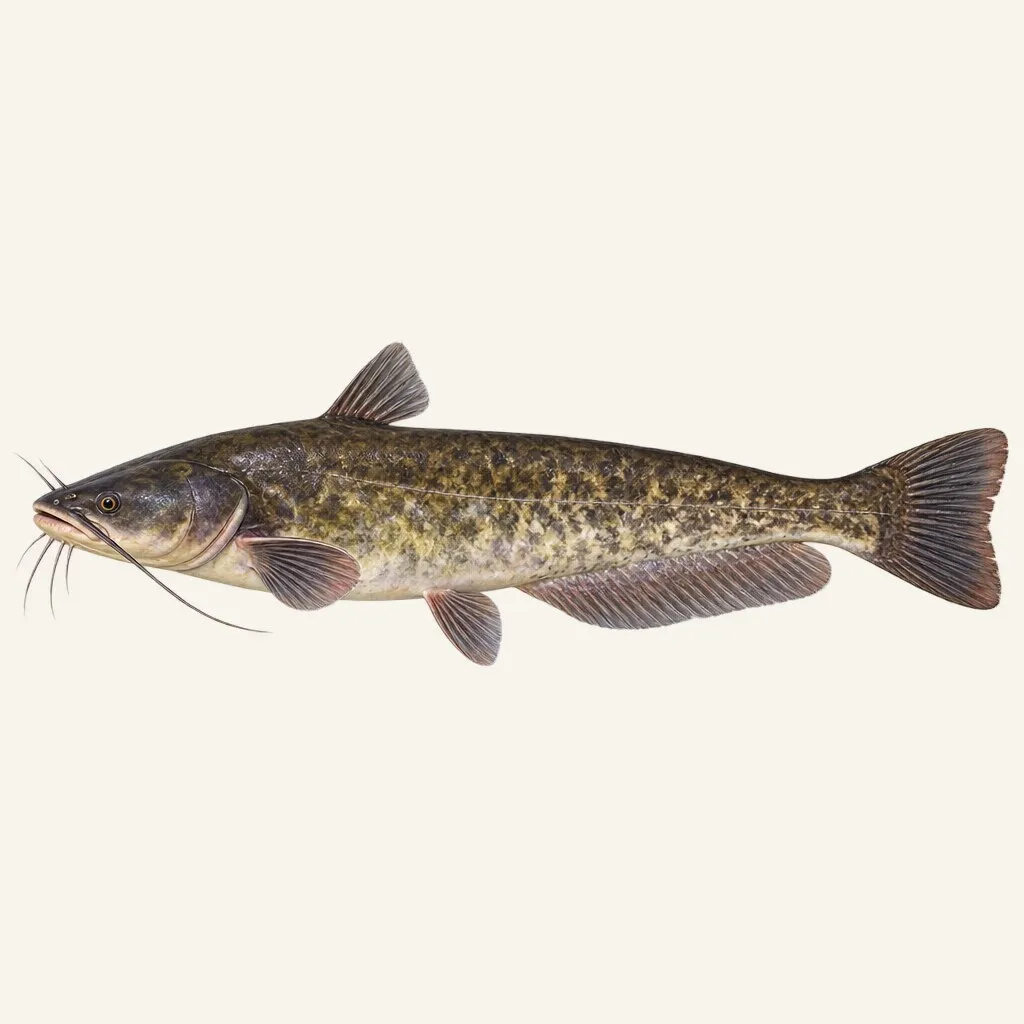
Southern catfish
Silurus meridionalis · Siluridae
- Freshwater
- Catfish
- Medium
- Size
114 cm
- Weight
11 kg
Where to fish
- Lake
- River
Habitat icons: Flaticon
The Chinese southern catfish is a large Asian freshwater catfish with an elongated, scaleless body, a broad head, a wide mouth lined with small teeth and long barbels. It inhabits the large rivers and lakes of southern China, where it is both an apex predator and a species valued in aquaculture.
Calendar
Recorded in 1 country
China
GBIF occurrence records — native and introduced populations combined.
Identifying it
What is documented about this catfish is its production, not its biology. The reference file carries no morphology rubric, no ray counts, no barbel formula, no note on colour. Under uses it carries a single line: commercial aquaculture. The species is being reared at scale by people who have never needed a diagnosis to do it.
The characters in circulation therefore come from the catalogue entry rendered on this page rather than from a published description — an elongated body without scales, a broad head, a wide mouth set with small teeth, long barbels. Every one of those would fit several members of the genus.
That leaves locality, and locality only half works. The large rivers and lakes of southern China are this fish's ground, but the Amur catfish occurs in China too, so a Silurus taken from a southern Chinese river is not identified by having been taken there. These species were separated in a taxonomic revision, on fine measurements, and that separation has never come down into a field character.
The water it needs
Slow water over mud, close to something solid. The pairing deserves marking, because a large predator that asks for neither current nor hard bottom is unusual. What organises its territory is not the flow but the obstruction: a sunken trunk, an undercut bank, the lip of a hole.
The rivers and lakes of southern China supply that in volume. So, increasingly, do the reservoirs, ponds and irrigation canals that the rearing industry has spread across the same basins.
Areas
- Deep holes
- Cluttered banks
- River confluences
- Slow current areas
Techniques
- Live bait fishing
- Worked dead bait
- Bottom soft lure
- Drift fishing
Baits
- Live fish
- Dead fish
- Frog
- Large earthworm
What it eats
A predator, and the top one in the waters it occupies.
The apparatus is a wide mouth carrying small teeth — something built to hold rather than to cut. Prey taken that way goes down whole, so the diet is bounded by the width of the gape and not by the strength of the jaw. On a fish like this one, growing a broader head enlarges the menu directly.
How to catch it
With no published account of the animal's behaviour, the fishing has to be reasoned from the water, and the water here is strongly characterised. Slow, silty, cluttered ground is not searched by covering it. It is divided into stations, and every station is an obstruction.
The commercial rearing is the other practical fact. Farmed stock puts the species into managed water throughout its range — impoundments, ponds, canals — so it is met in places that are not rivers at all.
Regulations
Check the local regulations in force (legal size limits, closed seasons, bag limits).
For guidance only. Legal sizes, quotas and open seasons vary by location and season: always check the local regulations in force before fishing.
Other names
Southern catfish is the vernacular the catalogue gives, while the description printed alongside it calls the fish the Chinese southern catfish. The two disagree by one word, and the missing word is the one that makes the name usable. South of what is the entire content of it.
The other languages get round this by keeping the family term. German has Südlicher Wels, Italian siluro meridionale cinese, and both tell a reader at once that the animal is a Silurus, a relative of the European wels. English gives no such signal, and catfish attached to a compass bearing is close to no name at all.
Meridionalis means southern, so the binomial says the same thing again. Two nomenclatures, one criterion, and it is the criterion that does not identify anything.
Sources: fishbase.se · api.gbif.org