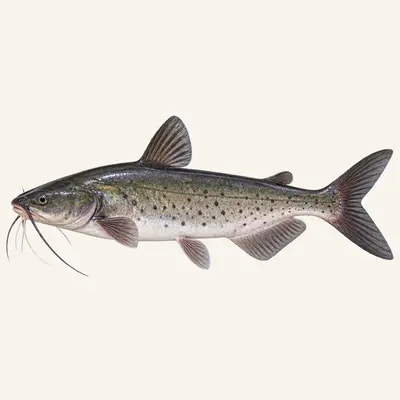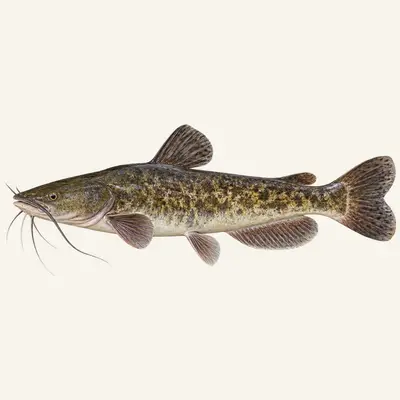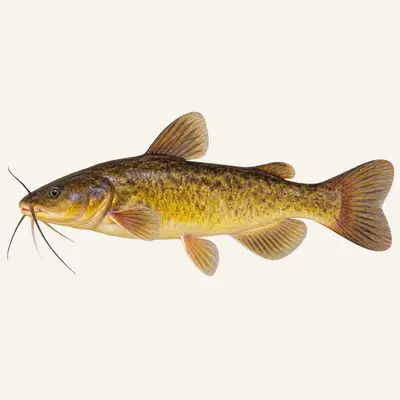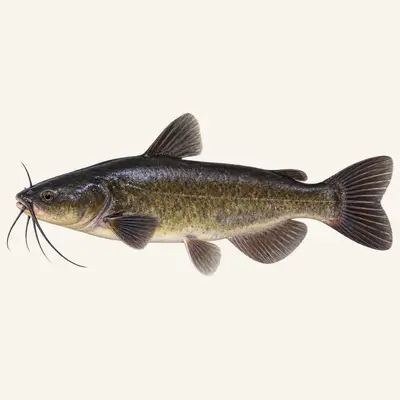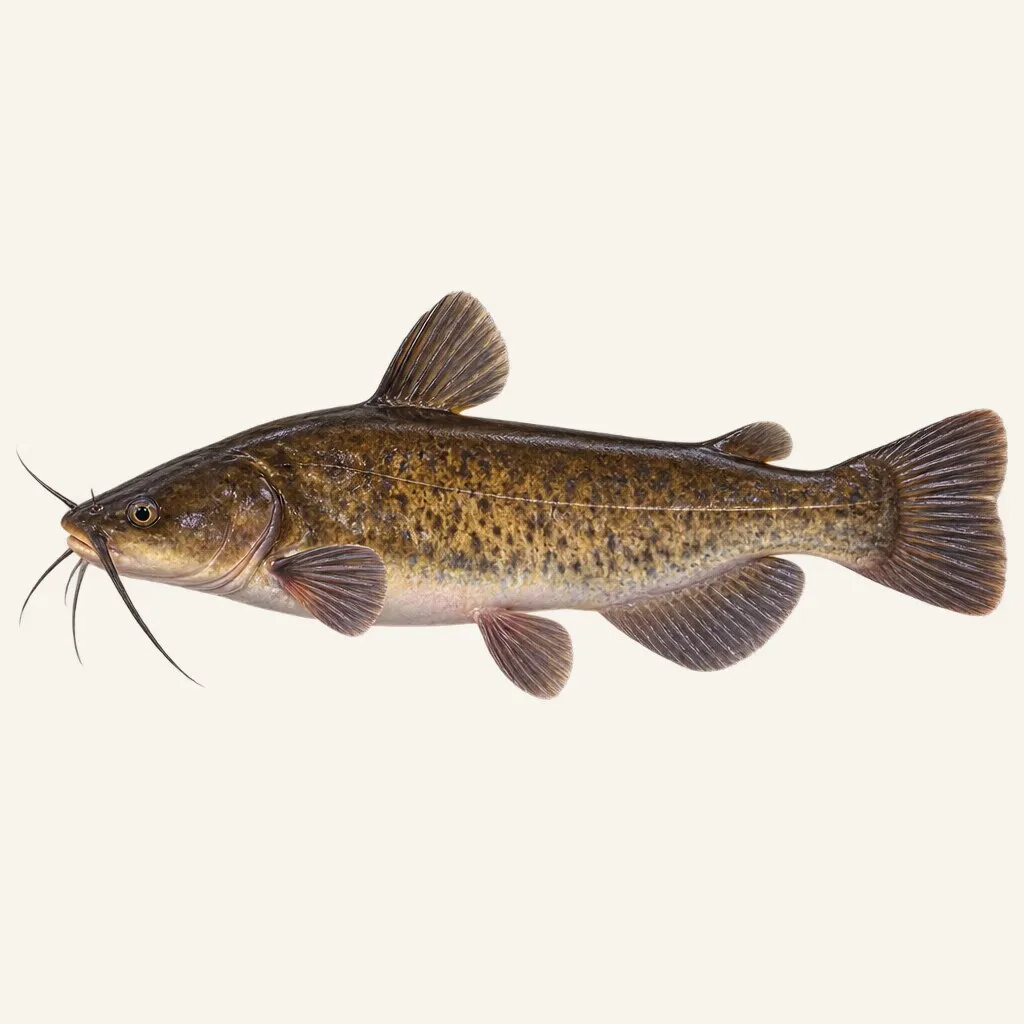
Brown bullhead
Ameiurus nebulosus · Ictaluridae
- Freshwater
- Catfish
- Medium
- Size
25–55 cm
- Weight
0.2–2.7 kg
- Lifespan
9 years
- Water temp.
0–37 °C
- Depth
0–12 m
Where to fish
- Canal
- Lake
- Pond
- River
Habitat icons: Flaticon
The brown bullhead is a stocky freshwater catfish widespread in North America and introduced in Europe and Oceania, characterized by its eight barbels, scaleless dark brown body and pectoral spines.
Calendar
Recorded in 10 countries
Belgium · Canada · Denmark · Germany · Netherlands · New Zealand · Norway · Poland · Ukraine · United States
GBIF occurrence records — native and introduced populations combined.
Its range
The natural range is double and vast. On one side the drainages of the Atlantic and Gulf slopes, from Nova Scotia and New Brunswick down to Mobile Bay in Alabama; on the other the St Lawrence and the Great Lakes, Hudson Bay and the Mississippi, from Quebec west to south-eastern Saskatchewan and south to Louisiana.
The species has been introduced into several countries, and several of them have observed ecological damage after it settled in. Physiological tolerance is the direct cause of that success: a fish stopped by no water parameter establishes itself wherever it is put down, degraded habitats included, in water nothing else will colonise.
Identifying it
A single spine in the dorsal, followed by six or seven soft rays; one spine in the anal; 18 or 19 rays in the tail. A stocky naked body, eight barbels, smooth slippery skin. That is the description, and it will not be enough.
The determination problem here is the black bullhead. The two species are close enough that the reference literature declines to say which of them occupies certain countries where both have been released. Telling them apart needs the fish in hand and a key; a photograph does not permit a conclusion, and identification by default is the rule rather than the exception.
Maturity is reached around 26.6 cm, within a range of 20 to 33, so an adult fits comfortably into two hands.
Breeding
The pair lies head to tail. After a period in which the two fish stroke each other with their barbels, they settle over the nest facing in opposite directions, keeping their bodies in contact, and spawn in that position. The nest has been built by one of the two or by both, with no fixed rule.
The care that follows is detailed and active. The parents fan the clutch with the paired fins, move and stir the eggs with their barbels, and go as far as taking them into the mouth and ejecting them again — a routine that is what makes hatching possible, since eggs left still silt over.
The same behaviour sometimes goes wrong. Parents eating their own clutch has been reported, and nothing in the published descriptions distinguishes the stirring movement from the predatory one. The ambiguity is worth knowing: this is not a passive watch over a nest, it is constant handling that occasionally tips over into something else.
The water it needs
This fish holds on where water becomes unliveable, and that is the central fact of its biology. The recorded thermal range runs from zero to 37 degrees. It puts up with high carbon dioxide and very low oxygen, resists domestic and industrial pollution, and has been observed burying itself in mud to wait out unfavourable conditions. Experiments place its upper lethal limit at 37.5 degrees while it lives routinely up to 31.6.
No other fish of these waters assembles that combination. A pond that warms, loses its oxygen and loads with organic matter sheds its cyprinids, its percids and its predators long before it inconveniences this one.
The ordinary habitat is more mundane: pools and weak currents over loose substrates, in creeks as in large watercourses, plus impoundments, lakes and ponds, within the first 12 m. Brackish water is entered only exceptionally.
Mud, then, is not only the bed it searches for food. It is also its refuge, and that capacity to disappear into the sediment changes how to read a water body that appears to have lost its fish after a heatwave or a partial drawdown.
Areas
- Ponds and pools
- Muddy-bottomed canals
- Vegetated banks
- River backwaters
Techniques
- Bottom fishing (weighted rig)
- Feeder fishing
- Live bait fishing
- Setline fishing
Baits
- Earthworm
- Chicken liver
- Stink cheese bait
- Maggot
What it eats
The list of recorded prey is one of the longest in the catalogue: molluscs, insects, leeches, crayfish and plankton, worms, algae, plant material and fish. Juveniles of 3 to 6 cm keep to chironomid larvae, cladocerans, ostracods, amphipods, bugs and mayflies.
One entry on that list weighs more than the others ecologically, and it is eggs. The species consumes the spawn of least cisco, of herring and of lake trout, which is a far more direct mechanism of impact than competition for food. A nocturnal bottom fish grazing the spawning grounds of salmonids and whitefish is working exactly where those species have no defence at all.
How to catch it
Feeding is nocturnal and takes place on the bottom. The useful hours start at dusk; the rig works lying on a loose substrate, in still water, with a bait that gives off scent.
Marginal waters are worth trying, and that is specific to this species. A warm murky pool, a discharge canal, the silted-up end of an impoundment — water where nobody would make a cast for anything else — often hold dense populations, because this fish is there on its own.
Handling: bare slippery skin, and pectoral and dorsal spines that lock upright and sting badly. Take the fish from above, fingers behind the pectorals, and hold it firmly rather than delicately. It is by letting it turn in the hand that people get spiked.
Conservation
It is not this species that is at risk. It is the spawning grounds it exploits.
Eating the spawn of whitefish and salmonids, in lakes where those fish breed on accessible bottoms, removes a year's recruitment without a single adult being touched. The effect therefore does not appear in the season's catches but three or four years later, when a year class is missing. That is the worst possible timetable for establishing responsibility, and reason enough never to carry this fish from one water to another.
Its resistance adds a management difficulty. The interventions that see off other unwanted species — drawdown, treatment, drying out a pond — rest on conditions this one sits through by burrowing. The administrative category it falls under, and the obligations that go with it, vary from country to country, and the manager of the water concerned is who states them.
Regulations
Check the local regulations in force (legal size limits, closed seasons, bag limits).
For guidance only. Legal sizes, quotas and open seasons vary by location and season: always check the local regulations in force before fishing.
Other names
Brown bullhead in English, and hornpout — horned pout in full — throughout New England, where the older name is still what people actually say and refers to the spines rather than to anything about the head.
Mudcat gets applied to it and to several other bottom-living catfishes on the same continent, and identifies nothing on its own.
The epithet nebulosus means clouded, after the mottling on the flanks. That is the least dependable mark the animal offers: the pattern fades on a large fish, and the black bullhead can show something similar, so the scientific name points straight at the character least able to carry an identification.
Hot-smoking is the traditional North American preparation, and it is the only culinary use documented specifically for the species.
Sources: fishbase.se · api.gbif.org