Giant pangasius
Pangasius sanitwongsei · Pangasiidae
- Freshwater
- Catfish
- Hard
- Size
50–300 cm
- Weight
0.8–300 kg
Where to fish
- Lake
- River
Habitat icons: Flaticon
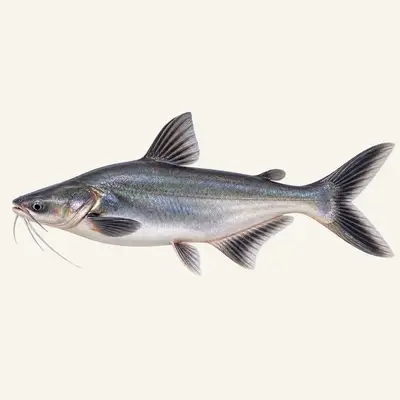
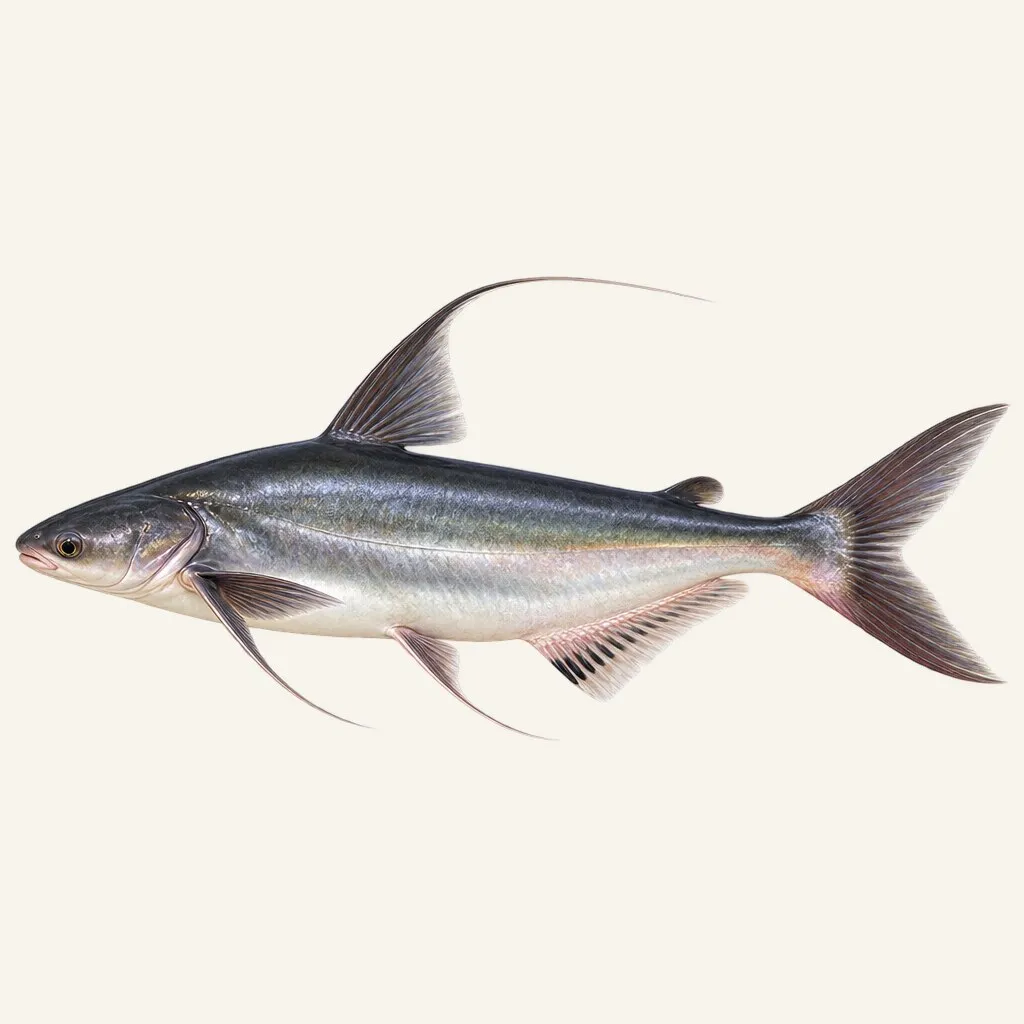
The giant pangasius is one of the largest freshwater catfishes of Southeast Asia, with a massive elongated body identifiable by its large head, long barbels and blue-grey coloration with silvery sheen.
Calendar
Recorded in 5 countries
Cambodia · China · South Africa · Thailand · Vietnam
GBIF occurrence records — native and introduced populations combined.
Its range
The large rivers of southern Asia between 25°N and 9°N, with the fish moving inside the freshwater network and never to the sea.
Age classes are separated by the size of the watercourse. Adults hold the big rivers; juveniles are found in the larger tributaries. That is a fixed arrangement rather than a preference, and it implies both a downstream shift as a fish grows and a dependence on tributaries that has nothing to do with where the adults get counted.
Identifying it
Open the mouth. The palatine and vomerine teeth are fused into one long crescent across the roof of it instead of sitting as separate patches — a single continuous band, and the character that names this species in a key.
Outside the mouth, three pairs of fins trail. The first soft ray of the dorsal, of the pectorals and of the pelvics is drawn out into a filament, so the animal carries streamers off the whole front half of its body.
The gape is in proportion to the rest. Mouth width goes 5.5 to 5.9 times into standard length, putting it between a sixth and a fifth of the body. The head is broad. The fins are loaded with dusky melanophores, and the first few rays of the anal carry black tips.
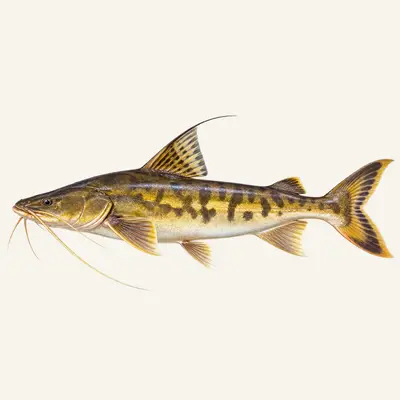
Those black tips are the character that does not wear off. They are present at every size, clearest on juveniles but still there on adults — unlike the striped livery of the farmed pangasius, which is shed with growth. On a large pangasiid, a mark that survives growth is worth more than a mark that does not.
The body is elongated, compressed in section.
Breeding
Spawning is set just ahead of the rains, and the young of the year measure about 10 cm by the middle of June.
Those two statements together fix the whole first season. Everything from egg to a ten-centimetre fish happens inside the opening weeks of the wet season, which is when a tropical river carries its greatest volume of drifting food and its greatest area of reachable margin. Growth at that rate is available only in that window.
The consequence is that recruitment here is keyed to a date rather than to a temperature. A wet season that arrives late, or arrives blunted, shortens the growing period from the near end, and does it to an entire year class at once.
The water it needs
Deep water in the main rivers, worked from the bed upward. Like the rest of the family this species can take air at the surface without depending on it, and that tolerance is what makes a dry-season pool habitable: a deep hole in a shrunken tropical river is warm, crowded and poorly renewed, and a fish of this mass would otherwise have to leave it.
Areas
- Deep holes in large rivers
- Strong-current confluences
- Rapids below dams
- Main river channels
Techniques
- Large river bottom fishing
- Large dead bait presentation
- Live bait on heavy rig
Baits
- Large dead fish
- Giant shrimp
- Carp chunks
- Baitfish
What it eats
Fish and crustaceans, at every size. Young and adult are given the same two items, which is unusual — most large predators in this catalogue start on invertebrates and graduate.
Then the file records something else about the biggest individuals. They have been found feeding on the carcasses of fowl and of dogs, and it names those same carcasses as the baits in common use for the species.
That is one observation counted twice. The evidence for the diet is what came out of fish caught on those baits, so the entry describes a fishery as much as it describes an appetite. It is still worth having. Whatever route brought the animal to the carcass, it ate it, and a predator of this size will take carrion at that scale.
How to catch it
The bait question is therefore already answered by local practice, and the answer is blunt: something large and dead. A fish that accepts a carcass does not have to be deceived, and the entire problem shifts to the rig and to whether it holds.
The season is the monsoon's negative. Spawning precedes the rains and the great rivers become workable once the flood has fallen away, so the dry months carry the fishery.
The number to take to the bank is the common length: 50 cm. The animals that made this species famous are exceptions, and they have become more exceptional with each decade. Gear chosen for the photographs spends most of its life out of proportion to what is actually on the end of the line.
Conservation · Critically Endangered (IUCN) — This species is threatened with extinction. Always release it (no-kill), handle it with the utmost care and check local rules — fishing for it may be prohibited.
Conservation
Three pressures are named together — over-harvesting, habitat loss, pollution — and all three fall on a migratory fish whose breeding is timed to the arrival of the rains. Any regulation of flow interferes with that signal, and it does so upstream of everything else on the list.
The date on the assessment is the other thing to notice. It was made in March 2007 and nothing more recent appears in the file. For a fish being reduced by three cumulative pressures, an old diagnosis does not overstate the problem. It describes an earlier and better version of it.
This species is farmed commercially, as is its relative in the neighbouring genus, and the comparison instructs rather than reassures. Aquaculture absorbed the demand for the smaller fish so completely that its name became a supermarket word. It has done nothing of the kind here. The two catfishes come out of the same rivers and only one of them has been replaced in the market by a pond.
One line in the file belongs here rather than in a history. The fishery that targeted this animal was formerly accompanied by rites and ceremonies of a religious kind. That is a measure of what the fish meant to the people living along the river, before it became a line in a landings table.
Regulations
Check the local regulations in force (legal size limits, closed seasons, bag limits).
For guidance only. Legal sizes, quotas and open seasons vary by location and season: always check the local regulations in force before fishing.
Other names
Giant pangasius in English, and every other language in the catalogue says the same thing. Size is the only property any of the vernacular names have retained.
The scientific name goes the other way and describes nothing. Sanitwongsei is a personal name in Latin dress, a dedication rather than a character, so the binomial carries no diagnostic information whatsoever — an ordinary situation in ichthyology, and an awkward one for a species whose published description is as short as this.
For an English-speaking reader the confusion sits in the genus. Pangasius on a menu or a packet almost never means this fish. It means the farmed species of the neighbouring genus, whose trade name borrowed the word wholesale. The animal that actually holds the name is the one nobody is selling.
Sources: fishbase.se · api.gbif.org