Flathead catfish
Pylodictis olivaris · Ictaluridae
- Freshwater
- Catfish
- Medium
- Size
155 cm
- Weight
56 kg
- Lifespan
25 years
Where to fish
- Lake
- River
Habitat icons: Flaticon
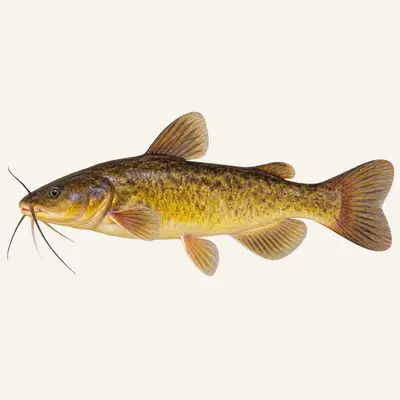
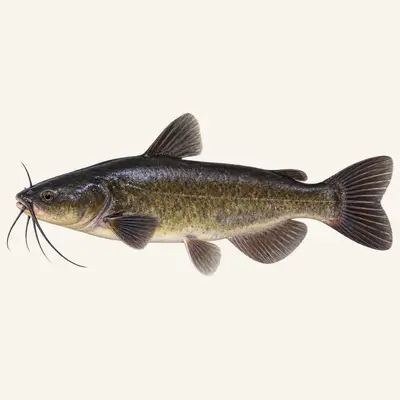
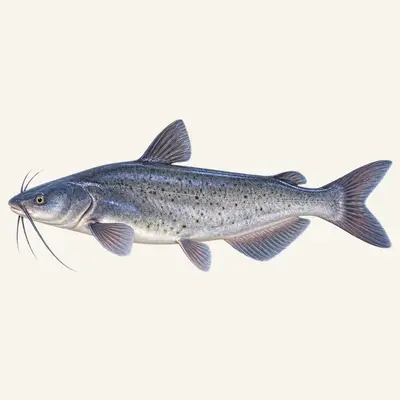
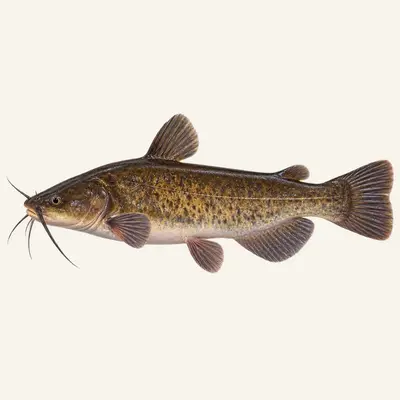
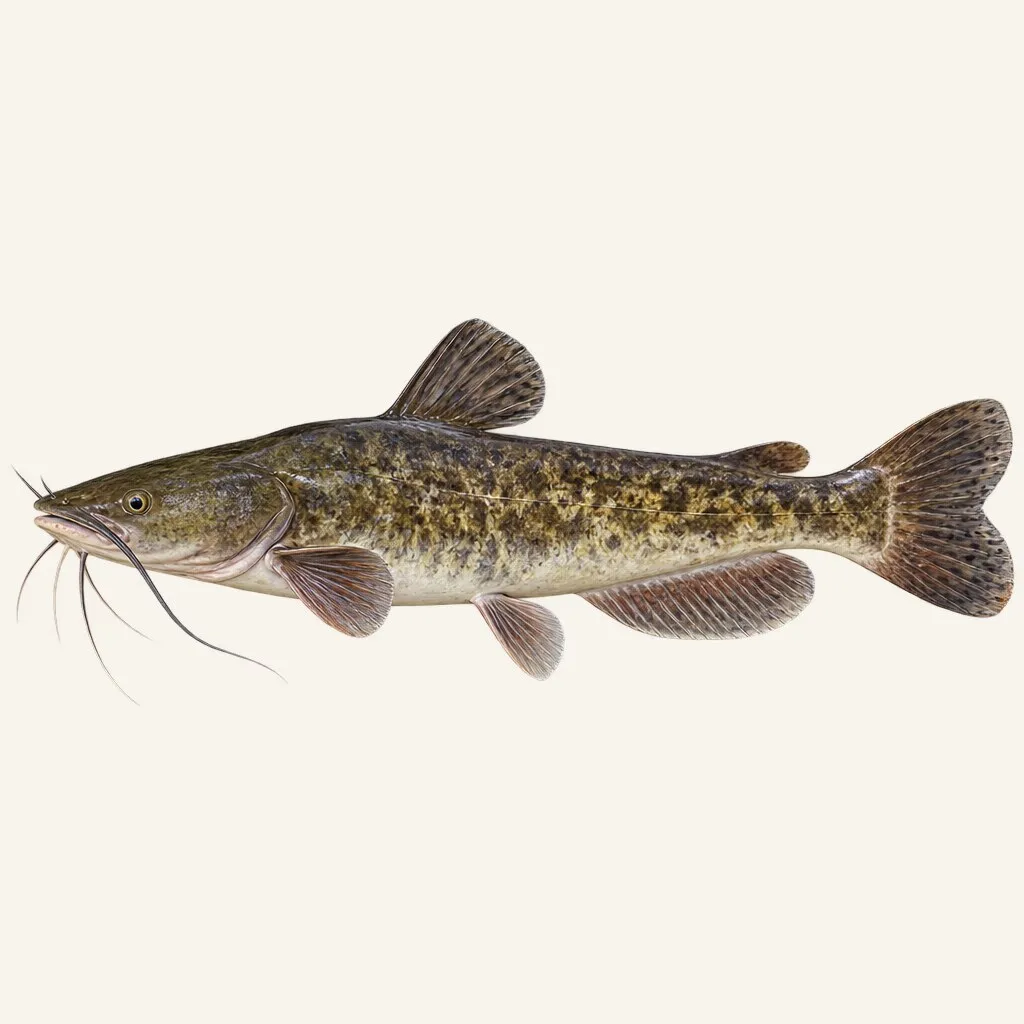
The flathead catfish is a large North American freshwater Ictaluridae identifiable by its broad, flattened head, protruding lower jaw, and mottled yellowish-brown coloration.
Calendar
Recorded in 4 countries
Canada · China · Mexico · United States
GBIF occurrence records — native and introduced populations combined.
Identifying it
Mottled yellow-brown, in blotches rather than in spots. The broken pattern is the first thing to read and it is doing a job: an animal marked that way is meant to be looked at against wood, and wood is exactly where the adult of this species lives.
The head is broad and flattened, and the lower jaw projects beyond the upper. A protruding lower jaw is not a common arrangement on a catfish. It aims the mouth forward and slightly upward instead of down at the bed.
The file consulted supplies no diagnosis — no counts, no proportions — so those three characters, taken from the catalogue entry above, are what there is. They are enough. This fish is the only member of its genus here, and the head alone separates it from every ictalurid sharing its rivers.
The water it needs
Two habitats, and they belong to two ages of the same animal.
Adults hold pools containing logs and other debris, in rivers of low to moderate gradient, small and large alike, and also in lakes and impoundments. Juveniles are somewhere else entirely: rocky and sandy runs and riffles, which is shallow, broken, fast water.
The switch is unusually clean. Most fish shift habitat by degrees as they grow; here the young occupy the kind of water the adult has abandoned, and the two size classes can be caught within a hundred metres of each other while sharing almost nothing.
Areas
- Snags and submerged stumps
- Holes below dams
- Rocky banks
- Deep confluences
Techniques
- Large live bait fishing
- Slow worked dead bait
- Drift fishing
- Bottom soft plastic lure
Baits
- Large live fish
- Cut bait
- Large shrimp
- Whole dead fish
What it eats
The diet splits along the same line. Juveniles take immature aquatic insects out of the riffles they live in. Older fish take crayfish, clams and fishes.
Look at what the adult list demands. A crayfish has to be prised out from under a stone and it fights back. A clam has to be lifted off the bed and crushed. A fish has to be caught. Not one of the three arrives by itself or waits to be found, and the whole list is work.
That is the correction this species makes to the reputation its family carries. Catfishes are widely taken for scavengers, and the reference entry for this one names nothing dead, nothing vegetable, and nothing that could be collected passively.
How to catch it
The age split is a size filter, and it is the most useful thing on this page. A run or a riffle produces small fish. A jam of timber at the bottom of a pool produces large ones. These are not two stages of one day's fishing; they are two different fisheries, and the choice between them is made before the first cast.
For the adult, the station is a specific object — a stump, a laydown, a raft of drowned branches on the floor of a hole. The presentation that matches the diet is something behaving like prey rather than something smelling like food: a live bait of decent size, held just clear of the bottom within the fish's reach of that cover.
Timing is nocturnal through the warm months, and the pre-spawn period in spring compresses the same behaviour into a shorter part of the night.
First maturity comes at 48.3 cm, inside a reported band of 46 to 50.8. That band is narrow — five centimetres wide, on a fish that goes on growing for decades — so half a metre here is a real threshold rather than a statistical average, and anything under it has never spawned.
Conservation
Two numbers matter, and they are the maturity figure and a maximum reported age of 25 years.
A population holding large individuals of this species is the product of a quarter of a century of undisturbed water, and it can be taken apart in a few seasons. Nothing in the biology allows it to be rebuilt at a comparable rate: half a metre before the first spawning, then years of growth beyond that before anything worth calling large exists.
The transplants are the other file entry, recorded without comment — moved elsewhere in the United States, outside the native range. What a transplant of this species introduces is not a general feeder that will fit in around the existing community. It is a specialist taking crayfish, bivalves and live fish out of structured water, and in a receiving river it draws on the same account the resident predators are already drawing on.
Regulations
Check the local regulations in force (legal size limits, closed seasons, bag limits).
For guidance only. Legal sizes, quotas and open seasons vary by location and season: always check the local regulations in force before fishing.
Other names
Flathead catfish, and for once the English name has picked the character that survives everything else. Colour changes with the water and the tail shape is shared, but the flattened skull and the projecting jaw are there on a juvenile in a riffle and on a fish of twenty-five years in a log jam.
The word itself is not exclusive, which is the English-language difficulty. Flathead in an unqualified text may be the trout of the Anatolian headwaters or the grey mullet of the world's coasts, both of which carry it in their standard English names, and in Australia it belongs to an unrelated family of marine fishes altogether. A sentence that says flathead and stops there has named a shape.
Olivaris meanwhile points at the olive tint of the back — so the scientific name has taken the one character on this animal that the water is free to change.
Sources: fishbase.se · api.gbif.org