Blue catfish
Ictalurus furcatus · Ictaluridae
- Freshwater
- Catfish
- Medium
- Size
165 cm
- Weight
68 kg
- Lifespan
21 years
Where to fish
- Estuary
- Lake
- River
Habitat icons: Flaticon
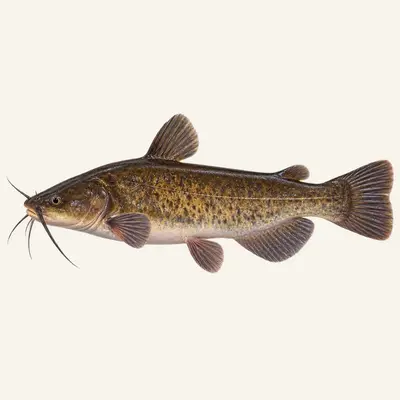
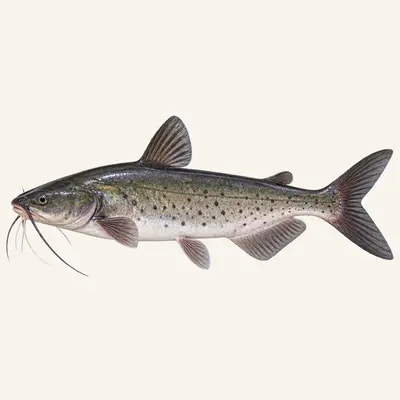
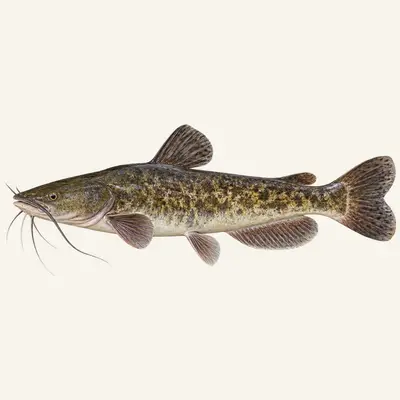
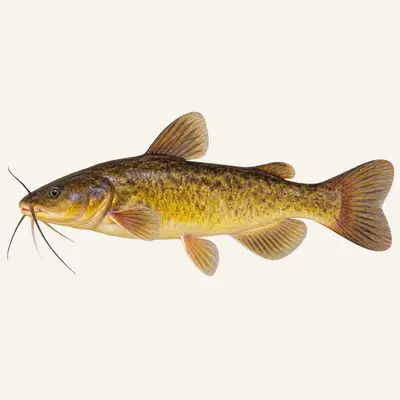
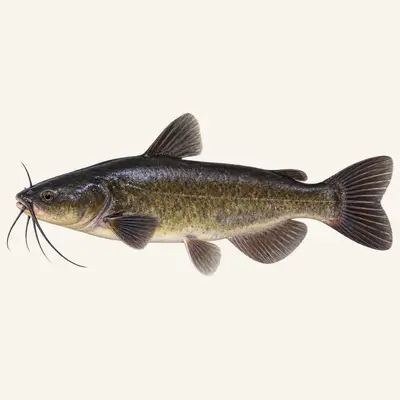
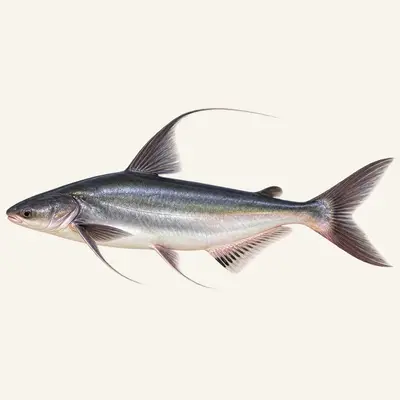
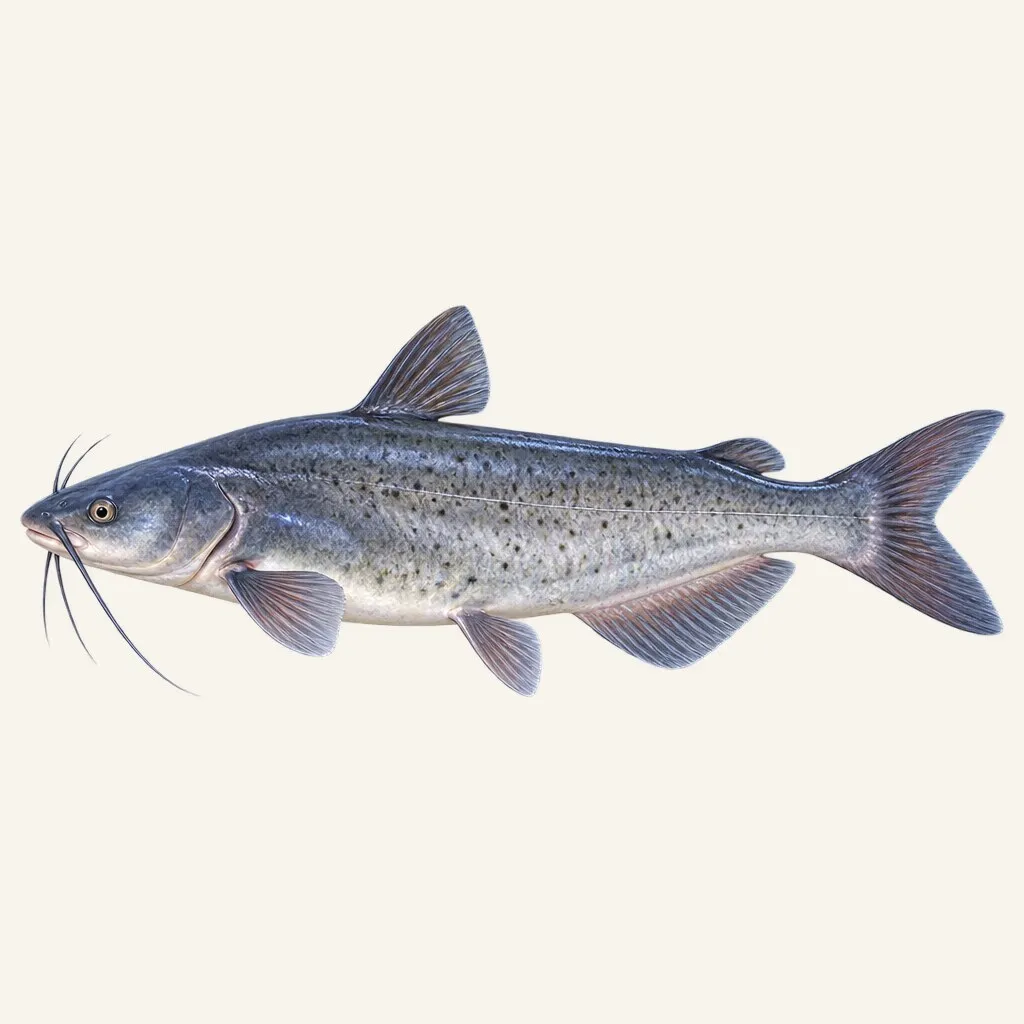
The blue catfish is the largest ictalurid in North America, with a robust, streamlined body of uniform greyish-blue colouring, a pale belly and a forked caudal fin. It inhabits large fast-flowing rivers and major reservoirs, where it is a formidable bottom predator.
Calendar
Recorded in 2 countries
GBIF occurrence records — native and introduced populations combined.
Its range
Native to the Mississippi basin from western Pennsylvania to southern South Dakota and the Platte in south-western Nebraska, south to the Gulf; then along the Gulf slope from the Escambia drainage in Alabama and Florida to the Rio Grande in Texas and New Mexico, and into Mexico.
The outline traces trunk rivers. It follows main stems and stops where the discharge stops being large, which is the map you would draw for a fish wanting depth and current together.
Introductions have since put it on the Atlantic slope, in the western states and in Minnesota, well outside that logic. Its presence in the Escambia drainage is itself recorded as an introduction, sitting inside the native block.
Identifying it
The file consulted carries no morphology rubric for this species at all. No ray count, no colour note, no proportion — the section simply is not there, which is worth knowing before reading any confident key.
The characters in general use are therefore borrowed in part from the other side of the comparison. What gets described is a robust, streamlined fish, uniform greyish blue with a pale belly and a forked caudal fin; the separation from the channel catfish is then made on the absence of the dark side spots that the channel catfish's own description records. That is a comparison built out of one description and one silence, and a silence is a weak thing on which to name a fish.
Take the positive half and leave the rest. Uniform slate-blue with no pattern on the flank, a pale underside, a deeply cut tail, heavy but streamlined through the body. Where a fish carries spots they mean something. Where it carries none, the reading is less secure than the literature makes it sound.
Breeding
The nest is under something. Eggs go beneath a log, inside a brush pile, or against the bank itself, and the male builds it, usually in a pool or a backwater.
The comparison the sources make between themselves is the useful part. Its congener excavates — a hole dug into sandy ground, a depression worked out by the pair. This one occupies a cavity that already exists. Two large catfishes in the same river, both with a guarding male, solving one problem in opposite ways: one digs, the other moves in.
Location matters as much as construction. Adults hold the deep main channel while the nest sits in slack water off to one side. Spawning therefore requires a move out of the current, and for the length of the season the fish are somewhere they are not found during the rest of the year.
The water it needs
Deep water in impoundments, main channels and backwaters of medium to large rivers, over mud, sand and gravel. The stated preference is for clear water and strong flow.
That preference contradicts the picture most people carry of a catfish. This is not an animal of the still, silted margin. It wants volume and movement and goes deep to find them: the recorded depth reaches 50 m, a figure that means anything only in a large reservoir.
It tolerates brackish water too, which extends it into the lower reaches of rivers and the fresh end of estuaries.
Areas
- Deep main channels
- Holes below dams
- River confluences
- Deep pass edges
Techniques
- Bottom fishing with cut bait
- Live bait fishing
- Boat drifting
- Worked dead bait
Baits
- Cut bait (skipjack)
- Live fish
- Freshwater mussel
- Chicken liver
What it eats
Small aquatic invertebrates, clams and fishes.
The base of that list is the surprising part. The largest ictalurid on the continent is recorded feeding on small invertebrates and on bivalves that have to be crushed before they are worth anything at all. A predator reaching this size on a diet weighted towards shellfish and small items is not living on the fish it could catch, and the bait tradition reflects it — cut baits and shellfish out-fish live prey here more often than the animal's size would lead you to expect.
How to catch it
One line in the file organises the whole fishery. The fish spends the day on the bottom in deep water and moves into swifter water at night to feed.
The consequence is that the daytime mark and the feeding station are different places, sometimes a long way apart in an impoundment or below a dam. Fishing the deep hole after dark is fishing where the animal was; fishing the fast water at noon is fishing where it will be.
The productive ground is the join between the two. The edge where deep still water gives onto moving water — a channel lip, the tail of a hole, the front of a wing dam — is what the fish crosses at dusk and again before first light, and it is the one position that is right at both ends of the night.
Presentation follows the destination. Feeding happens in current, so the rig has to hold bottom in flow rather than settle into slack, and weight is a requirement here rather than a handicap. Bait runs to cut, shelled or dead in preference to live.
The maximum reported age is 21 years. A large fish has spent two decades in one river system and knows its structure considerably better than the person looking for it.
Conservation
Nothing presses on this species inside its native basin, and its modern strongholds are partly artificial. Deep impoundment water is the first habitat the file names for it, so the engineering that cost these rivers their migratory fish has built this one a set of new headquarters.
The introductions are the live question. Putting the largest member of the family into a new drainage adds a predator at a size the resident community has no equivalent for, and it does so with an animal that crushes bivalves as a matter of routine — a resource fixed in place, which cannot get out of the way.
The brackish tolerance changes the scale of that. For most freshwater fish an estuary is a wall between neighbouring drainages. For this one it is not, so a stocking made into one coastal river is not necessarily confined to it.
Regulations
Check the local regulations in force (legal size limits, closed seasons, bag limits).
For guidance only. Legal sizes, quotas and open seasons vary by location and season: always check the local regulations in force before fishing.
Other names
Blue catfish, with the colour doing the work of a diagnosis in a family where colour is the least dependable character on offer.
The epithet compounds it. Furcatus means forked and points at the tail — the character this fish shares with the relative it is most often confused with, rather than one that separates them. Two names, and both describe something the channel catfish also has.
Set the three large North American catfishes side by side and the naming is incoherent by kind. One is named for a colour, one for a place in the river, one for the shape of its skull. Only the third picks a character that neither age nor water can alter.
Sources: fishbase.se · api.gbif.org