Channel catfish
Ictalurus punctatus · Ictaluridae
- Freshwater
- Catfish
- Medium
- Size
57–132 cm
- Weight
1.6–26 kg
- Lifespan
24 years
- Water temp.
10–32 °C
- Depth
0–15 m
Where to fish
- Lake
- River
Habitat icons: Flaticon
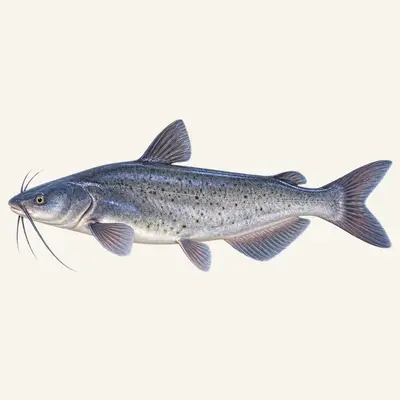
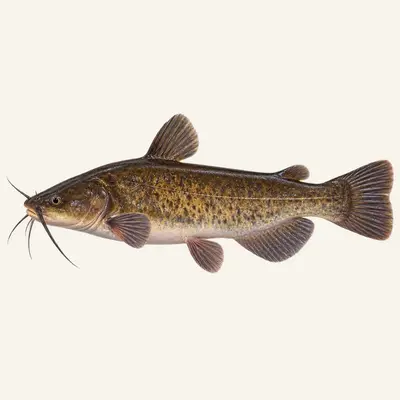
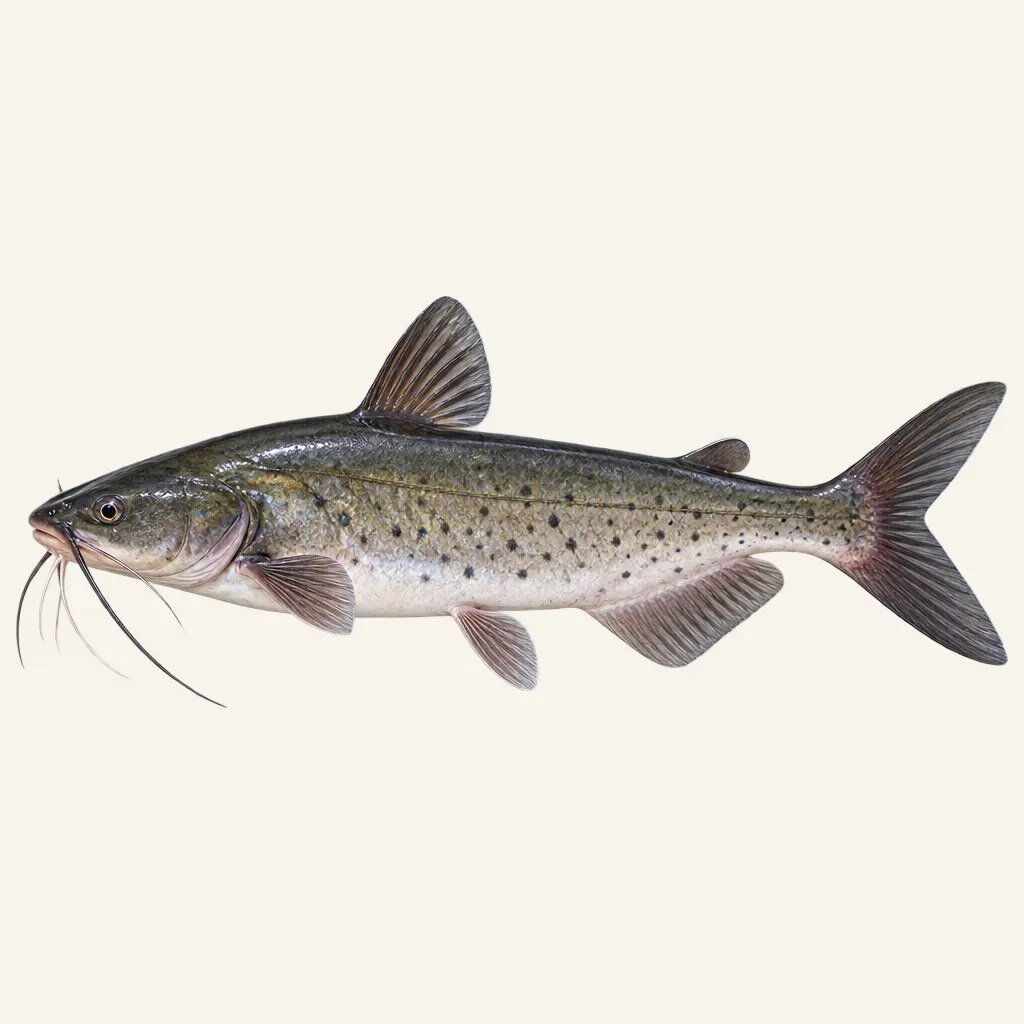
The channel catfish is the most widespread catfish in North America, recognisable by its streamlined bluish body with a grey-blue back, white belly and distinctive forked tail. An opportunistic predator of large rivers and lakes, it forages on the bottom using its eight sensory barbels.
Calendar
Recorded in 6 countries
Canada · Italy · Japan · Mexico · Russia · United States
GBIF occurrence records — native and introduced populations combined.
Its range
The native basins are the St Lawrence and Great Lakes, the Red River drainage of Hudson Bay, and the Missouri and Mississippi, from southern Quebec to southern Manitoba and Montana and south to the Gulf.
The interesting word comes next. On the Atlantic and Gulf slopes — from the Susquehanna to the Neuse, from the Savannah to Lake Okeechobee, west into northern Mexico and eastern New Mexico — the species is recorded as possibly native. Possibly, because it has been stocked across most of the United States for so long and so thoroughly that the original limits can no longer be recovered. The distribution has been overwritten by the fishery the distribution was meant to explain.
Identifying it
Dark spots scattered along the sides, and a deeply forked tail. That is the identification, and the source attaches a qualifier to half of it: the spots are usually present.
Take the qualifier seriously, because of where it breaks down. Older males darken, and on a dark fish the spots stop showing. Those same old males develop a head that looks very wide seen from directly above — the file gives that as a character in its own right, and it is the one still working when the colour has gone.
So the sequence is awkward but honest. A middling spotted fish with a forked tail is settled at a glance. A large dark one is not, because the tail it carries is the same tail its closest relative in these rivers carries, and the spotting that would have separated them is the first thing a big male loses.
Ground colour otherwise runs bluish olive, grey or black over the back and whitens below. Long barbels surround the mouth. The build is fusiform rather than heavy through the belly.
Breeding
The condition that governs where this fish can live is not the summer. It is the winter. Egg development requires cool water and short day lengths through the winter months — a photoperiod requirement as much as a thermal one, and no quantity of warm water substitutes for it.
Spawning itself then wants heat: April to July depending on latitude, at 27 to 28 degrees. So the species needs a cold dark winter and a hot summer inside the same year, a combination the temperate zone supplies and the tropics do not.
The nest is excavated. The female lays in a hole worked into sandy ground, the pair digs out a depression, and the male stands over it. Incubation runs three to eight days and larval development twelve to sixteen, both according to temperature. An egg mass can hold as many as 20,000 eggs. Sexual maturity arrives at two or three years.
One figure in the file does not work. Length at first maturity is given as 43.1 cm alongside a range of 54 to 67.2 cm — a range that does not contain its own mean. That is a defect in the compilation rather than a fact about the animal, and the honest reading is that first spawning happens somewhere around half a metre without the source being able to say where.
The water it needs
Lakes, and the deep pools and runs of rivers small to large, over sand or rock. Ponds and impoundments as well. The condition attached to all of it is clean, well-oxygenated water.
That condition is what separates this fish from the small ictalurids carried around the world, which thrive in stagnant ponds. This one asks for better and declines where the water declines. Its other tolerances are very wide — 10 to 32 degrees, pH 6 to 8, hardness 4 to 30, from the surface down to 15 m — so the oxygen requirement is doing nearly all of the limiting by itself.
Areas
- Deep channels
- Holes below dams
- Cluttered banks
- Backwaters
Techniques
- Bottom fishing with scented bait
- Live bait fishing
- Worked dead bait
- Bottom soft plastic lure
Baits
- Chicken liver
- Dead fish
- Earthworm
- Stink bait
What it eats
Small fish, crayfish, clams and snails, aquatic insects, and small mammals.
That list runs from a snail to a mammal, which asks two different things of one head: an ability to crush a shell, and a mouth able to take and hold an animal that struggles. It is not a scavenger's list and it is not a specialist's either.
How to catch it
The oxygen requirement is a search rule before it is anything else. This is the catfish that is not in the stagnant corner of the pond. The water worth fishing is the clean run or the deep pool over sand or rock with flow moving through it, and high summer — which shuts down slack-water bottom fishing — does not push this species out, because it was in the current already.
Detection is chemical, and the diet list argues for the bait. A fish accustomed to clams and snails is accustomed to food that does not run away, so a static bait carrying scent is not a compromise here but the natural presentation.
The nest-guarding window from spring into early summer alters the fishing rather than improving it. Males over a depression are aggressive and easy to place, and removing one leaves a clutch with nobody on it — for the period incubation and larval development take together, which is somewhere between a fortnight and three and a half weeks.
Common length is 57 cm and the maximum reported age 24 years, so a decent fish is generally older than it looks, and a large one has been in the system a long time.
Conservation
The file records no pressure on the species and one line pointing the other way: under threat to humans it is entered as a potential pest.
That is a statement about introductions, and the mechanism behind it is predictable. Where this fish establishes, it does so as a large generalist with a wide chemical and thermal tolerance. Where it fails, it fails on the winter — no cold season with short days, no viable eggs — which gives its invasive range a shape that can be drawn in advance. It is a poor candidate for the tropics and a good one anywhere temperate, and the record of introductions matches that.
The other half is worth turning around. Because this species needs clean, oxygenated water, its absence from a reach that ought to hold it is a reading on the reach. Bullheads persist through degradation that removes this fish, so a channel that has lost its channel catfish and kept its bullheads has told you something about itself.
Regulations
Check the local regulations in force (legal size limits, closed seasons, bag limits).
For guidance only. Legal sizes, quotas and open seasons vary by location and season: always check the local regulations in force before fishing.
Other names
Channel catfish names the water rather than the animal, which is unusual in this group and, as it happens, accurate: the deep run and the flowing channel are where it lives.
The informal name is where the trouble starts. In American usage a big channel catfish and a blue catfish are both simply a cat, and the two share the forked tail, the same rivers and a good part of the size range. The distinction gets made on the spotting, which is precisely what an old dark male has lost — so the case where the names matter most is the case where the character has already gone.
Punctatus means spotted, after the same character. Between them the scientific name and the English one cover the young fish and the habitat, and neither is any help with the animal that most needs identifying.
Sources: fishbase.se · api.gbif.org