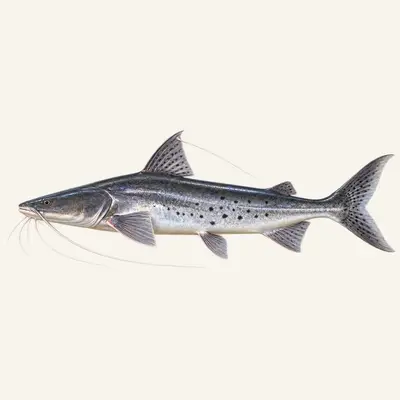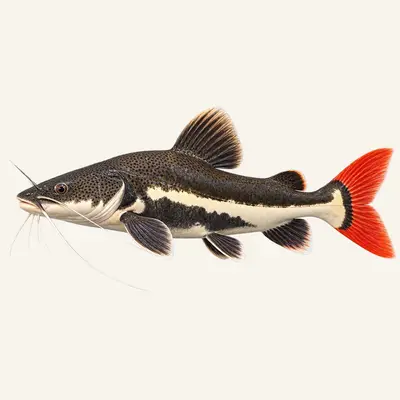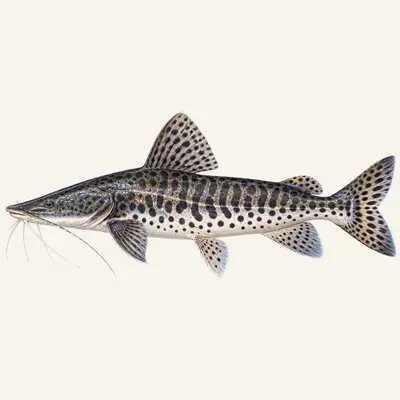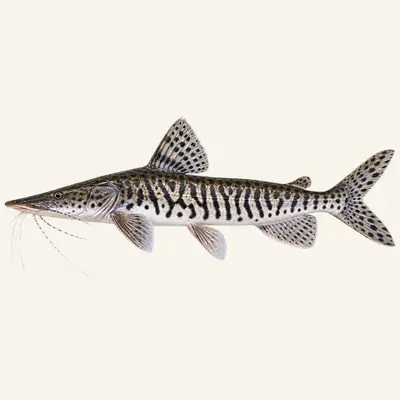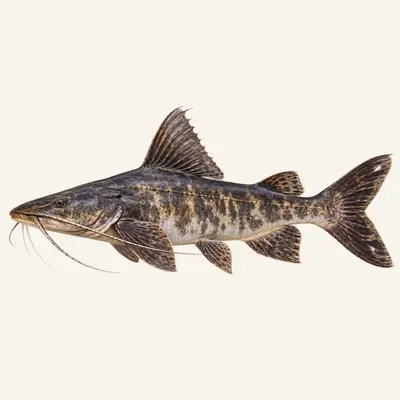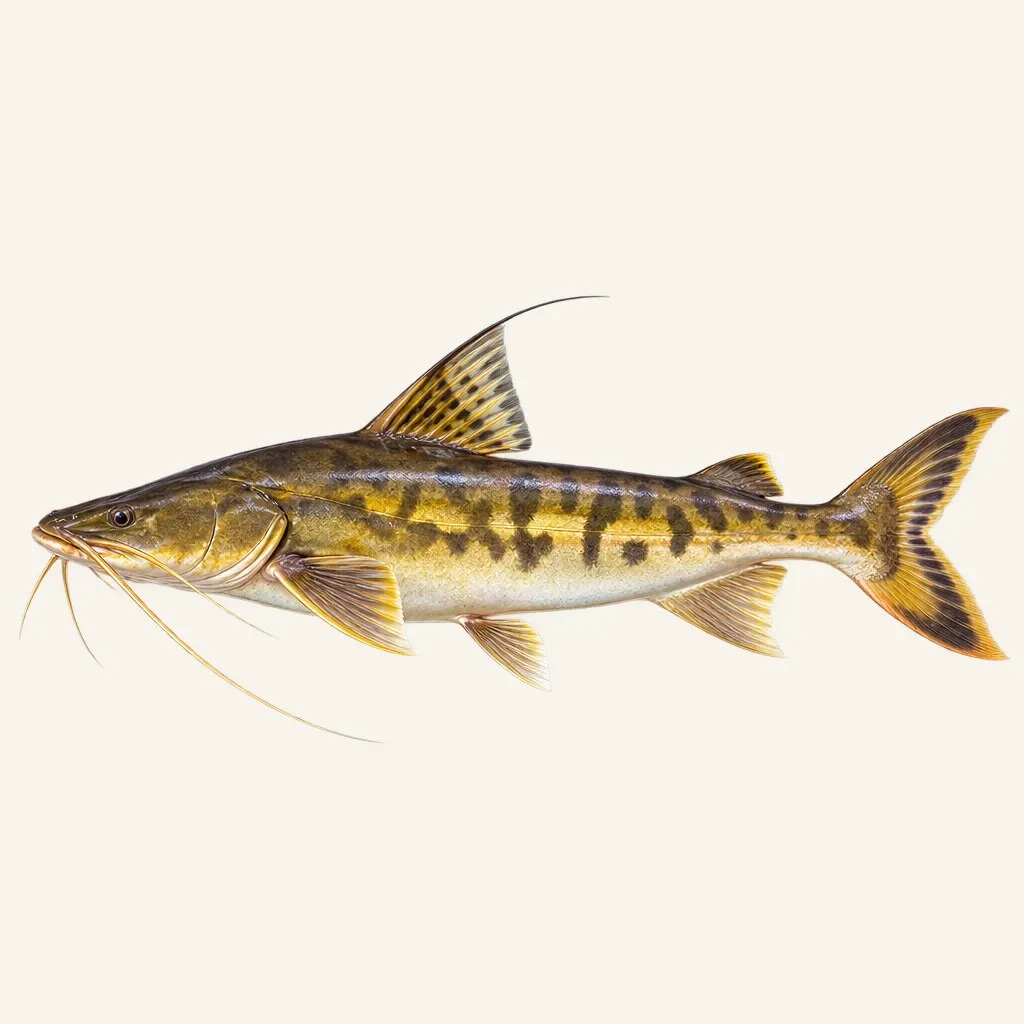
Gilded catfish (Dourada)
Brachyplatystoma rousseauxii · Pimelodidae
- Freshwater
- Catfish
- Hard
- Size
90–192 cm
- Weight
8.9–34 kg
Where to fish
- River
Habitat icons: Flaticon
A large golden-hued migratory Amazonian catfish renowned for undertaking one of the longest freshwater migrations in the world.
Calendar
Recorded in 3 countries
Colombia · French Guiana · Peru
GBIF occurrence records — native and introduced populations combined.
Its range
The dourada is listed on Appendix II of the Convention on Migratory Species, which is an unusual place for a freshwater fish to be. That appendix gathers animals whose range crosses borders and whose conservation therefore has to be arranged between states rather than settled inside one.
The listing states the problem better than any list of basins could. The Amazon and the Orinoco are the two largest networks on the continent, shared among a dozen countries, and the rivers of French Guiana add a jurisdiction of their own. No single fisheries administration holds this stock. Every reach dammed or worked upstream subtracts something from all the reaches below it.
What bounds the range, then, is not a climatic limit. It is the continuity of the river.
Areas
- Deep channels of large rivers
- River confluences
- Below rapids and cataracts
- Main-channel holes
Techniques
- Live-bait fishing
- Bottom legering
- Drift fishing
- Slow deep trolling
Baits
- Live baitfish
- Fish fillets
- Fresh cut bait
- Sardines
How to catch it
Length at first maturity is 73 cm, and on this species it is the only number that decides anything. Below it, the fish has not spawned once.
That weighs more here than it would elsewhere, because fishing is the pressure aimed squarely at the species. A fish returned to the water under that length is a spawner given back to the river; a fish kept under it is a spawning cancelled before it happened.
The rest is absent. Nothing is published under this name about its prey, the depth it occupies or the month it breeds — those rubrics are empty. Conduct on the water has to be deduced from the river instead of from the animal: turbid main channels, deep water, bait on the bed. For a fish of this commercial standing, that is an uncomfortable place to be starting from.
Conservation · Vulnerable (IUCN) — This species is threatened with extinction. Always release it (no-kill), handle it with the utmost care and check local rules — fishing for it may be prohibited.
Conservation
The 2023 assessment turns on a decline that is expected rather than measured. It projects across the next three generations what present habitat degradation and present exploitation imply, which is a demanding way to reach a verdict: it requires knowing what the river will become before knowing what has become of the fish.
The mechanism is the length of the journey. An animal that crosses an entire basin is exposed along the whole of it, and one impassable segment puts everything above that segment out of reach. A resident species can fall back on a stretch that was spared. This one cannot, because its cycle needs the set rather than a part of it.
The description shown with this page calls its migration one of the longest in fresh water. The account consulted here does not describe that migration at all — no route, no timing, no distance. That gap matters more than it looks: a route nobody has mapped cannot be protected segment by segment, and Appendix II asks precisely for agreements between the states the route passes through.
Regulations
Commercially important species subject to minimum landing sizes and quotas in several Amazonian countries; per local regulations.
For guidance only. Legal sizes, quotas and open seasons vary by location and season: always check the local regulations in force before fishing.
Other names
Dourada is the feminine of the Portuguese word for gilded, and the grammatical gender is doing real work. In the masculine, dourado names an entirely different fish in Brazil, a characiform of the southern rivers, and elsewhere in Latin America it names the dolphinfish of warm seas. Three unrelated animals from one root.
English steps around the whole thing by describing the colour: gilded catfish. That name is worth insisting on in any report or landing figure, because a document that says only dourada — still less dorado — has not identified a species.
Sources: fishbase.se · api.gbif.org