Crimson jobfish
Pristipomoides filamentosus · Lutjanidae
- Saltwater
- Coastal
- Medium
- Size
50–100 cm
- Weight
1.0–8.2 kg
- Lifespan
44 years
- Depth
40–400 m
Where to fish
- Reef
- Rocky shore
Habitat icons: Flaticon
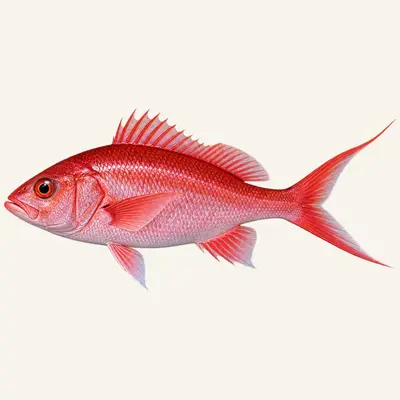
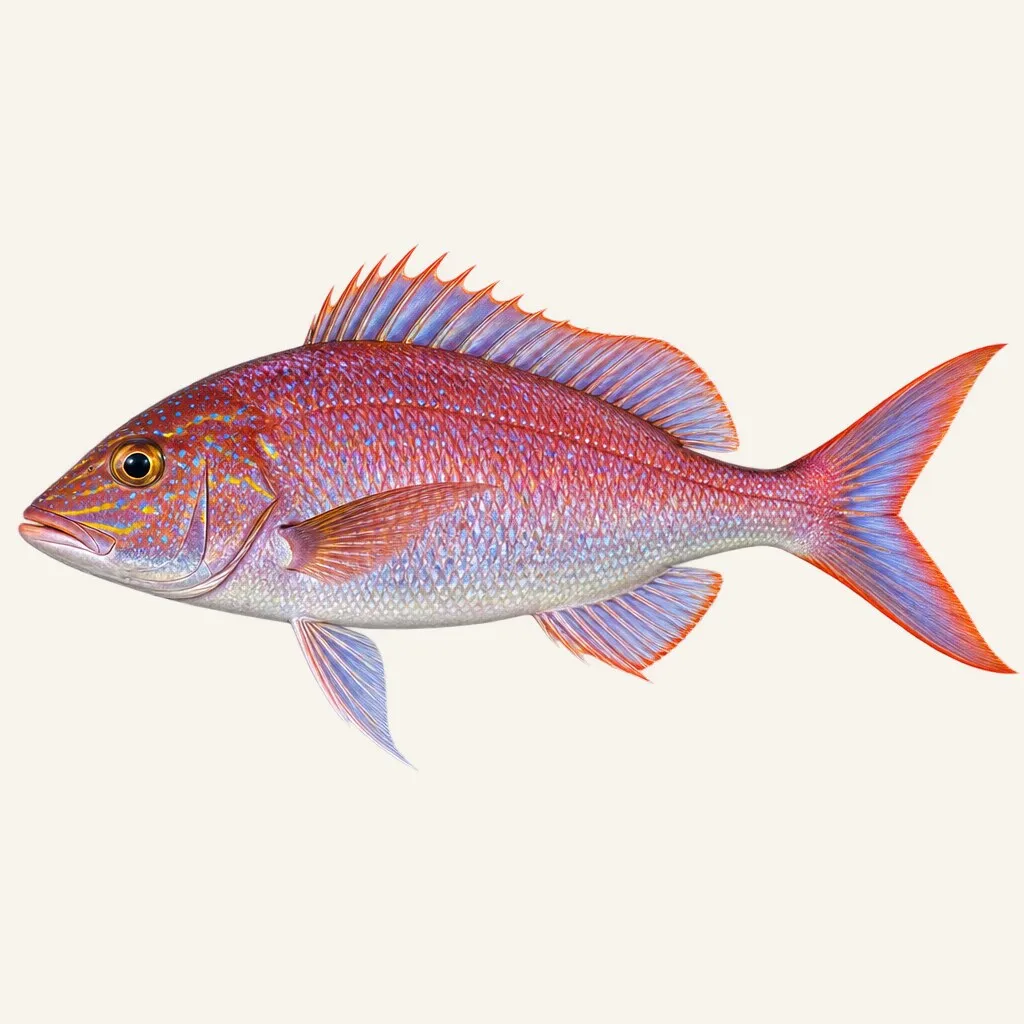
The crimson jobfish is a distinctive lutjanid with pinkish-violet flanks and elongated filaments on the lobes of the forked caudal fin, setting it apart from other deepwater snappers. It inhabits rocky bottoms and reef slopes from 40 to 300 metres across Asia, Africa, and Oceania.
Calendar
Recorded in 12 countries
Australia · Egypt · French Polynesia · Japan · Mayotte · New Caledonia · Réunion · Solomon Islands · South Africa · United States · Vanuatu · Wallis & Futuna
GBIF occurrence records — native and introduced populations combined.
Its range
East Africa eastward to Hawaii and Tahiti, north to southern Japan, south to eastern Australia and Lord Howe Island, between 35°N and 26°S.
The eastern figure is the one that draws a real boundary: 144°W. The range stops there, far short of the American coast, and it stops at roughly the line that separates the Indo-Pacific fauna from the eastern Pacific one. A slope-dwelling fish spreads along island chains and continental margins, and east of Hawaii and the Marquesas those stepping stones run out. It is not a distance problem so much as an absence of anything to stop on.
Identifying it
Colour is the first thing anyone reaches for on this fish and the last thing that will help. The published range for it is brownish, lavender, or reddish purple — three descriptions of the same species, offered as alternatives rather than as a sequence, with the dorsal and caudal fins light blue or lavender and edged in reddish orange.
The marking on the head is a different matter. Narrow yellow lines and blue spots cross the snout and the space between the eyes, and the source notes something useful about them: they often survive preservation as dark spots. A pattern that outlasts the specimen is worth more than a body colour that will not outlast the trip.
The character the epithet records is at the back of the vertical fins. The last soft ray of the dorsal and of the anal is well produced, noticeably longer than the ray in front of it. That is a filament in the strict sense, and it is where the published description puts it.
The mouth is the standard test of the genus. The premaxillae are protrusible, so the upper jaw slides forward when the mouth opens; the maxilla reaches back to about the front margin of the pupil and carries neither scales nor ridges; the lower jaw projects slightly or the two are about equal. Both jaws hold an outer row of conical to small canine teeth with an inner band of villiform teeth behind it, and the description is explicit that the front teeth are not appreciably enlarged. A triangular patch of teeth sits on the vomer.
Counts to finish: 10 dorsal spines and 11 soft rays, three anal spines and eight rays, 22 to 26 gill rakers on the first arch, and 57 to 62 tubed scales in the lateral line. The body is elongate and flattened from side to side, the interorbital region flat, the tail forked, and the pectorals about as long as the head or a little shorter.
The water it needs
Adults hold over rocky ground on the slope, benthopelagic rather than bottom-dwelling, in a recorded depth range of 40 to 400 m. The band that actually produces is much narrower: off Guam the species is taken most abundantly between 180 and 270 m.
Then the fact that reorganises the page. At night the fish migrate vertically, up into the top part of their habitat, to feed.
That is one population and one piece of ground, at two different depths depending on the hour. The productive depth over a given mark is not a property of the mark; it is a property of the time of day. Anything that assumes a fixed working depth for this species — a rig, a longline set, a memory of where the fish were last week — is right for half of every 24 hours.
Areas
- Deep rocky drop-offs
- Current-beaten headlands and capes
- Outer reef slopes
- Mixed sand and rock bottoms
Techniques
- Vertical jigging
- Deep live-bait fishing
- Deep trolling
- Coastal longline
Baits
- Metal jigs
- Whole squid
- Live fish
- Cut fish bait
What it eats
Small fishes, shrimps, crabs, amphipods, ascidians and salps.
The last two are the informative ones, because they are gelatinous, they carry almost no energy, and they do not live on rocks. Salps in particular are drifters: they are wherever the water has put them. Amphipods belong to the same picture.
A fish eating those things is not foraging over the bottom, it is taking what passes through the water column — and that is the same behaviour as the night climb, seen from the other end. The fish rises after dark into the layer where drifting life is concentrated and eats what it finds there. Diet and vertical migration are one behaviour described twice.
How to catch it
Bottom longlines and heavy deep handlines, on rocky ground located with a sounder, in the 180 to 270 m band by day.
By night that band moves up, and the fishery ought to move with it. A crew fishing the same numbers at the same depth after dark is fishing beneath the fish. This is the rare case where the useful variable is the clock rather than the position.
It also changes what a release means, in a way that has nothing to do with technique. Barotrauma is a function of the pressure difference a fish crosses, and here that difference is not fixed by the ground: a fish taken at midnight from the upper part of its habitat has come a shorter way than the same fish taken from the same mark at noon. The two are not equivalent propositions, and a decision to put fish back is more likely to mean something on a night trip than on a day one.
The numbers that frame all this are unusual for a fish of this size. Maturity comes at about 52 cm, with reports from 37 upwards. The common capture is around 50 cm in standard length. And the maximum reported age is 44 years.
Conservation
Forty-four years is the figure to hold, and it does not sit comfortably beside the other two.
The species is classed as highly commercial and is taken by bottom longline — gear that reaches exactly the band it lives in — while the fish routinely landed measures about 50 cm and the length at first maturity is about 52 cm. The ordinary catch is drawn from the size class that has only just started to breed, or has not started.
What makes that arithmetic worse here than in a short-lived species is the recovery term. A stock built on animals capable of four decades of life accumulates its spawning capacity slowly, over many years, in individuals that are removed at the point where they begin to hold any. Fishing pressure applied for a few seasons removes an accumulation that took far longer than a few seasons to build, and the deficit does not appear in the landings while the smaller fish keep coming.
Handling one of these commits you to that timescale. A fish of the common size is at the very beginning of a life that can run 44 years — not an old fish taken late, but a young one taken early, from a population whose reserve is measured in decades.
Regulations
Check the local regulations in force (legal size limits, closed seasons, bag limits).
For guidance only. Legal sizes, quotas and open seasons vary by location and season: always check the local regulations in force before fishing.
Other names
Filamentosus names the produced ray, and the English name that has stuck internationally, crimson jobfish, names a colour the diagnosis declines to fix at all.
The name that actually governs the fish is Hawaiian. Ōpakapaka is what it is landed as, sold as and managed as in the archipelago where its deep-water fishery is longest established, and on a dock there the English form would be the unusual one.
That is the general pattern for the species. Its range runs from East Africa to Tahiti, more than half the width of the planet, and across that span the fish is caught by small deep-water fleets that each named it for themselves and trade it close to home. There is no single market big enough to have imposed one word on the rest, so the catalogue name is a reference name rather than one anybody uses at a quayside.
Sources: fishbase.se · api.gbif.org