Grey snapper
Lutjanus griseus · Lutjanidae
- Saltwater
- Coastal
- Medium
- Size
40–89 cm
- Weight
0.8–20 kg
- Lifespan
30 years
- Depth
5–180 m
Where to fish
- Estuary
- Reef
Habitat icons: Flaticon
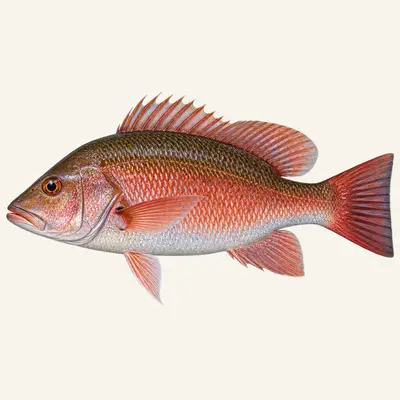
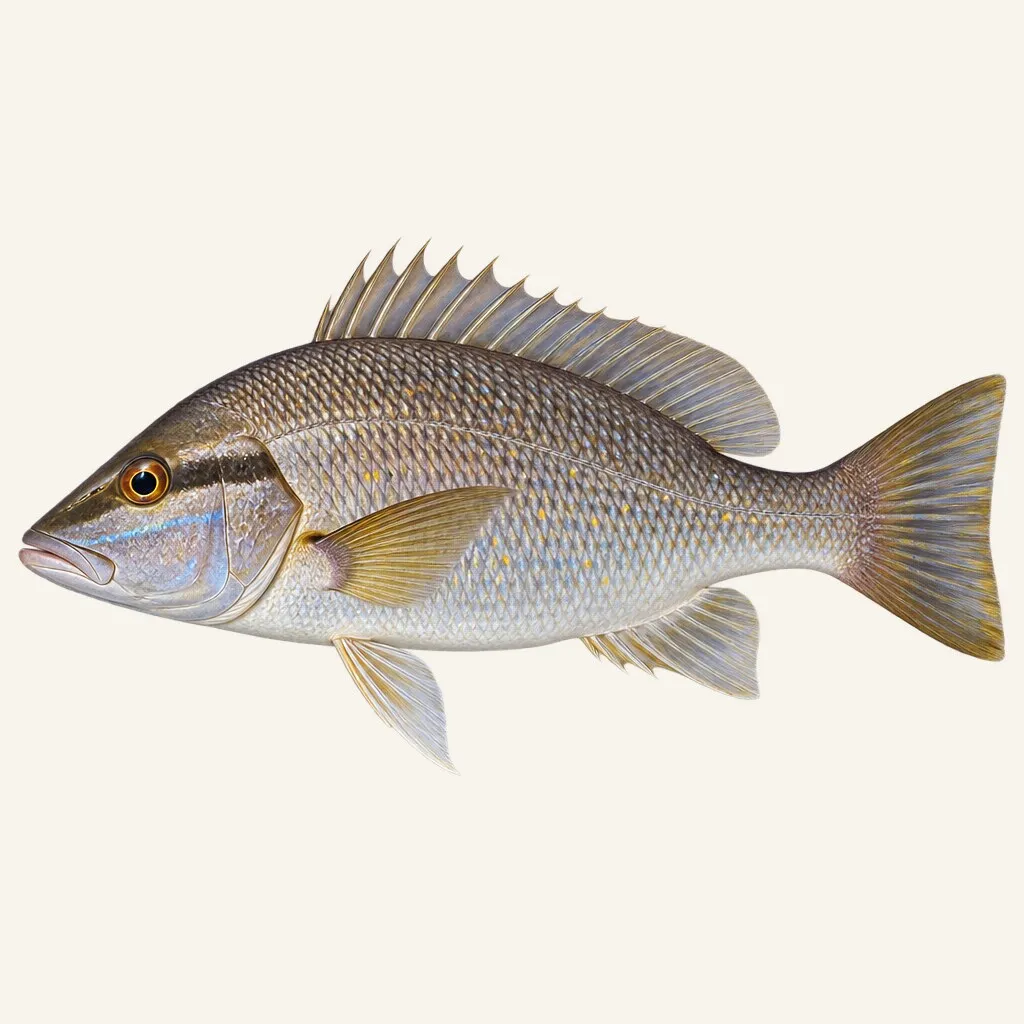
The grey snapper is a stocky snapper with an olive greyish-green back and slightly pinkish silver flanks. Highly adaptable, it inhabits mangroves, estuaries, reefs, and seagrass beds, tolerating variable salinity, making it one of the most common snappers in Caribbean coastal waters.
Calendar
Recorded in 22 countries
Bahamas · Belize · Bermuda · British Virgin Islands · Caribbean Netherlands · Cayman Islands · Colombia · Cuba · Curaçao · Guadeloupe · Honduras · Jamaica · Martinique · Mexico · Panama · Puerto Rico · St. Martin · Trinidad & Tobago · Turks & Caicos Islands · U.S. Virgin Islands · United States · Venezuela
GBIF occurrence records — native and introduced populations combined.
Its range
The range takes in the east coast of the United States as far as Massachusetts, Bermuda, the Bahamas, the whole Gulf of Mexico and the Caribbean. Two corrections are worth carrying before trusting an older account.
Brazilian records rest on misidentifications: this snapper does not run down to the south of the continent, unlike several species that share its northern waters. And the eastern Atlantic reports concern wandering individuals rather than a settled population.
The real range is therefore tighter than the old maps suggest, and it stops at a southern boundary the fish does not cross.
Identifying it
The dorsal profile of the head is slightly concave and the snout long and pointed. Written down that sounds like nothing, and in the water it is the character that works: in a genus where the forehead runs straight or bulges, a hollowed silhouette reads in profile, at distance, before any colour is legible.
Colour is no help here. The name promises grey; the animal runs from greenish grey to coppery bronze according to the ground it occupies, and a fish out of a mangrove creek does not look like one off an offshore reef.
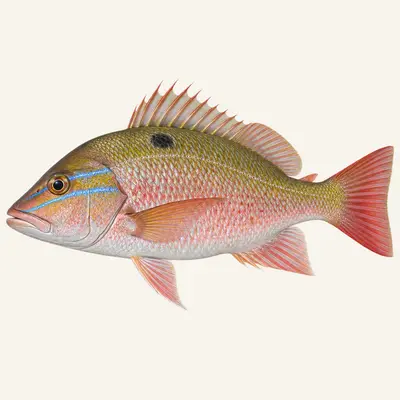
Young fish carry two marks that fill the gap. A dark stripe runs from the snout through the eye to the top of the gill cover, and a blue stripe crosses the cheek below the eye. Both fade with age, which leaves the adult genuinely patternless.
One scale detail is diagnostic and easy to verify in the hand. The rows on the back run parallel to the lateral line towards the front of the body, then tilt upward behind, under the soft part of the dorsal fin. That change of direction partway along the fish belongs to this species. Dorsal: ten spines, 13 or 14 soft rays. Anal: three spines, seven or eight.
Breeding
Spawning happens in summer, close to the full moon.
Two constraints stacked on each other, one seasonal and one lunar, reduce the reproductive year to a handful of nights that can be picked off a calendar in advance. This is not a tendency, it is an appointment, and it is public.
First maturity is recorded from 21 cm, averaging near 32. The oldest reported fish was 30.
The water it needs
Amphidromy is the organising fact. This snapper moves between salt and fresh water for reasons unconnected with breeding, which happens at sea; the movement is about food and cover.
Adults use offshore reef and rocky ground as readily as estuaries and mangrove. The young go further up — into the lower reaches of rivers, and in Florida into fresh water outright. The first part of the life cycle consequently plays out inland, upstream of anything a marine survey ever looks at.
Adults mostly stay above 50 m and reach 180 only occasionally. Aggregations are frequent and large, in and out of the breeding season, which is worth noting: for most snappers a shoal of that kind is a seasonal event rather than a way of life.
Areas
- Mangrove channels
- Estuaries and lagoons
- Coastal seagrass beds
- Shallow reefs
Techniques
- Bottom handline fishing
- Soft lure fishing
- Live bait fishing
- Natural bait fishing
Baits
- Live shrimp
- Small live fish
- Marine worms
- Squid
- Crabs
What it eats
Feeding is nocturnal. Small fishes, shrimps, crabs, gastropods and cephalopods make up the bulk, with a fraction of planktonic material on top.
That last item is out of character for a predator of this size, and it fits an animal that holds at the mouth of a tidal creek and lets the ebb deliver. It takes what the current brings as well as what it chases down, which is why a static bait in moving water works on this species at all.
How to catch it
The tide does the work. The fish sits at the mouths of mangrove creeks and cuts, facing the flow, and waits for what comes down it. Timing a session to moving water counts for more than choosing between two marks.
Night and dusk hold the activity, in line with the diet. Baits copy the menu, live shrimp ahead of everything else.
One detail changes the approach. The documentation calls the species easily approached, which is not its reputation at the end of a line. The two observations do not contradict each other: a fish that tolerates a diver beside it can still refuse a rig it can see. The suspicion attaches to the tackle, not to the distance, hence the value of fine traces in the clear water over the grass.
And a big grey snapper hooked a few metres from a root-choked bank needs about three seconds to reach the timber. The margin is short, and it is spent in the first moments of the fight rather than at the net.
Conservation
Two pressures act on this snapper and neither of them appears in marine catch statistics.
The first is where the nursery sits. Juveniles live in estuaries, in the lower rivers and up into fresh water — the most heavily altered habitats anywhere in the range. Embankment, diversion and changes in freshwater inflow all act on recruitment without ever registering as fishing pressure.
The second is the predictability of spawning. A few summer nights around the full moon are enough to concentrate the breeders, and a lunar calendar is available to anyone.
Handling deserves a word for a separate reason. A 30-year-old fish exists in this species and looks much like a ten-year-old one, because growth slows to almost nothing past a certain length. Deciding what happens to a large one is deciding what happens to three decades of growth.
Regulations
Check the local regulations in force (legal size limits, closed seasons, bag limits).
For guidance only. Legal sizes, quotas and open seasons vary by location and season: always check the local regulations in force before fishing.
Other names
Two English names split this fish between a colour and a habitat. Gray snapper is the standard one and records a shade the animal frequently does not hold. Mangrove snapper is the name anglers along the Florida and Gulf coasts actually use, and it records where the fish is caught.
Neither mentions rivers. This is a snapper taken regularly in fresh water, in Florida well above the reach of the tide, and no name in any language marks the fact — which matters, because it is the half of the life cycle nobody manages. Caribbean Spanish at least gets the impression right with pargo prieto, where the adjective carries darkness rather than grey.
Sources: fishbase.se · api.gbif.org