Emperor red snapper
Lutjanus sebae · Lutjanidae
- Saltwater
- Coastal
- Medium
- Size
60–116 cm
- Weight
3.4–33 kg
- Lifespan
40 years
- Depth
5–180 m
Where to fish
- Reef
- Rocky shore
Habitat icons: Flaticon
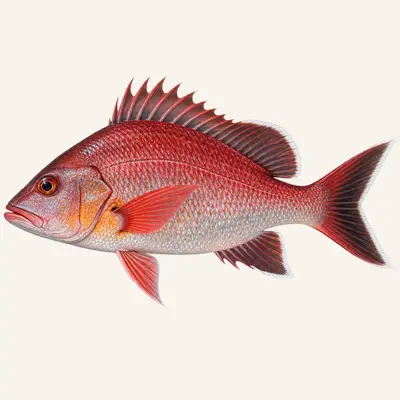
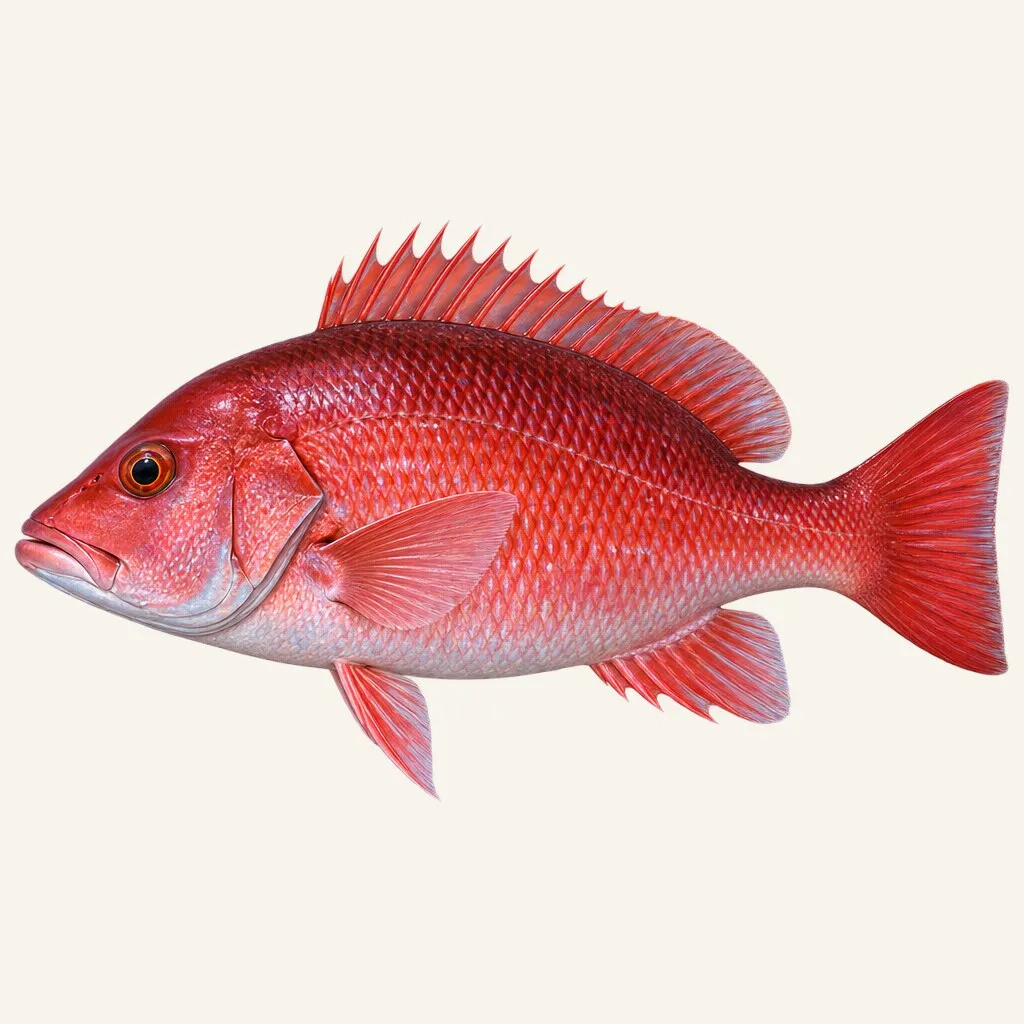
The emperor red snapper is unmistakable with its vivid red body crossed by broad white bands and a dark stripe through the eye. This large lutjanid of tropical reefs across Asia, Africa, and Oceania can exceed 60 cm in length.
Calendar
Recorded in 4 countries
Australia · Indonesia · Japan · Mozambique
GBIF occurrence records — native and introduced populations combined.
Identifying it
Three dark red bands cross a young fish of this species, and their paths are specific. The first drops from the first dorsal spine, crosses the eye and reaches the tip of the snout. The second runs from the middle of the dorsal fin down to the pelvic. The third links the base of the last dorsal spine to the caudal peduncle.
That is the pattern everybody pictures, and it belongs to an animal which has not finished growing. Large adults turn uniformly red, darker over the back, every fin red except the pink pectorals. At that stage the best-known portrait of the species no longer applies to it.
Counting takes over, and here it decides rather than confirms. Eleven dorsal spines with 15 or 16 soft rays, three anal spines with ten soft rays — where most snappers sharing its waters show ten and eight. Few characters in this genus separate a species that cleanly.
The build agrees with the counts: a steeply sloping head profile, a broad preorbital bone, a moderately developed preopercular notch and knob, and a body depth of 2.6 to 3.0 in standard length, which makes a distinctly stocky animal.
One conversion is useful for reading the literature, established on 828 individuals: total length equals 1.00 cm plus 1.24 times standard length. Reports in one measure and figures quoted in the other are not comparable without it.
Breeding
The species is a broadcast spawner. Gametes go into the water column, there is no nest and no guarding, and the eggs take their chances on the current.
First maturity settles around 54.2 cm, from 49 upward, which places first spawning near half the achievable length, with most of a life of up to 40 years still ahead of it.
The water it needs
Adults keep to the vicinity of coral and rocky reef but spill well out onto the adjoining sand flats and gravel patches, and they are trawled lower down on relatively flat ground as well. This is not a species tied strictly to relief.
Juveniles live differently. Under 20 cm they use turbid nearshore water and mangrove, and they shelter among the spines of sea urchins in shallow coastal bays. That commensal arrangement stands in for cover until size supplies some of its own: a banded 10 cm fish inside a ball of spines is close to unattackable.
Depth then sorts the ages, because the fish moves deeper as it grows. Large individuals reverse the rule during the winter months and come back towards the shore.
Hence a field observation. Schools are made up of same-sized fish, or the fish is alone. A uniform school is not a social coincidence; it is the consequence of sorting by depth.
Areas
- Deep coral reefs
- Outer drop-offs
- Wrecks
- Coral bommie areas
Techniques
- Deep live bait fishing
- Bottom handline fishing
- Deep trolling
- Jigging lure fishing
Baits
- Live fish
- Whole squid
- Deep-water shrimp
- Crabs
- Cut octopus
What it eats
Fishes, crabs, mantis shrimps, other benthic crustaceans and cephalopods. The bottom supplies most of it and the water column the remainder.
The mantis shrimps are worth noting. Stomatopods are armed prey with a strike quick enough to injure, and few reef predators take them willingly. A snapper that includes them regularly is eating something its competitors leave alone.
How to catch it
Two facts govern the search. The first is the sorting by size: if the first fish is small, its neighbours will be small too, and the answer is to change depth rather than to persist. The second is the winter movement of large fish towards the coast, which brings within reach of an inshore boat animals normally taken well offshore.
This is the heaviest snapper recorded in the genus on this side of the world. The difference between a 10 kg fish and a 30 kg one is not one of degree: the second breaks what the first bends, and coral finishes the job.
The sand and gravel around the coral heads deserve as much attention as the coral itself. That is where the fish feeds, and reef anglers tend to work the structure instead.
In parts of the Indian Ocean, large individuals of this species have caused ciguatera poisoning. The hazard tracks the ground a fish came from and increases with its size, which makes it a question for local fishermen before a big one is kept.
Conservation
Three gears take this species, and each of them works on a different age.
The aquarium trade takes juveniles, which are wanted for the bands and sold on the strength of them. Trawlers take adults off the flat bottom. Handlines take them on the reef. None of the three counts what the other two remove, and there is a single stock underneath all of it.
The biological calendar sets the pace of any recovery. Forty years of longevity and maturity at 54 cm describe a slow animal: year classes rebuild over a decade, not over a season. The species is also farmed, which supplies part of the market from another source while leaving the wild juvenile trade exactly as it was.
Regulations
Check the local regulations in force (legal size limits, closed seasons, bag limits).
For guidance only. Legal sizes, quotas and open seasons vary by location and season: always check the local regulations in force before fishing.
Other names
Red emperor is the Australian name, and it collides with an entire family. Emperors, in accepted English usage, are the Lethrinidae, a separate group of reef fish that shares this snapper's range and is sold beside it. Calling a lutjanid an emperor puts it in the wrong family on the very coast where the right one is on the slab.
The FAO name, emperor red snapper, keeps the honorific without settling anything, and it refers to nothing observable: not the size, which is not the greatest in the genus, and not the plain red adult.
sebae is a personal name in the genitive, honouring the Amsterdam collector Albertus Seba rather than describing the animal — unusual in a genus whose epithets are mostly built on a colour or a shape.
The aquarium trade adds names of its own, all of them built on the juvenile bands, which is to say on a stage the fish grows out of before it is old enough to breed.
Sources: fishbase.se · api.gbif.org