Deepwater longtail red snapper
Etelis coruscans · Lutjanidae
- Saltwater
- Coastal
- Medium
- Size
50–120 cm
- Weight
1.7 kg
- Lifespan
20 years
- Depth
45–400 m
Where to fish
- Reef
- Rocky shore
Habitat icons: Flaticon
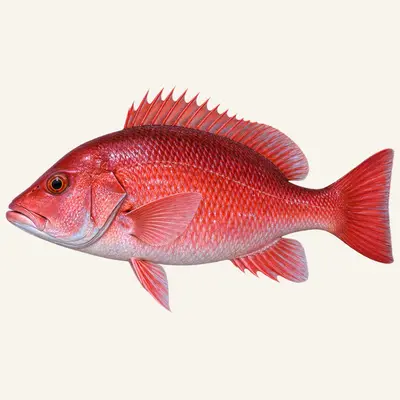
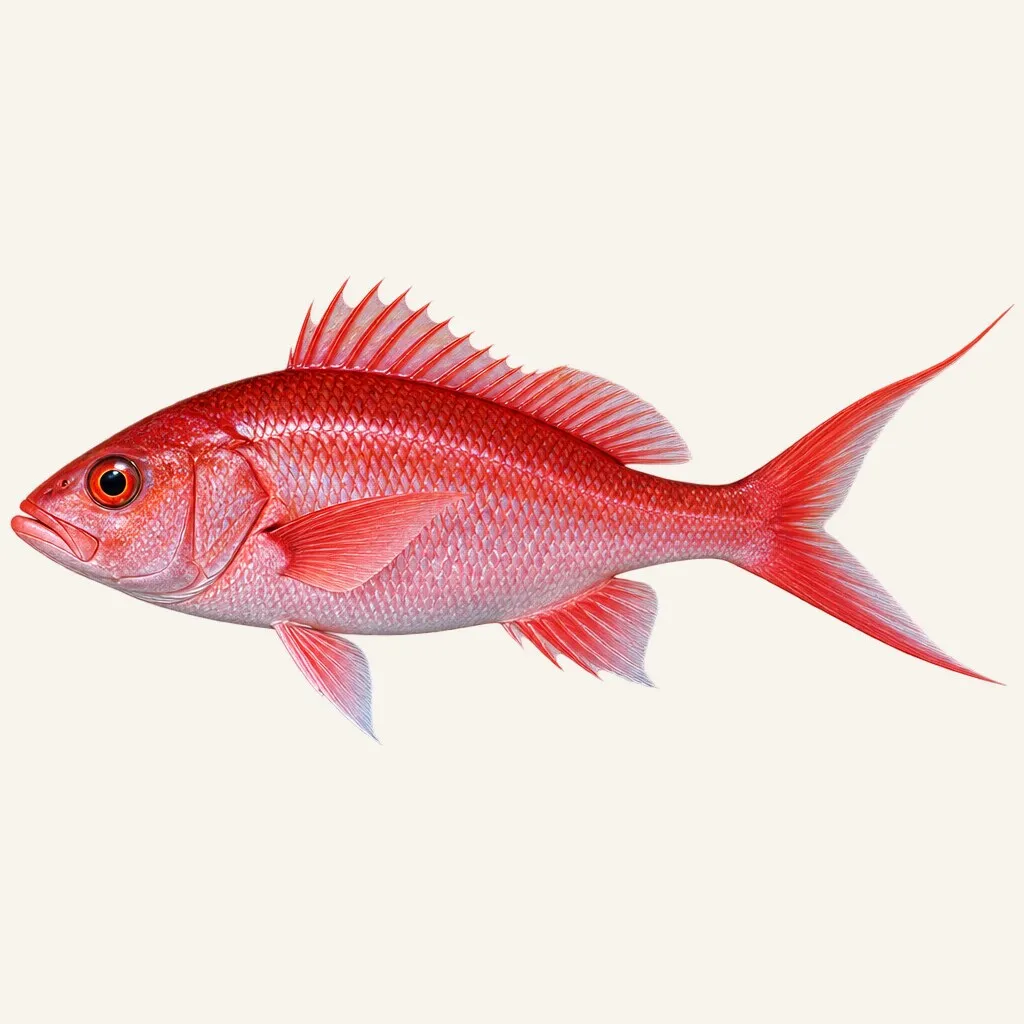
The flame snapper stands out for its extremely elongated caudal fin lobes and uniform bright red coloration, reflecting its life in deep waters between 100 and 400 metres. This pelagic-benthic lutjanid of reef slopes across Asia, Africa, and Oceania is a prized target for deepwater anglers.
Calendar
Recorded in 10 countries
Australia · China · French Polynesia · Japan · Mayotte · New Caledonia · Réunion · Solomon Islands · United States · Wallis & Futuna
GBIF occurrence records — native and introduced populations combined.
Its range
East Africa eastward to Hawaii, north to the Sea of Japan, south to Queensland, New South Wales and Lord Howe Island, with records off the Kermadecs northeast of New Zealand and from the Marquesas. That is 29°E to 139°W — 168 degrees of longitude, most of the way round the tropics.
The far corners are the informative part, and they are all islands: Lord Howe, the Kermadecs, the Marquesas, isolated points with a great deal of deep ocean between them and anything else. What each of them supplies is a slope. A species that lives on the drop-off of a continental shelf will also live on the drop-off of a seamount or a young volcanic island, and once that is understood the range stops looking like a continuous territory and starts looking like a list of edges.
Identifying it
The upper lobe of the tail becomes greatly elongated with increased growth. That is how the diagnosis puts it, and the wording is exact: the character is not present and then more present, it develops. A large fish trails a streamer behind it that nothing else on the ground can be confused with. A small one has an ordinary forked tail and gives no such help.
Which means the feature the species is named for, in every language, is a feature of the fish at the end of its growth — and, as the fishing section sets out, not the fish that usually comes up.
Two characters work at any size. The maxilla is covered with scales, and the bases of the dorsal and anal fins are not. That pair takes about five seconds to check and does not depend on how big the animal is or how long it has been dead. The space between the eyes is flat, and the scale rows across the back run parallel with the lateral line.
Colour is uniform and total: deep pink to red across the back and upper sides, pink below, and pink to red fins with it. No band, no spot, no blotch anywhere. At the depths this fish occupies, red is the first wavelength to disappear, so a uniformly red animal down there is effectively an unmarked one — the livery only becomes a colour at the surface, in a boat.
Counts: 10 dorsal spines and 11 soft rays, three anal spines and eight rays.
The water it needs
Rocky bottoms of the continental shelf and the slope, and benthopelagic — the fish holds in the water above the relief rather than sitting in it. On a drop-off that means it is over the edge, not in the cracks, and a bait resting on the ground is fishing underneath it.
The depth figures say something the equivalent figures for its neighbours do not. The recorded range runs from 45 to 400 m and the usual range is given as 90 to 400. The band described as usual is 310 m thick and reaches the bottom of the range: there is no narrow productive layer to find here, and no depth at which the species stops being plausible until the ground itself does.
Areas
- Deep reef slopes
- Outer drop-offs
- Seamounts
- Deep hard bottoms
Techniques
- Deep jigging
- Natural bait fishing on the bottom
- Deep trolling
- Live-bait fishing
Baits
- Heavy metal jigs
- Squid
- Fresh cut fish
- Sardines
What it eats
Small fishes, squids and crustaceans.
Three mobile prey, all of them capable of moving away, none of them attached to the bottom. That agrees with the benthopelagic position: this is an animal hunting in the dark water above the relief, and every item on its list has to be detected and then caught. Nothing here is picked off a rock.
How to catch it
Heavy handline or bottom longline, on relief found with a sounder, anywhere from 90 m down. The species is highly commercial, is fished for sport, and is occasionally used as bait; the flesh is rated highly.
The decisive fact is a pair of lengths that do not meet. First maturity is given as 66.3 cm, with observations from 52 cm upwards. The common capture is 50 cm in standard length. Those two are not measured the same way and are not strictly comparable, but the gap is far too wide to be closed by the conversion: the fish this fishery ordinarily lands has not spawned.
Sorting at the rail cannot fix that. A snapper brought up from 200 m has decompressed long before the line is halfway in, and putting it back over the side is a gesture with no fish at the end of it. Nor is there the option of working the shallow end of the range, because the range does not really have one — the band described as usual begins at 90 m and goes down from there. Whatever choice exists has to be made before the weight goes over: the ground, the size of the hooks, and how many drops the day is going to include.
The tails are the one piece of feedback available. A fish without an extended upper caudal lobe is a young fish, so a run of ordinary forked tails coming aboard is a statement about what that piece of ground is currently producing. It arrives too late to help the individual fish, which is precisely why it should be read as information about where to fish rather than as a question about what to release.
Conservation
Twenty years of recorded life, maturity at 66.3 cm, a home on the deep slope and a fishery classed as highly commercial. Four entries, all pointing the same way: a stock that responds slowly to anything done to it, in either direction.
The specific problem is the interval between the size ordinarily landed and the size at first spawning, and the reason it matters is that the interval cannot be closed by handling. In a shallow fishery, a fish below the useful size goes back and the population keeps it. Here the fish below the useful size does not go back, because it cannot. What replenishes this population is the fraction that never meets the gear at all, and that fraction is set by where and how much the fleet fishes rather than by anything decided after a fish is hooked.
There is a second, quieter difficulty in the record itself. The name Etelis carbunculus has been misapplied to this species by earlier authors. Two red slope snappers, both marketed, both present in the same archipelagos, were not reliably separated in the older literature — and correcting a name does not retroactively split a tonnage. A catch series covering both cannot be asked which of the two declined, and on a twenty-year animal the answer to that question would take a generation to become visible even if the data were clean.
Regulations
Check the local regulations in force (legal size limits, closed seasons, bag limits).
For guidance only. Legal sizes, quotas and open seasons vary by location and season: always check the local regulations in force before fishing.
Other names
Every one of the six names this catalogue carries points at the tail: deepwater longtail red snapper in English, and the same idea in French, Spanish, German, Italian and Portuguese, each language spelling out the long tail in its own words. Six for six, on one character.
The character belongs to large fish. It develops with growth, so a name that everybody agreed on describes an animal that a fishery landing 50 cm specimens mostly does not see. It is a name coined by people looking at the best fish they ever caught, and it is close to useless on the ordinary one.
Hawaii, where the deep-water snapper fishery is longest established, calls it onaga, borrowed from Japanese — and that word says long tail as well. The one name that came from a fishing culture rather than from a catalogue arrived at the same character by the same route.
Coruscans means flashing or glittering, which is what a red fish does under a deck light and not what it does at 300 m.
Sources: fishbase.se · api.gbif.org