Doublespotted queenfish
Scomberoides lysan · Carangidae
- Saltwater
- Coastal
- Medium
- Size
60–110 cm
- Weight
1.5–11 kg
- Water temp.
26–29 °C
- Depth
0–100 m
Where to fish
- Reef
- Rocky shore
- Offshore
Habitat icons: Flaticon
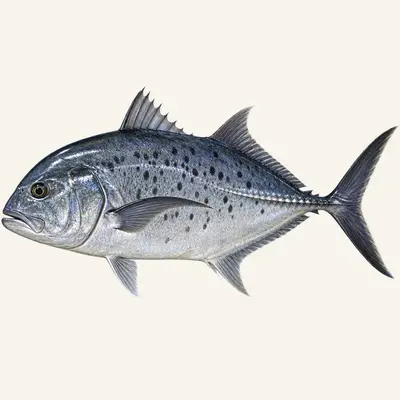
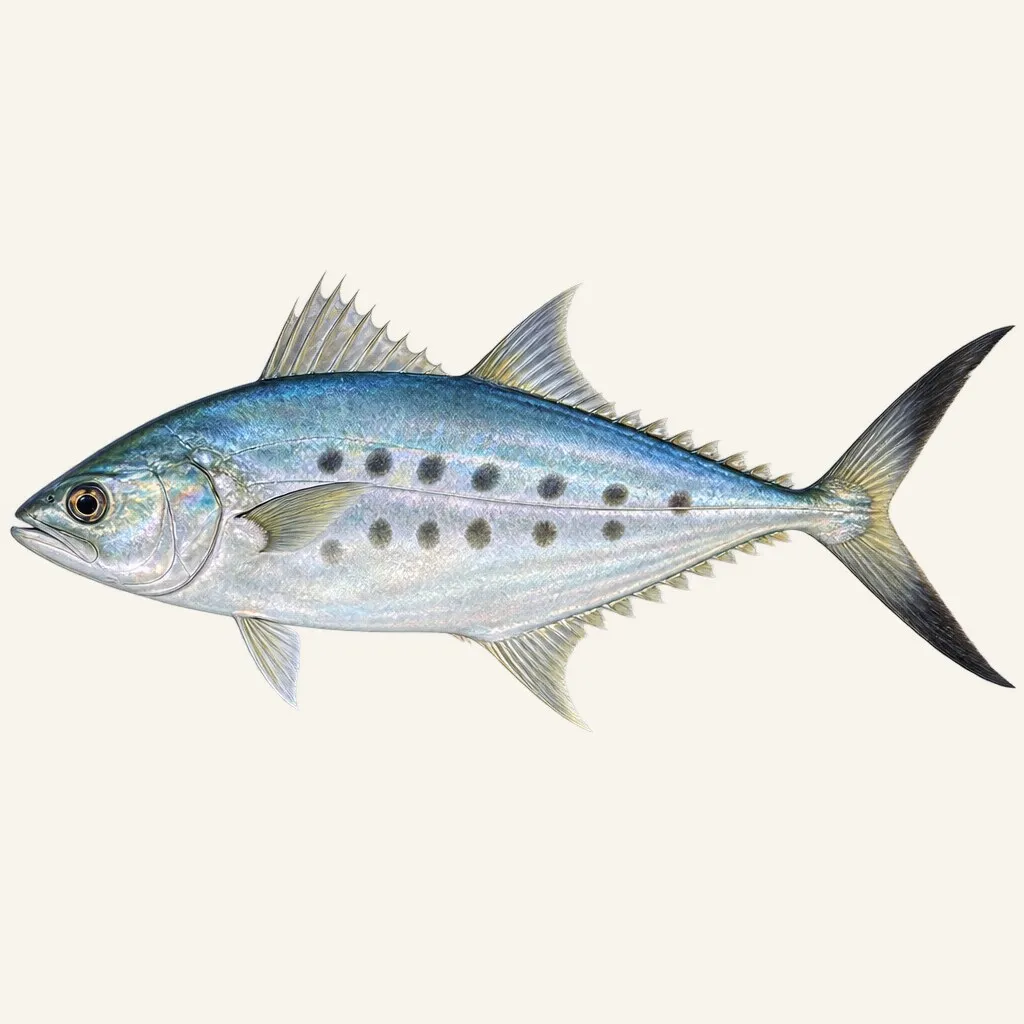
The doublespotted queenfish is a slender carangid of tropical coasts across Asia, Africa and Oceania, recognisable by its row of oval dark spots along the flanks and its elongated, slightly compressed body. A fast surface predator, it strikes small fish with agility and frequently leaps out of the water.
Calendar
Recorded in 13 countries
American Samoa · Australia · French Polynesia · Indonesia · Japan · Maldives · Mozambique · New Caledonia · Northern Mariana Islands · Seychelles · South Africa · Taiwan · United States
GBIF occurrence records — native and introduced populations combined.
Identifying it
Two readings of the same animal, and both are in the record. Seen from the side the fish is a spindle; seen head-on it is a blade. Fusiform in outline, compressed in cross-section: that pairing belongs to a swimmer that holds open water without leaning on its fins to do it.
The unpaired fins run long and low. Seven or eight spines open the dorsal, followed by 19 to 21 soft rays; the anal carries three spines and 17 to 19 rays. Two opposed bases of nearly equal length, extending the body back to the peduncle.
Beyond that the published diagnosis stops. It gives shape and it gives counts, and it assigns no colour to the fish at all. The entry carried on this page supplies what is missing — a file of oval dark markings along the flank on an elongate, slightly compressed body — and so do the common names, which are the subject of the last section.
Breeding
Spawning is set by the moon and by the edge of the reef. Adults move out to the outer reef slope several days after the full moon and breed there.
Both halves of that are usable on the water. The place is outside the lagoon the fish occupies the rest of the year, which means the spawning ground is not the fishing ground. The date needs no equipment beyond the sky and repeats twelve times a year.
The water it needs
Clear water is a requirement rather than a preference. The account restricts the species to relatively clear water and never qualifies the statement. Adults hold clear lagoon and seaward reef, from the surface down to 100 m, in water of 26 to 29 °C.
The young live somewhere else entirely. They occupy shallow inshore ground and brackish water, which is precisely the water the adult avoids.
The habit is pelagic and usually single. Groups do form on occasion, and the record is careful to call them loose; one fish on its own is the ordinary state.
Areas
- Rocky coasts
- Reef edges
- Passes and currents
- Coastal pelagic zones
Techniques
- Surface popper
- Stickbait
- Fast jigging
- Live bait fishing
Baits
- Large live fish
- Poppers
- Stickbaits
- Heavy metal jigs
What it eats
The juvenile does not hunt small prey. It feeds on other fish without killing them, tearing scales and skin tissue from the flanks of fish in schools and swallowing those.
That is a living taken by theft rather than by pursuit. Nothing has to be run down and nothing has to be subdued; the approach has to succeed, and the victim then regrows what was taken. A young fish making its living this way has no reason to behave like a surface predator, and it is why the shallow brackish nursery makes sense: the schools are there.
The adult gives the trade up. It takes small fishes and crustaceans and falls back into line with the rest of the family.
Two switches happen together, then, and they reinforce each other. Brackish shallows and stolen scales on one side; clear reef and hunted prey on the other. One fish, two ways of eating, and the change of water is what carries it across.
How to catch it
The outer slope in the nights following a full moon assembles fish that are otherwise met one at a time. For a pelagic animal that lives alone, that is the only period in which its position can be predicted rather than searched for.
Outside it, the search follows water clarity. A blow or a run-off does not make the species harder to catch; it moves it, and the transparent lagoons and outer reefs remain the ground.
Handling deserves a note, and the reason is a comparison the source makes itself. Venom glands were looked for in this species and could not be confirmed on the specimen examined, and the human-hazard rubric was left open rather than closed. The record of the talang queenfish, worked over by the same specialists, reads harmless outright. That difference is not a finding about the venom, but it is a reason to take this fish across the body with a full hand and to keep the long spiny dorsal away from the palm.
The flesh goes out fresh, dried, salted or frozen. Four preservation routes for one species is the signature of a fish landed a long way from ice, on a commercial fishery that stays modest and where the animal also serves, now and then, as bait.
Regulations
Check the local regulations in force (legal size limits, closed seasons, bag limits).
For guidance only. Legal sizes, quotas and open seasons vary by location and season: always check the local regulations in force before fishing.
Other names
Scomberoides means mackerel-like, and the resemblance is real enough on the water: the same spindle, the same long low unpaired fins, the same manner of holding open water. The relationship is not; this is a carangid.
The common names all count. Doublespotted queenfish in English, Doppelfleck-Königsmakrele in German, leccia a due macchie in Italian, pez gallo de dos manchas in Spanish, peixe-galo-de-duas-manchas in Brazilian Portuguese, queenfish à deux taches in French. Six languages out of six fix on a pair of marks, and the diagnosis reproduced above does not mention them. Where every language names the same thing and the description names none of it, the names are the better field character.
Queenfish is the second point, and it is an English-language one. The word covers more than one member of this genus, which is why each species needs its qualifier: this one is the doublespotted, and the larger talang queenfish shares the same coasts.
Sources: fishbase.se · api.gbif.org