Dog snapper
Lutjanus jocu · Lutjanidae
- Saltwater
- Coastal
- Medium
- Size
60–128 cm
- Weight
2.8–29 kg
- Lifespan
33 years
- Depth
2–40 m
Where to fish
- Reef
- Rocky shore
Habitat icons: Flaticon
Inhabits estuaries and occasionally enters rivers. Feeds mainly on fishes and benthic invertebrates, including shrimps, crabs, gastropods and cephalopods.
Calendar
Recorded in 15 countries
Belize · Brazil · British Virgin Islands · Cayman Islands · Colombia · Cuba · French Guiana · Guadeloupe · Honduras · Martinique · Mexico · Panama · Puerto Rico · U.S. Virgin Islands · United States
GBIF occurrence records — native and introduced populations combined.
Its range
The American range runs from Massachusetts to São Paulo, Gulf of Mexico and Caribbean included. That much is expected of a large Atlantic snapper.
The unexpected part lies on the far side of the ocean: St Paul's Rocks, Ascension Island, and Tinhosa Grande south of Príncipe. Three specks of reef in the central and eastern Atlantic, cut off from the American continent by thousands of kilometres of deep water.
Each of those populations sits on a few hectares of hard ground. Nothing reaches them from the west on the timescale of a season, and what is removed there is not replaced from elsewhere. A range that looks broad on a map is really two unrelated things — one continuous continental stock, and three isolates that answer only to themselves.
Identifying it
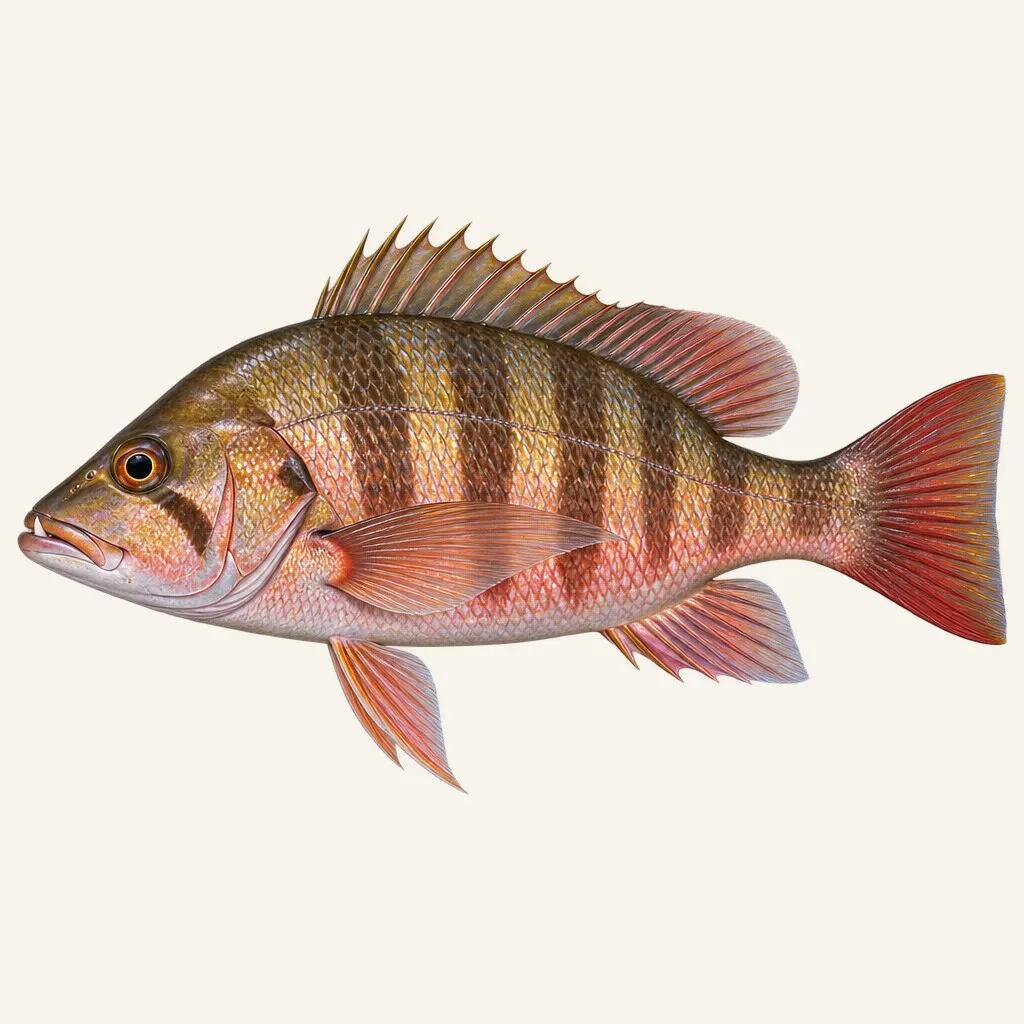
One pair of canines in the upper jaw is much longer than the rest — long enough to stay visible with the mouth shut. No other snapper of the western Atlantic shows its teeth that way, and the character reads on a fish in a cooler as well as on one in the water.
The second mark is a pale triangular bar stretched between the lower edge of the eye and the back of the mouth. It is constant.
The third changes with age, and among its neighbours this is the only case of it. Juveniles carry a continuous blue line under the eye; on adults that line breaks into a row of separate spots. The mark does not vanish, it fragments, so an adult that looks free of blue is still carrying the pieces of one.
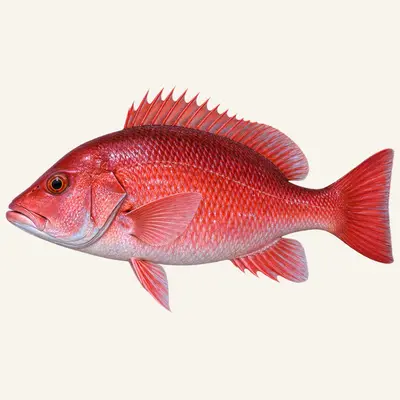
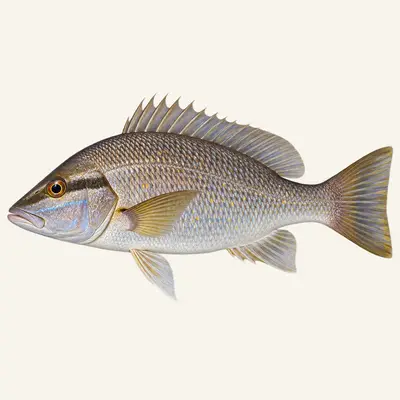
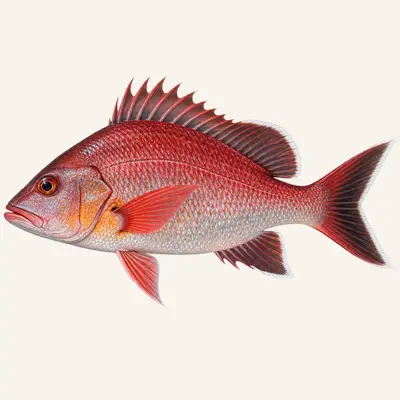
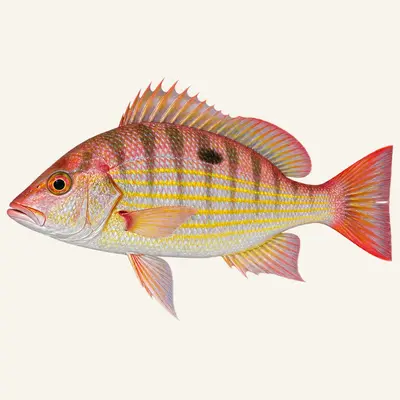
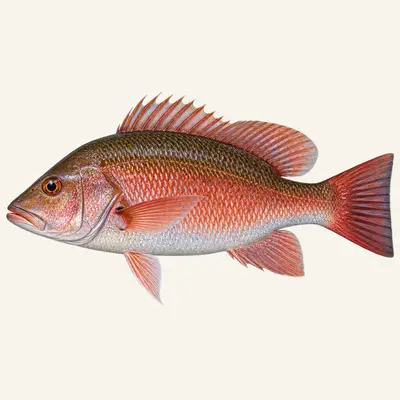
Back and upper flank are olive brown with a bronze cast, sometimes crossed by narrow pale bars, and the lower body is light red washed with copper. The pectorals are long, reaching the vent. Fourteen or 15 soft rays follow ten dorsal spines; the anal has three spines and eight rays.
The water it needs
This is the shallowest of the large Atlantic snappers. The full band runs from 2 to 40 m, the ordinary one from 5 to 30.
It is worth measuring what that means. The largest individuals live in a layer a free-diver crosses, a shore cast covers and a sounder is barely needed to read. No depth protects it at any point in its range.
Adults hold rocky and coral reef. The young live apart, in estuaries and mangrove, and occasionally push up into rivers, so the opening of the life cycle happens off the reef entirely.
Areas
- Deep reef drop-offs
- Submerged rocky structures
- Wrecks
- Coral reef edges
Techniques
- Deep live bait fishing
- Bottom handline fishing
- Deep trolling
- Soft lure fishing
Baits
- Small live fish
- Whole squid
- Live shrimp
- Crabs
- Cut octopus
What it eats
Fish dominate, with benthic invertebrates behind them: shrimps, crabs, gastropods, cephalopods.
That diet accounts for the dentition. An oversized pair of canines is made for seizing and holding prey that struggles, not for crushing shell — the equipment of a predator that takes live fish, with the rest of the list as filler. It is also the reason a live bait outfishes a dead one here by a wide margin.
How to catch it
Live bait is the logical choice and the finesse of the rig is the real constraint. The documentation describes a wary fish, and the shallow water it occupies makes that worse: in ten metres of clear water everything shows, leader included.
Two ages, two grounds. Juveniles come from estuaries and mangrove edges; big fish from drop-offs and rock structure inside the 5 to 30 m band. Searching for the second in deep water is a mistake of address rather than of method.
Common length is 60 cm. The published maximum belongs to another category of animal, and a fish of that size has roughly three decades behind it — reported longevity reaches 33 years.
The canines deserve respect at unhooking. They are developed enough to show with the jaws closed, and the mouth of a large individual is no place for fingers.
Conservation
Three traits combine in this species that would each be harmless on their own.
It lives in the top 30 m, the band where spearfishing, artisanal fishing and general coastal pressure all concentrate across the whole of its range. It grows very large, which marks it as a target wherever it is found. And it lives a long time, so every big individual is irreplaceable on any short timescale.
Maturity, by contrast, arrives early: around 32 cm, inside a range of 31 to 36. Most landed fish have already spawned, so the weakness does not lie there. It lies in the slow disappearance of old fish from a population that needs three decades to produce one.
The eastern Atlantic isolates read differently again. A population confined to an equatorial rock has no neighbour and no reserve: what is taken from it is rebuilt on site or not at all, and nothing guarantees the site has the means.
Regulations
Check the local regulations in force (legal size limits, closed seasons, bag limits).
For guidance only. Legal sizes, quotas and open seasons vary by location and season: always check the local regulations in force before fishing.
Other names
Dog snapper is the English name, and the tooth explains it — but dog, in English fish names, almost always means a shark. Dogfish, spurdog, and the dogtooth species scattered across several families have made it a shark word, so the one snapper it genuinely fits gets misheard by anyone who knows the rest.
The epithet is not Latin describing anything. jocu is a Caribbean vernacular carried whole into the binomial, which is why Spanish can say pargo jocú without translating a syllable. Brazilian Portuguese went straight to the tooth and calls the fish dentão, the big tooth, which names the character worth checking rather than the resemblance somebody imagined.
Sources: fishbase.se · api.gbif.org