Cubera snapper
Lutjanus cyanopterus · Lutjanidae
- Saltwater
- Coastal
- Medium
- Size
90–160 cm
- Weight
8.6–57 kg
- Lifespan
55 years
- Depth
18–70 m
Where to fish
- Reef
- Rocky shore
Habitat icons: Flaticon
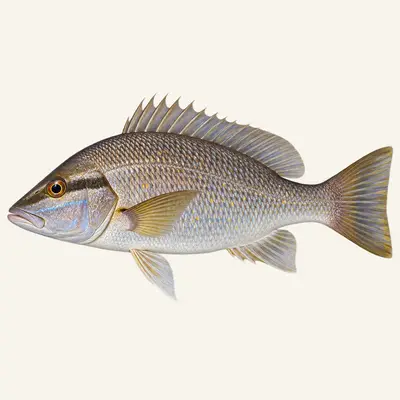
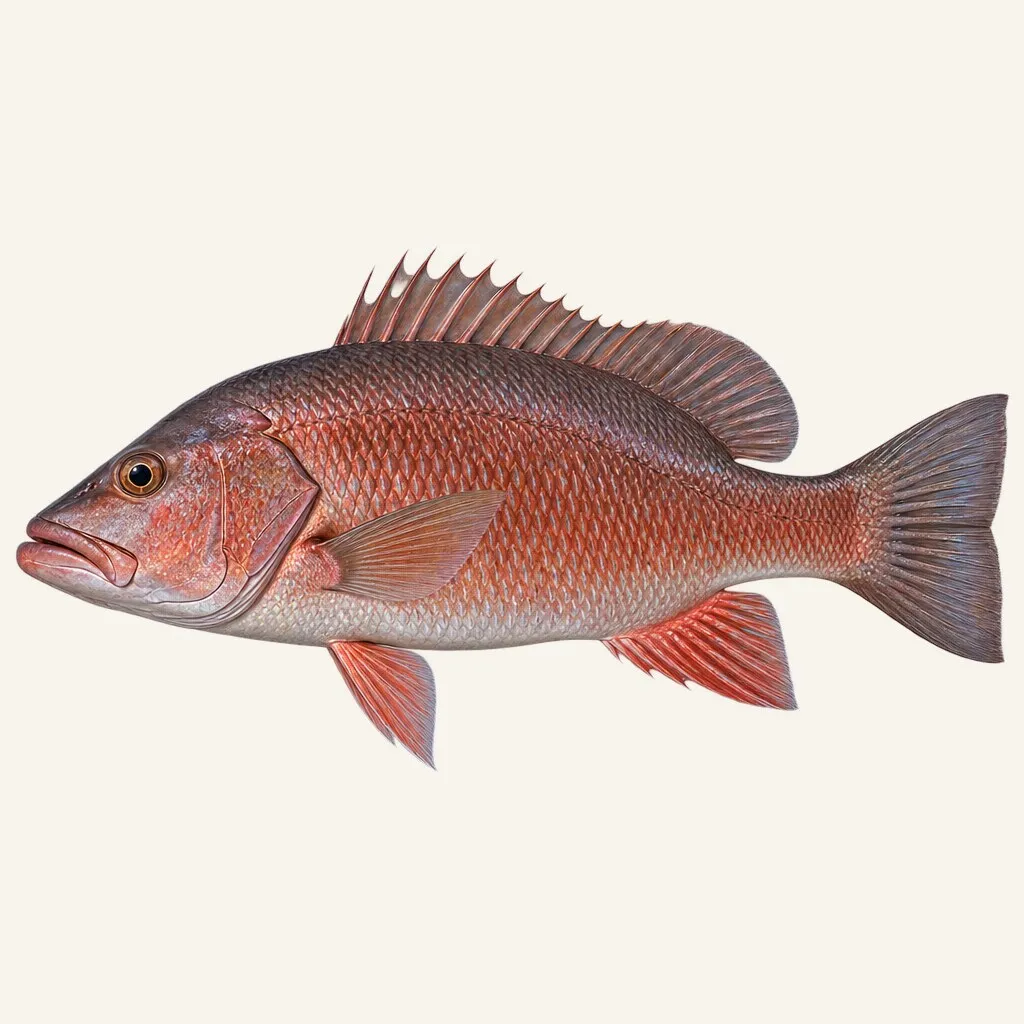
The cubera snapper is the largest Atlantic snapper, with a massive grey-bronze body showing purplish hues on the back and distinctive thick lips. It inhabits deep rocky and coral reefs, underwater walls, and caves in tropical American waters.
Calendar
Recorded in 12 countries
Bahamas · Brazil · Caribbean Netherlands · Cayman Islands · Colombia · Cuba · Honduras · Mexico · Panama · Puerto Rico · U.S. Virgin Islands · United States
GBIF occurrence records — native and introduced populations combined.
Its range
From Nova Scotia and Bermuda to the mouth of the Amazon — and then two qualifications that matter more than the outline. The species is rare north of Florida, and apparently rare in the Gulf of Mexico too.
The second point separates it from the red snapper of the same coast, whose entire population is the Gulf. Two large snappers, one shared band of latitude, and a shelf that holds one of them in quantity while barely holding the other.
Identifying it
Thick lips, first of all. In a genus where the lips are thin, a snapper with heavy ones stands out, and on a large specimen that is the feature which registers before any other.
The colour scheme announces nothing: back and flanks pale to dark grey with a reddish cast, the dorsal and caudal fins greyish, the anal and pelvics reddish, the pectorals translucent to grey. Ten dorsal spines and 14 soft rays, three anal spines and seven or eight rays, with the preopercular notch and knob barely marked.
Size finishes the identification, because this is the largest snapper in the Atlantic: an ordinary fish measures 90 cm, and the oldest one aged had reached 55 years. A grey, thick-lipped snapper over a metre long in Caribbean water is not going to be anything else.
The water it needs
Adults keep to ledges over rocky bottom and to the margins of reefs, between 18 and 70 m. The young sometimes use mangrove areas, which puts the start of the life cycle in water no adult ever visits.
The documentation adds a behavioural note worth having. This is a wary fish, not easily approached underwater. In a genus with a reputation for curiosity that reserve is unusual, and it applies to the diver and to the angler in the same way.
Areas
- Deep reefs
- Submerged wrecks
- Rocky drop-offs
- Offshore hard bottoms
Techniques
- Heavy live bait fishing
- Deep bottom handline fishing
- Bottom trolling
- Large soft lure fishing
Baits
- Large live fish
- Whole squid
- Octopus
- Cut lobster
- Large shrimp
What it eats
It feeds on fishes, shrimps, crabs and lobsters, using its strong canines to do it.
This is the one place in the catalogue where the documentation ties a snapper's teeth directly to a prey item. Robust canines break into the carapace of a spiny lobster, an abundant and largely uncontested resource on the rocky ground the species occupies, because most reef predators of comparable size cannot handle armour that thick. A fish with the tools for it is eating well where its competitors are not eating at all.
How to catch it
Rock ledges and reef margins are the marks, and the wariness of the fish is the difficulty. A noisy approach or a coarse presentation is enough to write off a spot for the session, which is not true of most snappers of this size.
The teeth set the terminal tackle. A trace sized for a sea bream will not survive dentition built to open crustacean shell, and neither will a knot tied in a hurry over a ledge.
The two ages are fished in unrelated places — small fish in the mangrove, adults on the rock — so a single species asks for two entirely separate kinds of trip.
Conservation · Vulnerable (IUCN) — This species is threatened with extinction. Always release it (no-kill), handle it with the utmost care and check local rules — fishing for it may be prohibited.
Conservation
There is no published length at first maturity for this species. Not a wide interval, as with several of its relatives: nothing at all. For the largest snapper in the Atlantic, an animal that reaches 55 years, the size at which it first spawns is unknown, which means no size-based measure anywhere in its range can be calibrated against the biology.
The dependence of the young on mangrove is a pressure that runs independently of fishing. A coast that loses its mangrove stops producing juveniles, and nothing visible happens on the reef for years afterwards.
Its wariness, on the other hand, gives it partial protection from spearfishing, which has emptied reefs of several more approachable groupers. That is a rare case of a behavioural trait working in a species' favour.
Regulations
Check the local regulations in force (legal size limits, closed seasons, bag limits).
For guidance only. Legal sizes, quotas and open seasons vary by location and season: always check the local regulations in force before fishing.
Other names
Cubera snapper carries a Spanish word into English untranslated. Cubera is what the fish is called in the Spanish-speaking Caribbean, and English took the name over rather than inventing one of its own — which is why the label means the same thing on both sides of the market.
The scientific name is the odd one out. cyanopterus means blue-finned, and the description of the fins runs greyish, reddish and translucent, with no blue anywhere on the animal. The name asserts a colour the species does not have, and it is the name that will outlast every market term attached to the fish.
Sources: fishbase.se · api.gbif.org