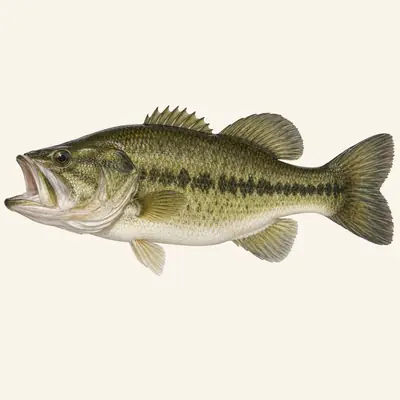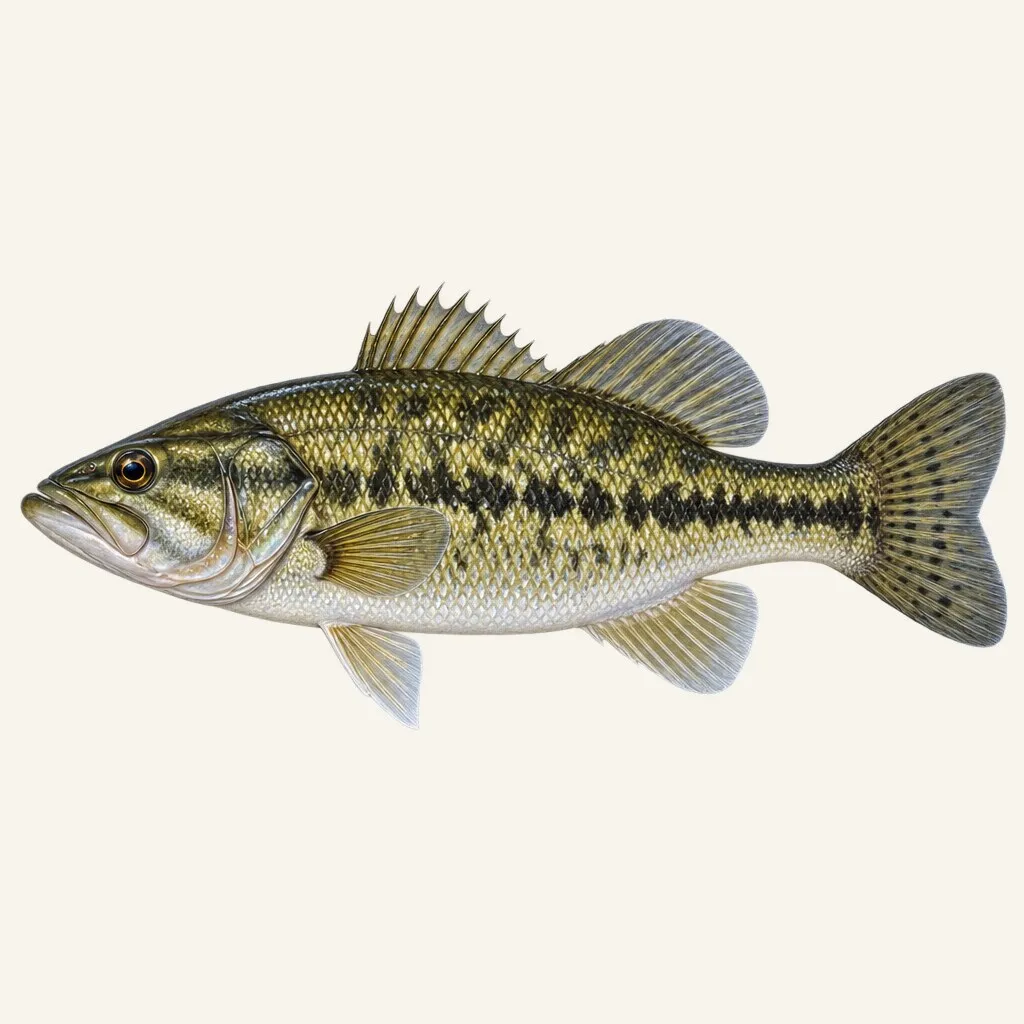
Guadalupe bass
Micropterus treculii · Centrarchidae
- Freshwater
- Predators
- Hard
- Size
46 cm
- Weight
1.7 kg
Where to fish
- River
Habitat icons: Flaticon
Gravel riffles, runs and flowing pools of creeks and small to medium rivers
Calendar
Recorded in 1 country
GBIF occurrence records — native and introduced populations combined.
Its range
This fish lives on the Edwards Plateau in Texas and nowhere else on earth. It occupies the headwaters of the Brazos, the Colorado, the Guadalupe and the San Antonio, and the upper Nueces, where it was put rather than found.
An outline that small usually traces a mountain range or an island. Here it traces a rock formation. The Edwards Plateau is limestone, and limestone holds water: rain sinks into it, moves underground, and comes back out as springs that feed clear cool creeks through a part of Texas where the surface water is neither. The range of the species is the map of that aquifer's outflow, drawn in fish.
Very few animals match a geological unit so exactly, and the match is also the explanation for why the species never spread. There is no second plateau next door.
The water it needs
Gravel riffles, runs and flowing pools in creeks and rivers of small to medium size.
Read on its own that is a smallmouth bass habitat description, and the resemblance is real: hard substrate, moving water, clarity. The difference is scale and origin. These are spring-fed streams a few metres across in places, holding their temperature because their water arrives from underground rather than from the sky, in a landscape whose other rivers run warm and turbid.
Areas
- Rocky riffles and rapids
- Stony river margins
- Stream confluences
- Pools below rapids
Techniques
- Fly fishing (nymph, dry fly)
- Light topwater
- Ultra-light spinning
- Small soft lures
Baits
- Small soft lures
- Insect imitations
- Earthworms
- Small spinners
How to catch it
The setting is the whole of the specificity. Small, clear, cool water in hot country, fished on foot, for a fish that persists in the one kind of stream the surrounding region does not otherwise produce.
Expectations scale to the stream. A fish approaching the published maximum, out of a plateau creek, is an exceptional one. The species is not built to be measured against reservoir bass a few kilometres downstream.
Clarity forces the approach and current over gravel dictates the presentation. Water this transparent shows the angler to the fish first, and a lure that stays in touch with a gravel bottom in a moving pool covers the ground the fish actually holds.
Conservation · Near Threatened (IUCN) — This species is in decline. Release your catch quickly and handle it with care — wet hands, as little time out of the water as possible.
Conservation
A species confined to spring-fed streams on one limestone plateau depends entirely on what comes out of the ground. Groundwater pumping in a dry region is therefore a direct pressure on the habitat, and it operates whatever the state of the banks, the riparian trees or the water quality at the surface. A spring that stops flowing does not degrade the stream; it removes it.
The second pressure is internal to the genus. Smallmouth bass stocked into these rivers for sport hybridise with this species, and the hybrids are fertile, so what spreads is not a competitor but a dilution. With four native river systems and no population anywhere else, there is no reservoir of unmixed fish to draw on once a drainage has gone.
That is why the conservation work here has been genetic rather than habitat-based in the first instance: finding the reaches that still hold unhybridised fish, and rebuilding from them.
Regulations
Check the local regulations in force (legal size limits, closed seasons, bag limits).
For guidance only. Legal sizes, quotas and open seasons vary by location and season: always check the local regulations in force before fishing.
Other names
Guadalupe bass in English, after the Texas river. The species epithet honours Auguste Trécul, the French botanist who collected in Texas in the middle of the nineteenth century.
It is the state fish of Texas, a designation that has done real work: it gave a small endemic with no commercial value a public identity, and the restoration programmes aimed at the least hybridised populations have been argued for in those terms.
The naming pattern is worth noticing because it repeats across the American Southeast. Basses of restricted range take the name of the river that holds them, so Guadalupe bass, Suwannee bass and their equivalents are geographic labels rather than descriptive ones. It works well until the fish is moved.
Sources: fishbase.se · api.gbif.org