Pumpkinseed
Lepomis gibbosus · Centrarchidae
- Freshwater
- Predators
- Easy
- Size
12–25 cm
- Weight
0.0–0.4 kg
- Lifespan
12 years
- Water temp.
4–30 °C
- Depth
0–41 m
Where to fish
- River
Habitat icons: Flaticon
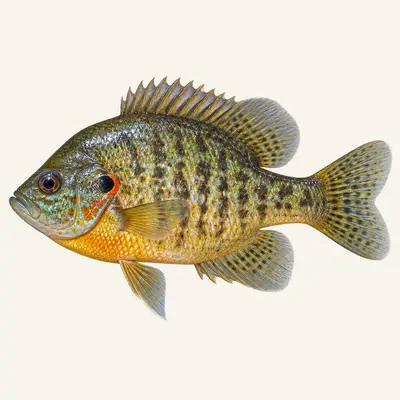
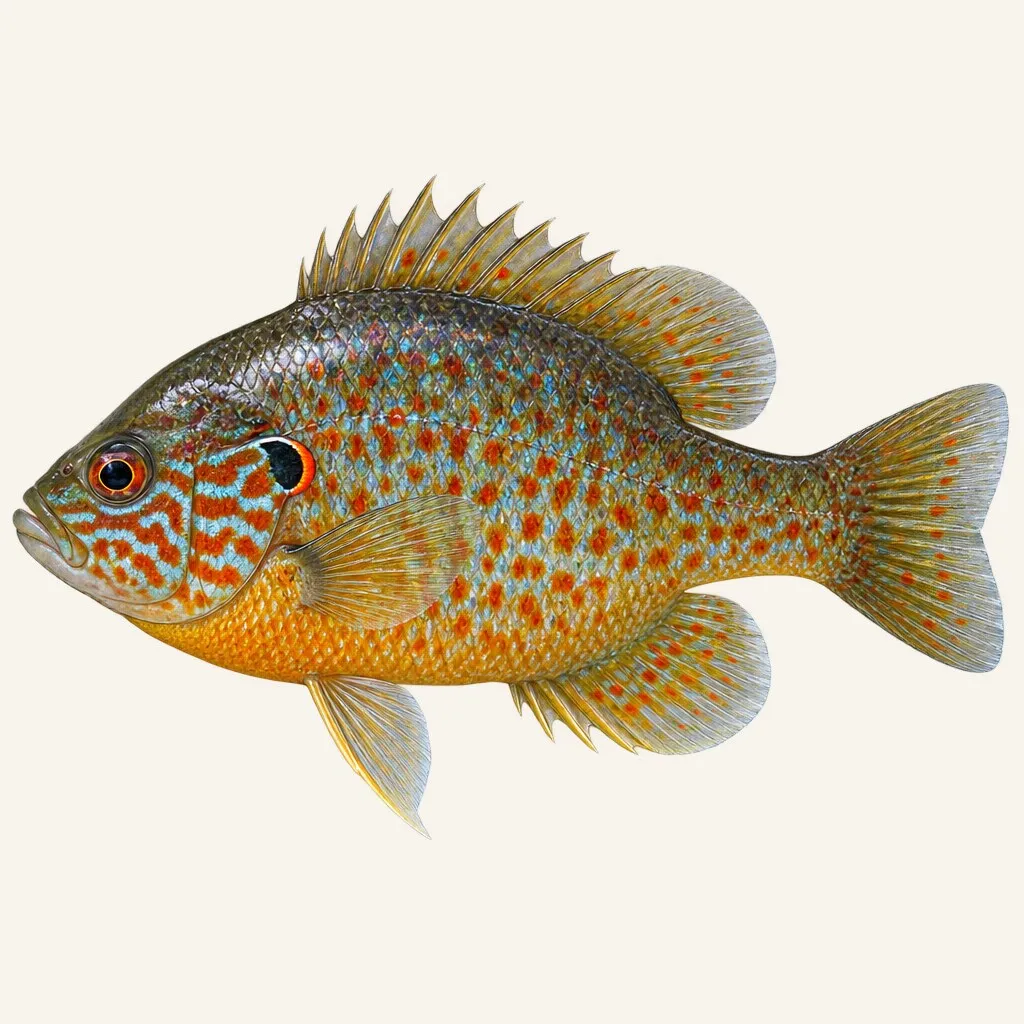
Very colorful (orange, blue, green) - Harmful invasive species - Destroys native species
Calendar
Recorded in 27 countries
Austria · Belgium · Bulgaria · Canada · Croatia · Czechia · Denmark · Finland · France · Germany · Greece · Hungary · Italy · Luxembourg · Netherlands · Norway · Portugal · Romania · Serbia · Slovakia · Slovenia · Spain · Sweden · Switzerland · Ukraine · United Kingdom · United States
GBIF occurrence records — native and introduced populations combined.
Its range
The native range runs from New Brunswick south to the Savannah River in Georgia, and inland through the Great Lakes, the Hudson Bay drainage by way of the Red River and the upper Mississippi, from Quebec west to southeastern Manitoba and North Dakota and south into northern Kentucky and Missouri. Anyone who learned to fish in that quarter of the continent caught this species before they caught anything else.
The additions are all human. Pacific drainages from British Columbia down to California hold it, and so does much of Europe, and a number of countries have since recorded damage to their own fauna where it settled in.
What bounds the range is current, not cold. The species holds between four degrees and 30, which covers almost any temperate water, but it will not live in a swift river. Every water it has taken outside its native range is a still one: a pond, a gravel pit, a canal, a reservoir margin, an ornamental lake.
One tolerance widens the map more than it looks. In Europe it turns up in estuaries at salinities as high as 18.2 parts per thousand — half the strength of sea water, in a fish otherwise associated with farm ponds. An estuary is therefore not a barrier between two river systems for this species, which is worth knowing when working out how it reached the next catchment along.
Identifying it
Look at the ear flap. The rear edge of the gill cover finishes in a hard orange-red spot, and pale blue wavy lines run back across the cheek from the eye. No other sunfish likely to take the same worm out of the same margin carries both marks together, and on a fish this small the flap is the only character worth arguing over.
The rest is genus rather than species. Ten to 12 dorsal spines, about as many soft rays behind them, three anal spines and eight to 11 rays, 28 to 30 vertebrae. The body is short, deep and pressed flat from the sides.
That shape is not an accident of family resemblance. A disc turns inside its own length, which is what a fish living among plant stems needs and what a fusiform predator of open water cannot do. Everything the pumpkinseed does for a living happens in the first couple of metres out from the bank, in among stems, and the outline is built for exactly that.
Breeding
The nest goes in almost no water at all. The male clears it close in to the shore, in the shallowest water that will cover him, and the pair then circles above it, releasing eggs and milt in bursts rather than in one act.
He stays. Seven days over the eggs, then about 11 more with the fry after they hatch, and as soon as they leave he puts the scrape back in order and spawns again — with the same female or a different one. In European water a single male may take several females into one nest and hold it until the last larvae disperse.
The clutch is small: up to 1,000 eggs. Set against the millions a carp releases that looks like a species in trouble, and it is the opposite. Guarded eggs in warm shallow water hatch at a rate that broadcast spawning never approaches, and the male turns the same nest over two or three times in a season.
Few eggs, heavy guarding, repeated clutches, all of it in water shallow enough to wade: that combination is what fills a pond with pumpkinseeds within a few years of the first one arriving.
The water it needs
Vegetated lakes and ponds, and the quiet pools of creeks and small rivers. Within those, the pumpkinseed holds the margin — the strip of shallow weed nearest the bank, where a fish can be seen from above on a bright day.
It has all the same been recorded at 41 m, which sits oddly beside a fish most people catch in knee-deep water. The depth record is real and the habit is not: it marks what the species can survive rather than where it makes its living.
Sociability changes with age. Young fish gather in fairly large schools; adults rarely school at all, sitting instead in pairs or in loose groups of three or four. A dozen small ones on the same bait means a shoal of juveniles, not a concentration of good fish.
Areas
- Vegetated margins
- shallow warm-water zones
Techniques
- Worms
- Small baits
Baits
- Small lures
- Ultra-light line
What it eats
Two accounts of the diet exist and they do not match. In North America the species is recorded taking small fishes, other small vertebrates, and fish eggs. In Europe it is reported working through a wide variety of invertebrates instead.
The eggs are the entry that matters. A fish of hand length that eats eggs is not competing with the other residents of a pond, it is working on their recruitment, and it does so in the same warm shallows where most of them spawn. That single item explains the effect of the species in water where it was introduced far better than its size does — nothing about a fish of hand length suggests it can hollow out the stock of something larger, and eating the next generation is how it happens.
How to catch it
Most anglers catch pumpkinseeds without meaning to, and the fisheries literature files the species plainly under undesirable catch.
The reason is not the size but the appetite. Where the fish is abundant, anything small left on the bottom is worked over within a minute — a worm, a maggot, a piece of sweetcorn, the tail of a lure. Fine fishing for anything else becomes impossible, and the usual answer is a bigger bait rather than a better one.
Fished for on purpose, which mostly means fished for by children, it is about as accessible as a fish gets. A tiny hook, a light float, a fragment of worm, dropped into the weed within a rod length of the bank, in the first hour of a warm afternoon. No boat, no distance, no waiting.
The species also sells as an aquarium fish, and that is the same problem in a different form. Moving one live fish between two waters is how the species crossed North America and how it crossed Europe, and it remains the main way it arrives anywhere new.
Conservation
Nothing presses on the pumpkinseed. The pressure runs the other way, and the mechanism is worth setting out because it is a specific one rather than a general complaint about introduced fish.
Guarded nests produce a reliable year class annually, the adults live up to 12 years, and the eggs of everything else spawning in the same shallows are on the menu. Put those together in a water with no predator large enough to thin the population, and the outcome is consistent: a very large number of very small fish, none of them growing, the whole system's production locked up in stunted panfish. The species is formally flagged as a potential pest for that reason.
Its one weakness is the one to work from. Current stops it. Still waters — pits, canals, ponds, reservoir arms — are where a released fish establishes, and running water is where it does not, which is the first thing to check when judging what an introduction is likely to cost.
Regulations
Mandatory destruction in several countries
For guidance only. Legal sizes, quotas and open seasons vary by location and season: always check the local regulations in force before fishing.
Other names
Pumpkinseed is the standard name and describes the outline: a squash seed, flattened and round-edged. Sunny does duty in much of the eastern United States, and Quebec says crapet-soleil, French perche-soleil.
Sunfish is where English trips. It is the family word for the whole of the Centrarchidae, so it covers this fish, the bluegill, the crappies and the black basses — and it is also the name of the ocean sunfish, a marine animal of another order entirely that reaches two tonnes. The species epithet, gibbosus, means humped, and refers to the deep back.
Sources: fishbase.se · api.gbif.org