Orangespotted sunfish
Lepomis humilis · Centrarchidae
- Freshwater
- Predators
- Medium
- Size
7–18 cm
- Weight
0.0 kg
- Lifespan
4 years
- Water temp.
10–28 °C
Where to fish
- Pond
- River
Habitat icons: Flaticon
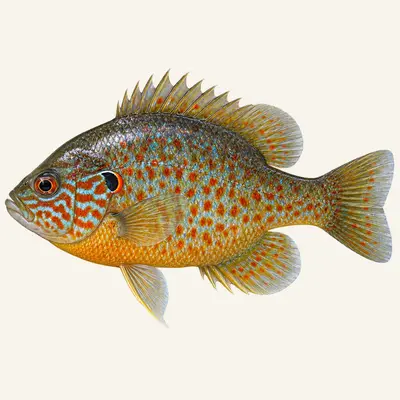
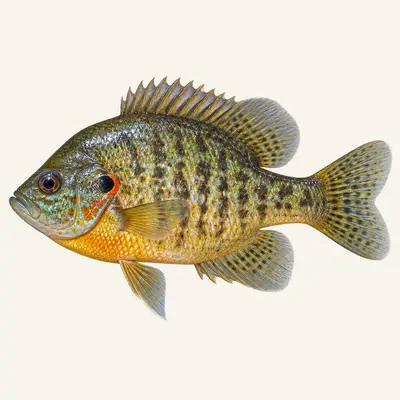
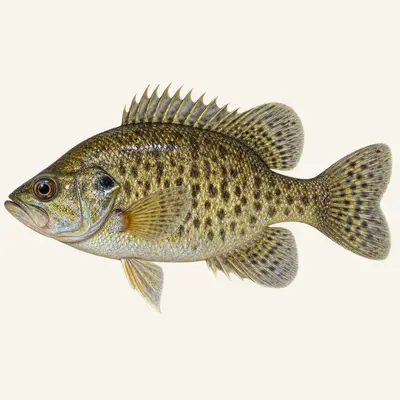
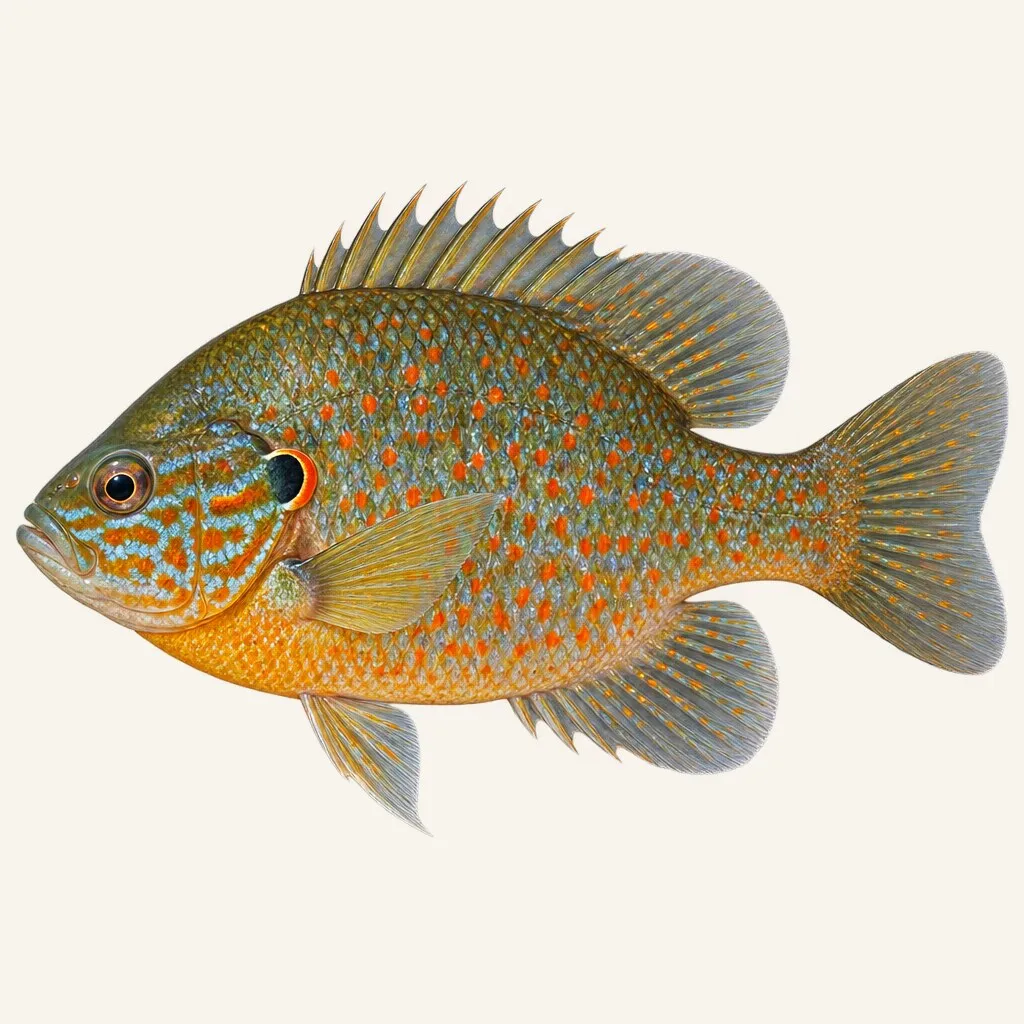
The orangespotted sunfish is the smallest North American sunfish, easily identified by its vivid orange or red spots on olive-brown flanks. It inhabits shallow, slow-moving or still waters with abundant aquatic vegetation.
Calendar
Recorded in 1 country
GBIF occurrence records — native and introduced populations combined.
Its range
The core of the range is the Mississippi drainage, from Ohio across to southern North Dakota and down to Louisiana, together with the Hudson Bay basin. To the south it holds the Gulf Slope drainages from Mobile Bay in Alabama west to the Colorado River in Texas.
The northern edge is the interesting part. The species reaches the Great Lakes only at the southern ends of Erie and Michigan — the warm, shallow, silt-laden corners of two very large cold lakes. It is not a lake fish being kept out by temperature so much as a river fish that has followed river conditions as far as they extend into the lake basin, and it stops where those conditions do.
The water it needs
Slack pools in creeks and in rivers of any size, often in rivers that are turbid, and generally close to brush.
The turbidity is the whole point. Most of this family wants water clear enough to hunt by sight in, and thick living weed to hunt among; this one accepts a river where a bait disappears from view 20 cm down, provided there is a raft of sunken branches to hold against. That combination — coloured water, drowned brush, no current — describes a great many prairie and lowland rivers that hold no other sunfish at all.
The recorded range of 10 to 28 degrees is on the cool side for the genus, which fits the same picture: silty rivers running off farmland across the middle of the continent rather than warm clear southern ponds.
Areas
- Vegetated margins
- Small shallow streams
- Ponds and marshes
Techniques
- Light live bait fishing
- Ultra-light spinning
- Toc fishing
Baits
- Earthworms
- Insect larvae
- Small surface insects
What it eats
Microcrustaceans and the larvae of aquatic insects, mostly midges.
That is the smallest prey list in the genus, and it fits both the size of the fish and the water it lives in. Neither a copepod nor a bloodworm needs to be seen to be eaten: they occur in enormous numbers in and just above soft sediment, and a fish working over that bottom collects them by touch and by taste. In water where visibility is measured in centimetres, that is the only feeding strategy available, and it is why the species can occupy rivers that a sight-hunting sunfish would starve in.
How to catch it
Everything is scaled down. This is the smallest of the North American sunfish — an ordinary adult is about 7 cm — and the diet means the hook, the bait and the shotting all have to match a fish taking midge larvae.
The water is the other constraint. Look in the coloured, slow, brush-filled sections that most anglers walk past, close in to the branches. Working out where the fish is holding without being able to see it is most of the difficulty, and a fixed bait beside cover beats anything mobile.
In practice it is nearly always an incidental catch, taken by someone fishing fine for something else. Four years is the greatest age reported, and there is little else on the record: the breeding of this species has never been described in the reference literature, so nothing about its nests, its season or its clutch size can be stated. Everything published on the subject belongs to its better-studied relatives, and transferring it here would be a guess dressed up as information.
Regulations
Check the local regulations in force (legal size limits, closed seasons, bag limits).
For guidance only. Legal sizes, quotas and open seasons vary by location and season: always check the local regulations in force before fishing.
Other names
Orangespotted sunfish is the standard name, and the spots are real: vivid orange to red flecks scattered over an olive flank, at their strongest on a male in spring, when this is one of the most intensely marked freshwater fish on the continent. Out of season the same fish is a plain small silvery panfish, and the name reads like a description of a different animal.
The species epithet, humilis, means lowly or small, and for once nothing about the naming misleads. It is kept in public aquariums for the colour rather than fished for in any deliberate way.
Sources: fishbase.se · api.gbif.org