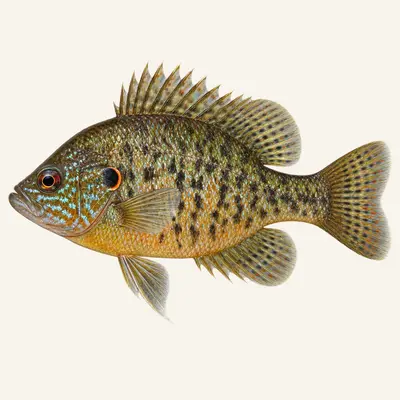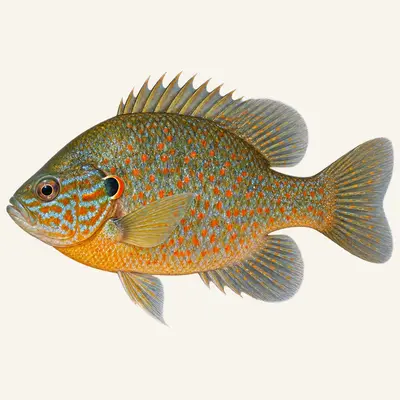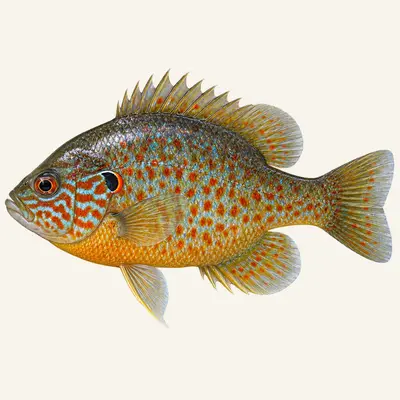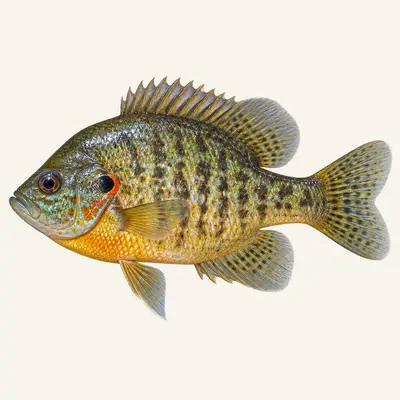
Longear sunfish
Lepomis megalotis · Centrarchidae
- Freshwater
- Predators
- Medium
- Size
12–24 cm
- Weight
0.0–0.8 kg
- Lifespan
6 years
Where to fish
- River
Habitat icons: Flaticon
Lives in shallow water, preferring habitats with dense vegetation in small lakes, ponds and slow-moving rivers and streams. Feeds on small aquatic invertebrates, insects, and occasionally small fishes
Calendar
Recorded in 1 country
GBIF occurrence records — native and introduced populations combined.
Its range
The range runs from northeastern Mexico north to the Great Lakes, and the record gives it in that one line and no more.
The vagueness is fair. This is an abundant small fish of the right kind of creek across the middle of the continent, of no commercial weight, and nobody has had reason to map its edges the way the edges of a game species get mapped. What the line does show is the shape of a warm-water animal that reaches its northern limit at the lakes and goes no further.
Breeding
The nests are dug side by side and packed into dense colonies close in to the shore. That is the fact that defines this species: where its relatives space their scrapes out along a shoreline, this one crowds them together, rim against rim, in an aggregation that can be counted from the bank.
The male does the digging, and he holds his patch of the colony against his neighbours through the whole run-up to spawning. Females stay away until the work is finished — one only comes in to a nest that is already complete.
Then the pair works a slow loop above the scrape, stopping every few seconds to put down a little milt and a few eggs at a time. The arrangement is not a bond. The male may drive his partner off the nest before she has finished; she may come back to the same one later, or go and spawn with somebody else two nests along.
The consequence is geographic and it is the useful part. A colony concentrates the entire spawning effort of a stretch of water into one small piece of bank, sometimes a few square metres of it. Everything that happens there in spring happens to all of it at once.
The water it needs
Nearly always in shallow water, and nearly always in thick growth: small lakes, ponds, and rivers and streams with little current in them. Dense vegetation is the condition, not a preference — a bare bank holds none.
Those three requirements together pin the species to the first few metres of water. It does not go out into the body of a lake at any time of year, which is unusual even among sunfish, and it is why the fish turns up so reliably in the sort of small overgrown creek that carries nothing else worth catching.
Areas
- Rocky riffles
- Shallow river margins
- Moderate-current areas
Techniques
- Toc fishing
- Light live bait fishing
- Ultra-light spinning
Baits
- Earthworms
- Aquatic larvae
- Small insects
What it eats
Small aquatic invertebrates and insects, with the occasional small fish.
That is a weed-bed list rather than an open-water one, and it matches the habitat exactly: what the longear eats is what lives on and among submerged plants, not what drifts past in the current. The occasional fish is the ceiling on the diet rather than a habit — with an ordinary adult around 11 cm, there is not much a longear can swallow.
How to catch it
Fish the bank and the growth in it, within a couple of rod lengths. Looking for this species further out is time thrown away, and its refusal to leave shallow water is precisely what makes it available to anyone on foot.
In clear water in spring the colonies are visible from above — a cluster of pale saucers scraped into the bottom, each with a fish over it. That is the standing position of every adult in the vicinity. It is also what lies underneath the cast, and a colony worked hard over a few days is a whole reach's spawning being handled one fish at a time.
Everything is scaled to a mouth that will take a maggot and not much else: a small hook, a fragment of worm or a larva, or a soft-hackled imitation of an insect. Six years is the greatest age recorded, so the largest fish in a colony is not a decade-old survivor, just an ordinary adult at the top of a short life.
Conservation
Nothing on the species is under pressure, but its colonial habit changes the arithmetic of disturbance, and that is worth knowing before deciding where to stand.
A population that puts all of its nests into one short strip of bank has no spread of risk. Bank clearance, a dredged margin, a boat wash channel, cattle in the shallows or a water level dropped at the wrong week does not damage a proportion of the recruitment — it can take all of it from that stretch. Species that space their nests along a shoreline lose a fraction in the same event.
The short life compounds it. With six years to work with, a population has few year classes in reserve, and a colony destroyed two springs running takes longer to make good than the same loss in a fish that lives 20.
Regulations
Check the local regulations in force (legal size limits, closed seasons, bag limits).
For guidance only. Legal sizes, quotas and open seasons vary by location and season: always check the local regulations in force before fishing.
Other names
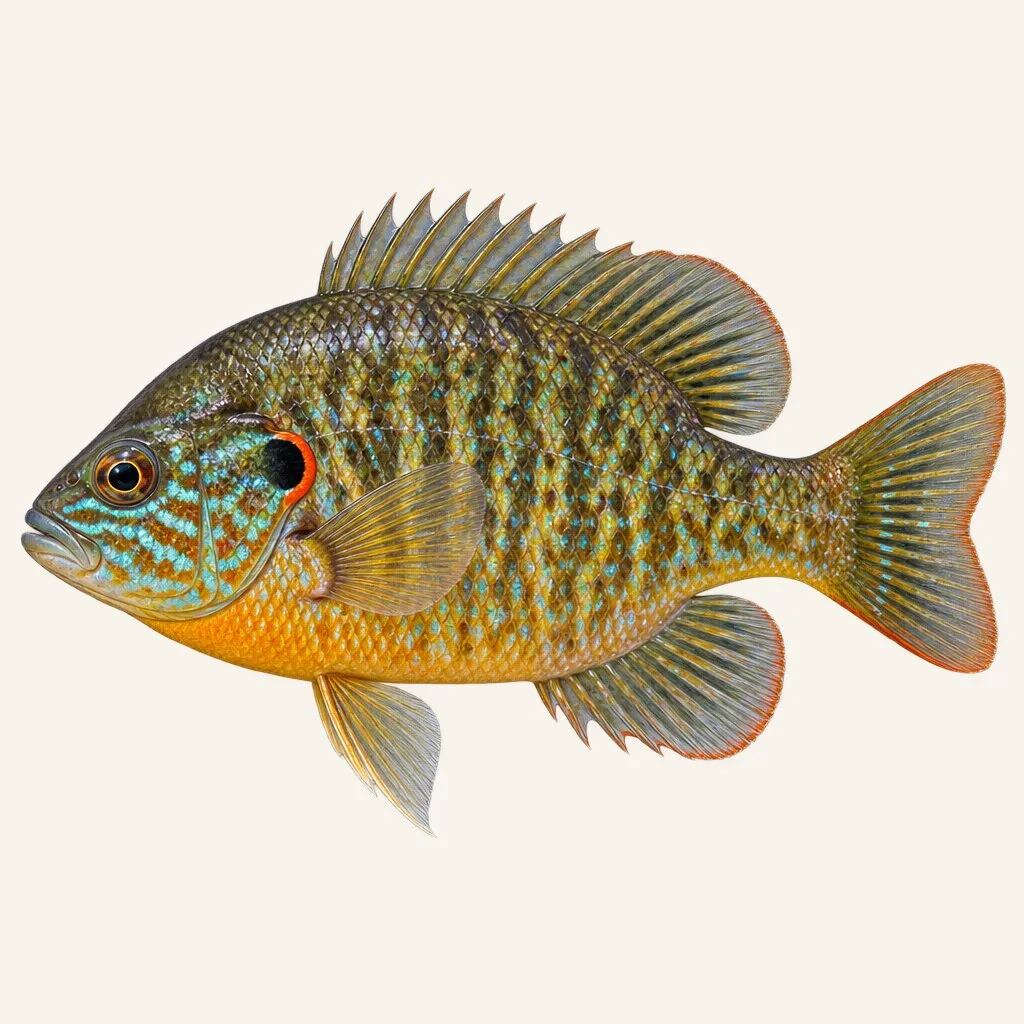
Longear sunfish is the standard name, and it and the scientific name say the same thing twice: megalotis is great ear. Both refer to the opercular flap, which in this species is drawn out backwards further than in any of its relatives and is longest of all on a breeding male.
It is one of the most strongly coloured freshwater fish in North America, which is why it is kept and shown in public aquariums — a rare thing for a native panfish, and the reason a great many people have seen one without ever having fished for it.
Sources: fishbase.se · api.gbif.org