Indonesian snakehead
Channa micropeltes · Channidae
- Freshwater
- Predators
- Medium
- Size
50–130 cm
- Weight
0.9–20 kg
- Water temp.
25–28 °C
Where to fish
- Canal
- River
Habitat icons: Flaticon
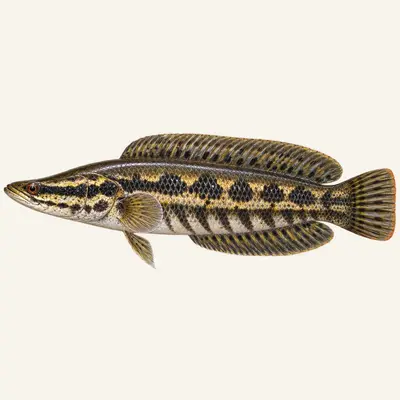
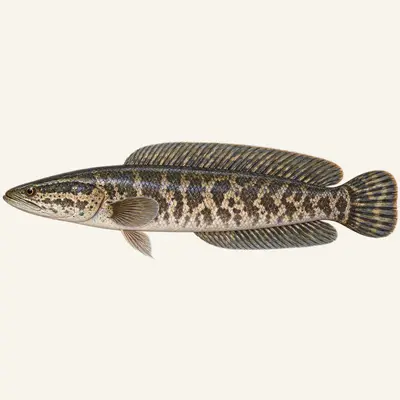
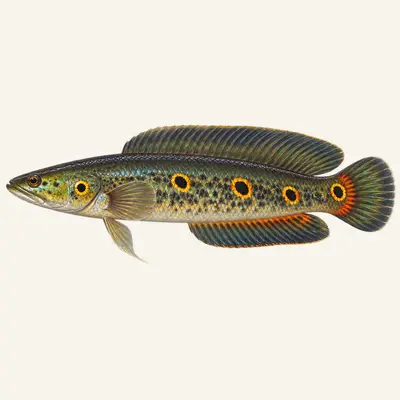
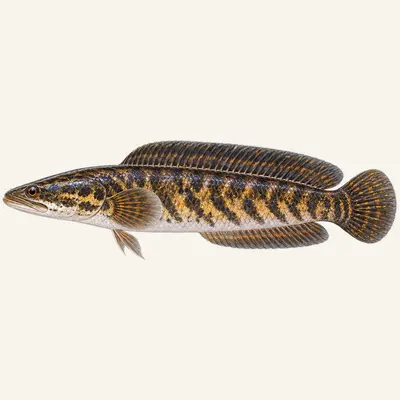
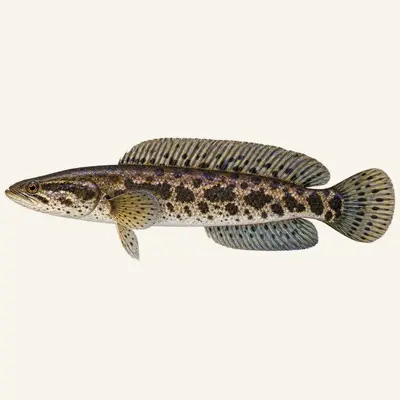
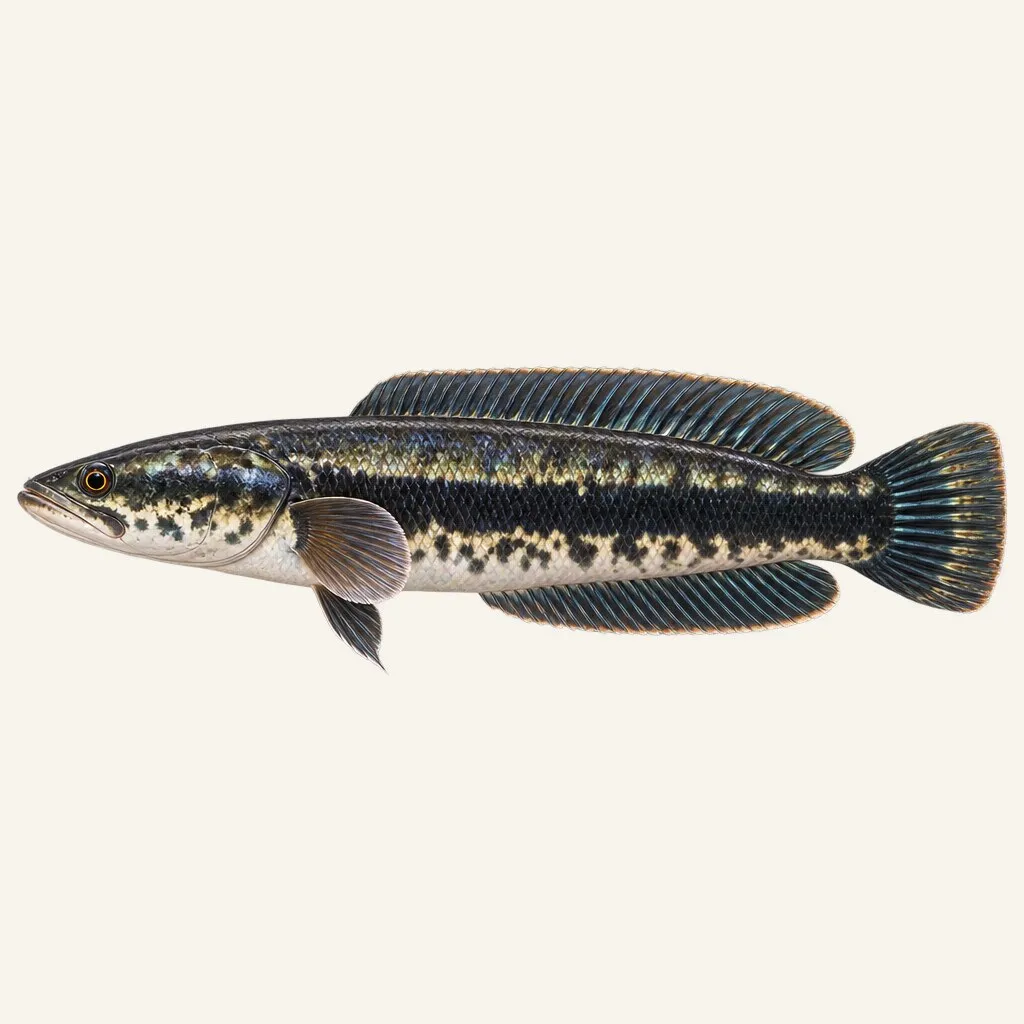
The Giant snakehead is an imposing predator with an elongated, cylindrical body, recognizable by its broad flat head, prominent jaw, and scales with reddish reflections on the belly in juveniles.
Calendar
Recorded in 13 countries
Brunei · Cambodia · Canada · Hong Kong SAR China · India · Indonesia · Laos · Malaysia · Singapore · Taiwan · Thailand · United States · Vietnam
GBIF occurrence records — native and introduced populations combined.
Its range
The native range covers the Mekong and Chao Phraya basins, the Malay Peninsula, and the islands of Sumatra and Borneo, between roughly 1 and 10 degrees north.
One correction matters for anyone reading older literature. Material from India assigned to this species in fact belongs to a distinct species, so an Indian record under this name should be treated as referring to something else until confirmed. The error is common enough that it has propagated into secondary sources.
Identifying it
Juvenile and adult look like two different fish, and for a long time they were described as such.
A young one carries two black longitudinal stripes with a band of bright orange between them. It is a striking pattern, and it is the reason the fish entered the ornamental trade at all — which in turn accounts for a share of the introductions outside its range.
An adult keeps only a single broad dark stripe running the length of a dull body. Nothing of the orange survives. The fish somebody buys and the fish they are trying to get rid of three years later have no colours in common, and photographs of the two rarely appear on the same page.
The body is elongate on the usual plan of the genus, and it keeps adding length long after the orange has gone.
The water it needs
Deep water, which is what separates this species from the ditch-dwelling members of its genus. Adults occupy lowland rivers and swamps and are generally associated with deep water bodies — large streams and canals with standing or slow flow, rather than the shallow stagnant pockets its relatives prefer. Recorded depth exceeds 100 m.
That figure is worth pausing on. Air breathing is obligatory in this fish as in the rest of the genus, meaning it has to reach the surface to take a breath. A fish that must come up and is nonetheless recorded below 100 m is making a vertical journey that no other obligate air breather of comparable size undertakes routinely.
Spawning goes to the other extreme. It happens in small streams with dense vegetation, so the same animal uses the deepest and the shallowest water available to it, at different points of the year.
Areas
- Vegetated banks and floating weed beds
- Swamps and flooded rice paddies
- Muddy-bottomed canals
- Shaded banks of slow rivers
Techniques
- Surface lure fishing (popper, frog)
- Cast and retrieve with soft lures
- Live bait fishing
- Dead bait fishing
Baits
- Artificial frogs
- Small live fish
- Shad-type soft lures
- Poppers
- Worked dead fish
What it eats
Mainly fish, with some crustaceans.
That is the narrowest diet in the genus by a distance. Where the great snakehead takes birds and rodents and the striped snakehead takes anything within a lunge, this one is close to a specialist piscivore, and it is the second largest predator in the family.
How to catch it
Deep still water first. Large canals, deep river arms and reservoirs hold this species, and the shallow muddy ground that produces its relatives generally will not. Getting that wrong is the most common way to blank on it.
Its reputation for aggression is the strongest in the genus and it centres on the young. A raft of orange fry at the surface means adults nearby and prepared to charge, which makes the approach as productive as it is exposed, and worth planning before rather than during.
The strict fish diet points to fish-imitating lures worked at or just under the surface rather than to the frog patterns that account for the more opportunistic species. Colour and profile matter less than depth and speed.
The size sets the tackle. A heavy ambush predator hauled out of structure is not landed on light gear, and neither is the fight the main problem — the first run into cover is.
Conservation
Capture fisheries for this species are economically substantial across its native range, where it is an ordinary food fish, and nothing in the record suggests they are pressing it.
The pressure runs the other way, through the aquarium trade, and it is a design fault of the trade rather than an accident. Juveniles are bought for the orange banding, outgrow every domestic tank within a few years, and get released. That route is well documented, and what it puts into water outside the native range is a bulky piscivore with no local predators and a demonstrated ability to occupy deep and shallow habitat alike.
Regulations
Check the local regulations in force (legal size limits, closed seasons, bag limits).
For guidance only. Legal sizes, quotas and open seasons vary by location and season: always check the local regulations in force before fishing.
Other names
Giant snakehead in English, toman in Malay and increasingly in English usage as well, pla chado in Thai.
Red snakehead is the trade name for the juveniles and refers to the orange band, which is exactly why the two life stages were sold and catalogued as separate fish for years. Anyone buying a red snakehead is buying this species.
The name giant snakehead invites confusion with the great snakehead, Channa marulius, which is in fact the larger of the two and shares part of the range. Where it matters, the scientific name is the only reliable form.
Sources: fishbase.se · api.gbif.org