Mirror carp
Cyprinus carpio (forme miroir) · Cyprinidae
- Freshwater
- Carp & coarse
- Hard
- Size
50–129 cm
- Weight
1.8–40 kg
- Lifespan
38 years
- Water temp.
3–35 °C
- Depth
0–29 m
Where to fish
- Canal
- Lake
- Pond
- River
Habitat icons: Flaticon
A variety of common carp with no scales or with large, scattered scales - Highly sought after by carp anglers
Calendar
Recorded in 46 countries
Algeria · Argentina · Australia · Austria · Belarus · Belgium · Brazil · Canada · Chile · China · Colombia · Croatia · Czechia · Denmark · Finland · France · Germany · Greece · Hong Kong SAR China · Hungary · India · Indonesia · Israel · Italy · Japan · Luxembourg · Mexico · Netherlands · New Zealand · Norway · Poland · Portugal · Romania · Russia · Slovakia · Slovenia · South Africa · South Korea · Spain · Sweden · Switzerland · Taiwan · Türkiye · Ukraine · United Kingdom · United States
GBIF occurrence records — native and introduced populations combined.
Identifying it
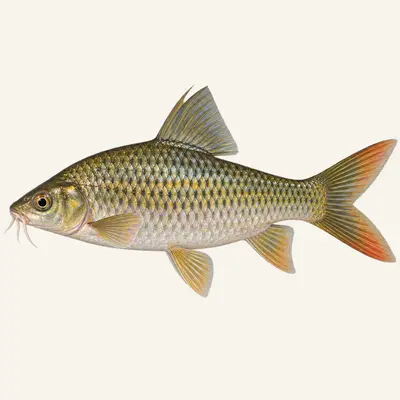
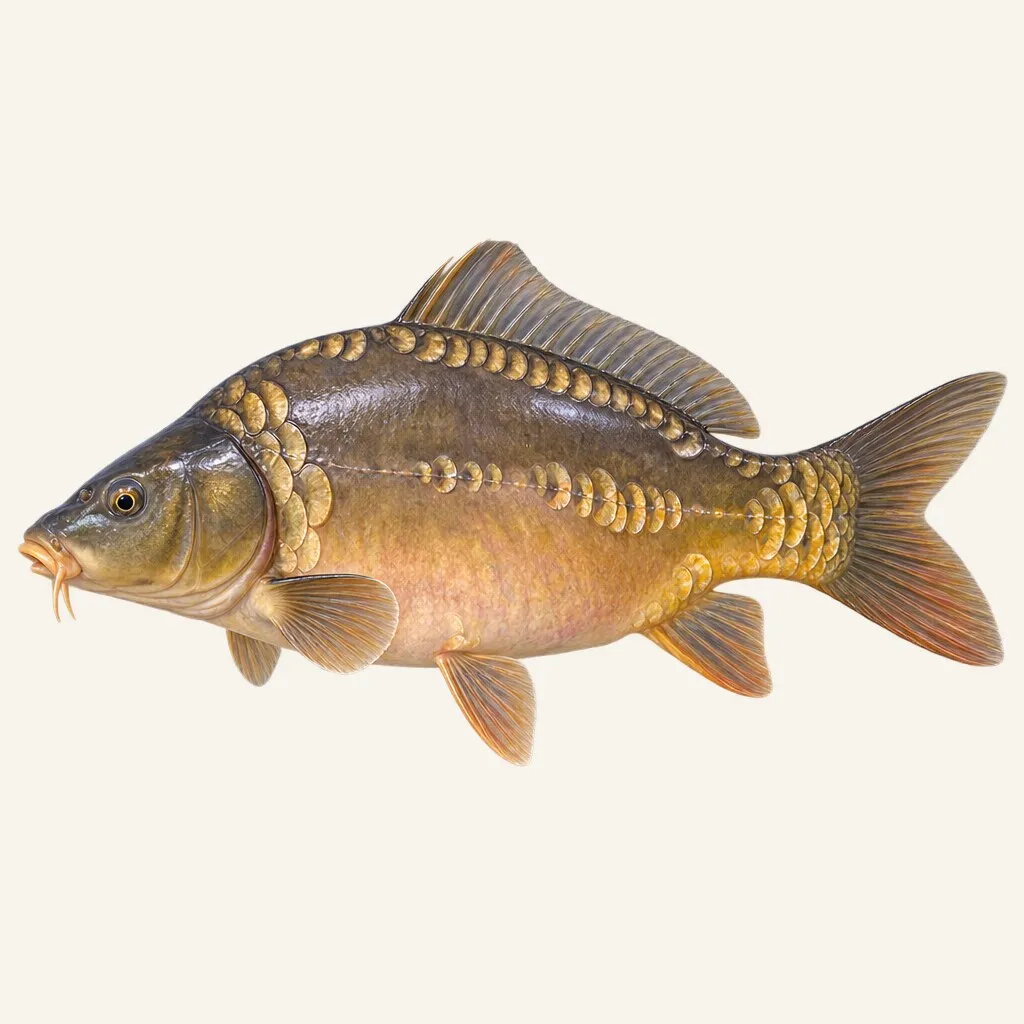
A mirror carp is identified by what has been taken away from it. A few large thick scales remain, placed in no order at all — most often a file running along the lateral line, sometimes a second row under the base of the dorsal, sometimes half a dozen scattered across one flank and none across the other. Between them the skin is bare.
This is not individual variation but a lineage fixed by selection. The species has a marked tendency to throw varieties and races under selective breeding, and scaling is the character that moved furthest: the wild form carries large thick scales over the whole body, the mirror keeps islands of them, the leather keeps none.
What matters beyond appearance is that the pattern is stable. It does not change over the life of the fish. The scales already present grow with the animal and no new ones are added, so every mirror carp carries a unique and permanent signature, legible from a photograph.
That is what makes these fish identifiable as individuals. On managed waters the heavy ones are recognised from one capture to the next, years apart, on the scale pattern alone — a check that no fully scaled carp allows.
Areas
- Ponds
- lakes
- gravel pits
- canals
Techniques
- Hair rig
- Method feeder
- Zig rig
Baits
- Boilie
- Pellets
- Seeds
How to catch it
Selection changed nothing in the behaviour. This fish feeds, moves and fights like the scaled form it came out of; approach, baiting and the conduct of the fight do not vary from one variety to another.
Two differences are real, and both concern handling. Bare skin shows everything: net marks, old hook holds and closed wounds read plainly on a flank without scales, where full cover would hide them. A fish caught often carries its history in the open.
The second follows from the first. An unscaled surface abrades faster against a dry bank or a coarse mesh, and time spent out of the water is paid for more visibly. Wet hands, wet mat, short stay: the precautions are those of any carp, but neglecting them leaves a mark that stays readable for years.
Conservation · Vulnerable (IUCN) — This species is threatened with extinction. Always release it (no-kill), handle it with the utmost care and check local rules — fishing for it may be prohibited.
Regulations
Check the local regulations in force (legal size limits, closed seasons, bag limits).
For guidance only. Legal sizes, quotas and open seasons vary by location and season: always check the local regulations in force before fishing.
Other names
Mirror carp in English, Spiegelkarpfen in German, carpe miroir in French, carpa a specchio in Italian — every one of those languages compares the isolated scales to mirrors set into the skin.
The trinomial has no standing in nomenclature. This fish is Cyprinus carpio, and the variety name marks a farmed lineage rather than a taxon. Beside it, the leather carp is entirely naked and the linear carp keeps a single file of scales along the flank. Two genes account for most of these patterns, and one of them is lethal in the double dose, which is why a leather strain never breeds true and always throws a proportion of mirrors.
The origin of the lineages is utilitarian. Reduced scaling was selected in European pond culture, where a fish that was easier to prepare was worth more at market. Sport fishing inherited an animal drawn by a kitchen constraint.
Sources: fishbase.se · api.gbif.org