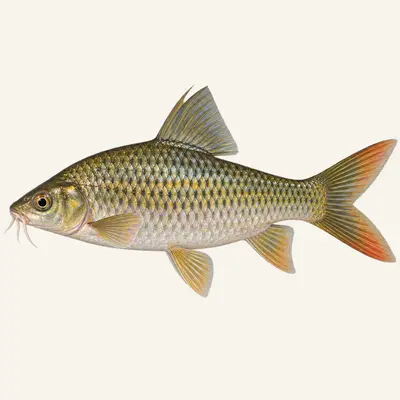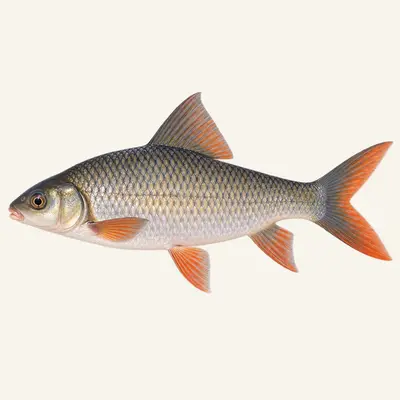
Mediterranean barbel
Barbus meridionalis · Cyprinidae
- Freshwater
- Carp & coarse
- Easy
- Size
20–30 cm
- Weight
0.1–0.3 kg
- Water temp.
5–25 °C
Where to fish
- River
Habitat icons: Flaticon
A small mountain barbel - Locally protected species - An indicator of good water quality
Calendar
Its range
Its range has shrunk three times without a single fish moving. The Spanish and south-French populations once filed under the name graellsii have become a species in their own right, and the Italian ones are now Barbus caninus. What remains is a range redefined by taxonomy rather than by ecology, and older distribution maps under this name are describing three different animals at once.
That remainder covers the Mediterranean rivers from the Besòs, near Barcelona, to the Var at Nice, and runs up the Rhône as far as Lyon. Coherent enough, except on one point: the fish also holds headwaters of the Garonne basin, in the Ariège, the Tarn and the Aveyron, which drain to the Atlantic.
The anomaly is partly natural. The species appears to be native in most of those headwaters, and introduced in at least some upper Tarn localities. The watershed has been crossed twice over — once by geological history, once by bucket — and the two crossings are not distinguishable on a map.
Identifying it
The ray that opens the dorsal fin is flexible and smooth: nothing stiffens it, and its trailing edge has no teeth on it whatever. That is the exact opposite of the common barbel, and since the two meet across southern France it is the check to make first, before the colour is even considered.
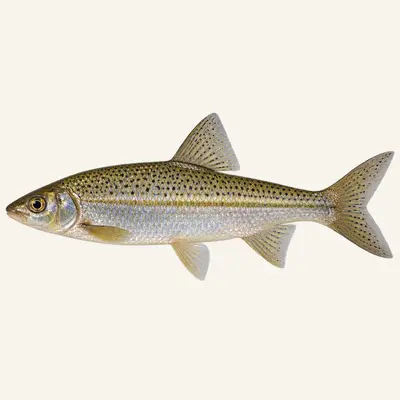
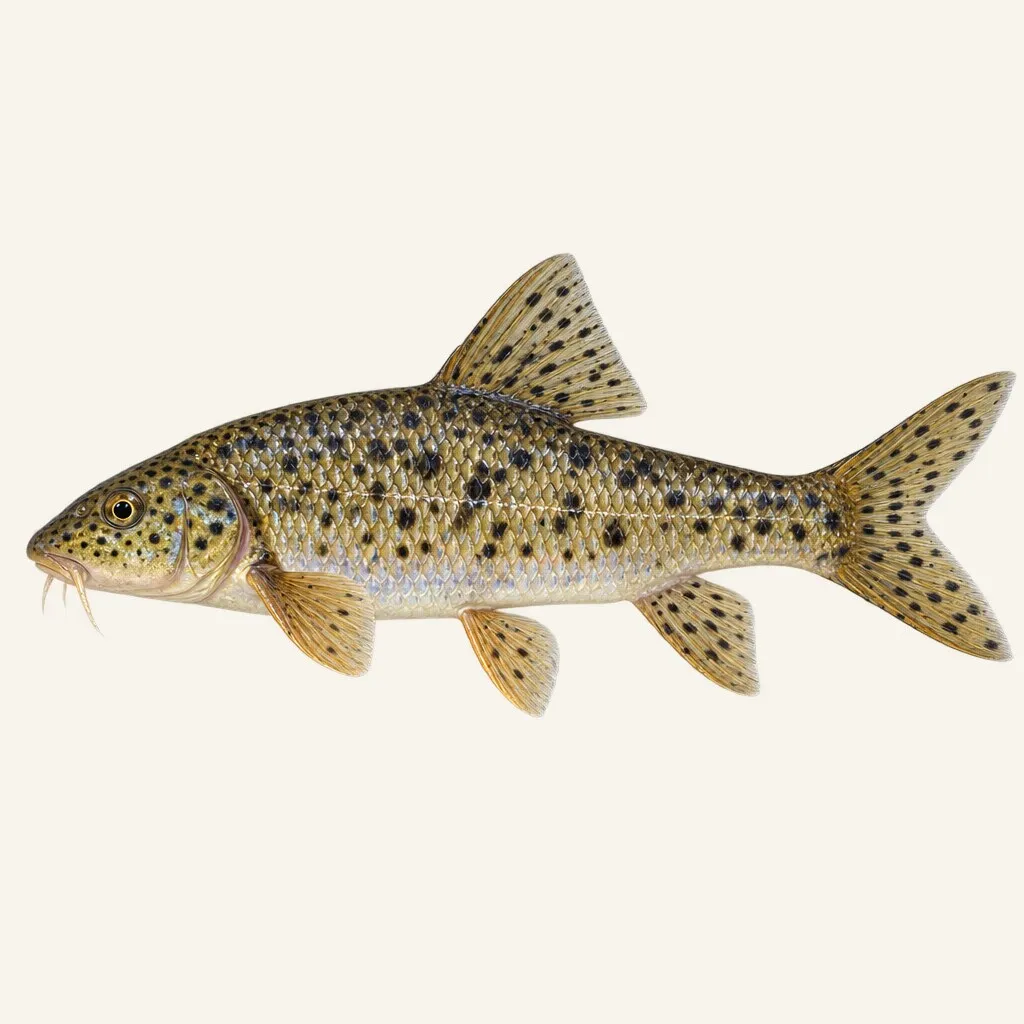
The markings come next, and they are heavy. Head, back, flanks and fins all carry large, irregular black blotches, poorly aligned, and they belong to the adult — growth does not fade them out. Among the other barbels of western Europe a spotted livery is a juvenile character, so a boldly marked fish of 20 cm in a Mediterranean stream is not a young common barbel.
Counts close the case: 44 to 48 scales down the flank plus two on the tail base, and 24 to 28 rows around the caudal peduncle. The lower lip is thick, with a swollen pad through the centre. The tail carries 16 to 19 rays, the dorsal seven to nine soft ones, the anal five or six, and the skeleton 34 or 35 vertebrae.
It is a small fish. Twenty centimetres is the ordinary measurement, and anything appreciably longer than that is a specimen rather than a routine catch. The tackle should be chosen on the ordinary fish, not on the exception.
The water it needs
It holds the upper and middle stretches, in fast, clear, well-oxygenated water over sand and gravel. Its thermal bracket runs from 5 to 25 °C, which puts it among the cool-water cyprinids without making it a fish of glacial torrents.
One detail of its altitudinal spread deserves more than a footnote: it comes down into the lowlands wherever the common barbel is absent. Its lower limit is therefore not thermal and not hydraulic, it is occupied. Where the large congener holds the bottom of the river, this one stays above it; where the large one is missing, it takes the whole length. Two rivers can hold the species at completely different altitudes for reasons that have nothing to do with either river.
Areas
- Mountain streams
- cool brooks
- stony areas
Techniques
- Pole fishing
- Ultra-light
Baits
- Worms
- Small baits
What it eats
Its feeding is almost entirely animal: small invertebrates off the bed, with plant material only exceptionally. A mouth 20 cm long dictates the size of the prey, and the gap between this fish and the metre-long barbels of the same genus is a gap of calibre, not of method.
That dependence on the invertebrate fauna of clean water makes its presence worth reading as a signal. The animals it eats disappear from a silted bed well before the fish itself does, so a population still present in a degrading stream is a lagging indicator rather than a reassuring one.
How to catch it
The problem on the bank in southern France is not catching one but knowing what has been caught. The species forms partly fertile hybrids with the common barbel where the two overlap. An intermediate fish — moderate spotting, a dorsal ray that is neither plainly toothed nor plainly smooth — is not a colour freak or a failed identification. It is the expected outcome in shared water, and it should be recorded as uncertain rather than assigned.
Tackle follows the size of the fish, not the reputation of the genus. Pole and light float gear, modest baits worked along the bed in the current. The water to read is riffle water: stony margins, quick seams, the cool brooks at the top of a catchment.
One handling point separates it from its big relative. Its dorsal does not cut, so the fish can be picked up without precautions — which does nothing to reduce the case for putting it back quickly. Fishing for it is regulated across part of its French range, and the rules for a given water come from the authority responsible for it.
Conservation · Near Threatened (IUCN) — This species is in decline. Release your catch quickly and handle it with care — wet hands, as little time out of the water as possible.
Conservation
Three pressures are named together: water abstraction, pollution and physical alteration of the channel. All three land on the same place — a short headwater brook, shallow, with no volume in reserve, where halving the discharge removes the riffles before it removes the fish.
Short life takes away the safety net. This species does not live long, so a lost year class is not absorbed by twenty years of standing adults the way it is in the big Iberian and Italian barbels; it shows up in the population two seasons later, in the catches and in the counts.
Hybridisation with the common barbel is the third mechanism and the quietest. Because the hybrids are partly fertile, genes move in both directions: this is not a reproductive dead end but a blending, and it erases what is locally distinctive without reducing the number of fish anyone counts. Where the large species has been stocked into a small Mediterranean river, both effects arrive together.
Regulations
Check the local regulations in force (legal size limits, closed seasons, bag limits).
For guidance only. Legal sizes, quotas and open seasons vary by location and season: always check the local regulations in force before fishing.
Other names
Mediterranean barbel is the English book name. It is accurate as far as it goes and it has essentially no currency among anglers, for the ordinary reason that no English-speaking country holds the fish. The Spanish barbo colirrojo — red-tailed barbel — is the only common name in the group that describes the animal instead of placing it on a map.
German says Semling and Italian barbo canino, and both of those are also used for Barbus caninus. That is a direct inheritance from the century when the Italian populations still carried this species' name: the two were separated in the journals, not in everyday speech, and the duplication has outlived the reason for it.
Sources: fishbase.se · api.gbif.org