Peloponnese barbel
Barbus peloponnesius · Cyprinidae
- Freshwater
- Carp & coarse
- Hard
- Size
19 cm
Where to fish
- River
Habitat icons: Flaticon
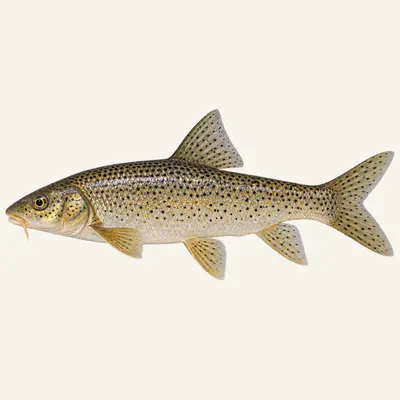
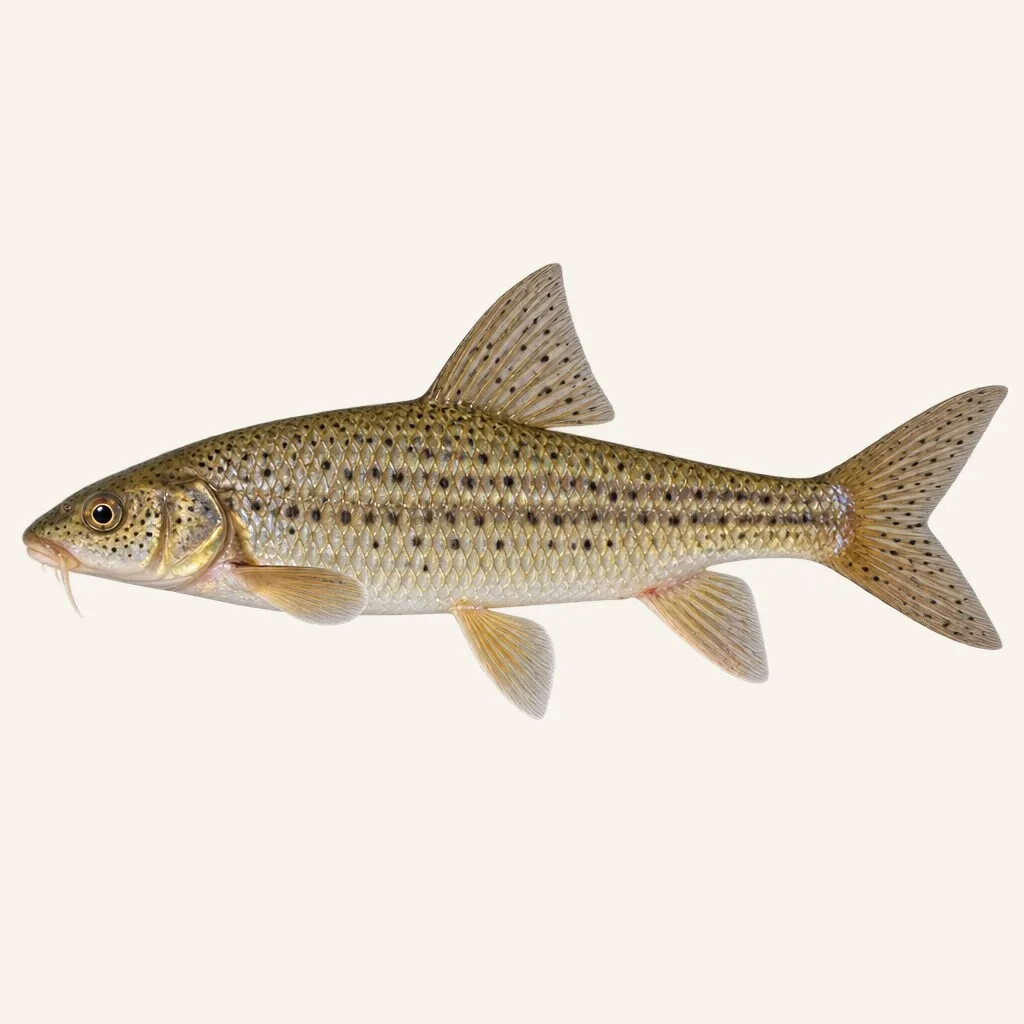
The Peloponnese barbel is a bottom-dwelling cyprinid endemic to the rivers of the Peloponnese peninsula in Greece, characterised by four barbels and an elongated body with golden, faintly spotted scales. It favours clear, well-oxygenated Mediterranean rivers with rocky or gravelly substrates.
Calendar
Recorded in 1 country
Greece
GBIF occurrence records — native and introduced populations combined.
Its range
The native range runs the length of western Greece, from the Kalamas to the Pamissos — Epirus to Messenia, in other words, and not the Peloponnese alone. The peninsula the name commemorates is the southern tip of it.
A second population lives at the other end of the Adriatic, in the Isonzo in north-eastern Italy, where the species was introduced and has established itself. That river already held a barbel of another species. The Greek endemic is now the resident foreigner there, and the two are working the same gravel.
Identifying it
Its dorsal fin has no armature of any kind. The simple ray that opens it is no stronger than the branched rays behind it and is smooth at the back: nothing projects, nothing stiffens the fin. In a genus where several members carry a working saw on that ray, the absence is itself a character.
The livery sets the opposite problem. Small black spots normally cover the head and body, often doubled by faint dark stripes or by lines of dots following the scale rows — but some populations in the Peloponnese itself are plain. The distinguishing mark fails precisely in the region the species is named after.
The counts hold everywhere. Forty-seven to 53 scales along the lateral line with two or three on the tail base, seven to nine soft rays in the dorsal, and above all only five to seven scale rows between the line and the base of the pelvic fins. That is the lowest figure among the Balkan barbels and it separates the species from its neighbours when the colour will not. The lower lip carries a swollen central pad. All of it sits on a fish of modest size, where the counts and not the outline do the work.
Breeding
The female digs, and the tool is on record: she opens pits in the bed with her anal fin and releases her eggs into them. She is a fractional spawner, laying in a series of separate batches rather than emptying in one session, which spreads a single female's output across several days and several pits.
Activity peaks in the evening, at sunset, with males and females beating the water together. That daily rhythm is the only one documented for the species, and it is worth knowing to anyone walking a Greek river in spring: the disturbance heard on a shallow cobble bar as the light goes is not a predator feeding.
The water it needs
It accepts two worlds that rarely go together. On one side lakes and low-lying plain waters with little or no current; on the other the lower and upper parts of streams with stone bottoms and real flow.
That amplitude is probably what keeps it common across so narrow a range. A fish tied to one habitat type disappears along with it; this one has two refuges, and a Greek summer does not dry both at the same time.
Areas
- Gravel shallows
- Grassy margins
- Moderate-current zones
Techniques
- Float fishing
- Light feeder
- Trotting
Baits
- Maggots
- Bloodworms
- Cereal paste
- Small nymphs
What it eats
Its feeding is restricted to aquatic invertebrates, with no plant fraction on record. Bloodworm, maggots and small nymph patterns therefore cover most of what a mouth that size will take off the bottom, and a cereal paste does the remainder on size alone rather than by resembling anything it eats.
How to catch it
Evening is the most legible hour in its calendar. It is the one moment when the species announces itself, and a spot located at dusk in spring stays good for the rest of the year, which is a rare piece of free information on a small cyprinid.
A light running line, a light feeder and a fixed line in the current between them cover both of the habitats it uses: a float worked down the gravel runs, a static bait laid in the slow water and along weeded margins. Nothing about it calls for power in the tackle.
A commercial fishery exists on this species in Greece. A cyprinid this slight being taken commercially says less about the fish than about the scale of Mediterranean inland fisheries, where the tonnage is made up out of small pieces and every species present is used.
Conservation
Water abstraction is the only documented pressure, and it strikes at just one half of the fish's life. The current stations over stone go first when a river is tapped: the discharge drops, the stones silt in, the seam stops being a seam, and the invertebrates go with it.
The lake and plain populations do not compensate for that, because they are other waters and not other seasons. A species with two habitats loses the first without the second growing to replace it, and what looks like a stable total conceals the disappearance of half the range of conditions the fish can use.
Regulations
Check the local regulations in force (legal size limits, closed seasons, bag limits).
For guidance only. Legal sizes, quotas and open seasons vary by location and season: always check the local regulations in force before fishing.
Other names
The scientific name points at the Peloponnese, and the vernacular names in every language have copied it: Peloponnese barbel in English, barbo del Peloponeso, Peloponnes-Barbe. One peninsula named for a range that covers the whole of western Greece.
The error is an ordinary one in nomenclature — a name freezes the locality of the first specimen described, not the distribution found afterwards. It is worth flagging here because it misleads in the most inconvenient direction: it sends anyone looking for the fish too far south.
Sources: fishbase.se · api.gbif.org