Putitor mahseer
Tor putitora · Cyprinidae
- Freshwater
- Carp & coarse
- Medium
- Size
183–275 cm
- Weight
57–54 kg
- Water temp.
13–30 °C
Where to fish
- River
Habitat icons: Flaticon
Golden mahseer - coarse fish, Asia (Himalayas)
Calendar
Recorded in 7 countries
Bangladesh · Bhutan · India · Myanmar (Burma) · Nepal · Pakistan · Tanzania
GBIF occurrence records — native and introduced populations combined.
Identifying it
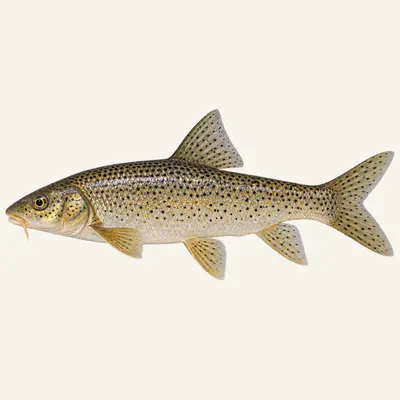
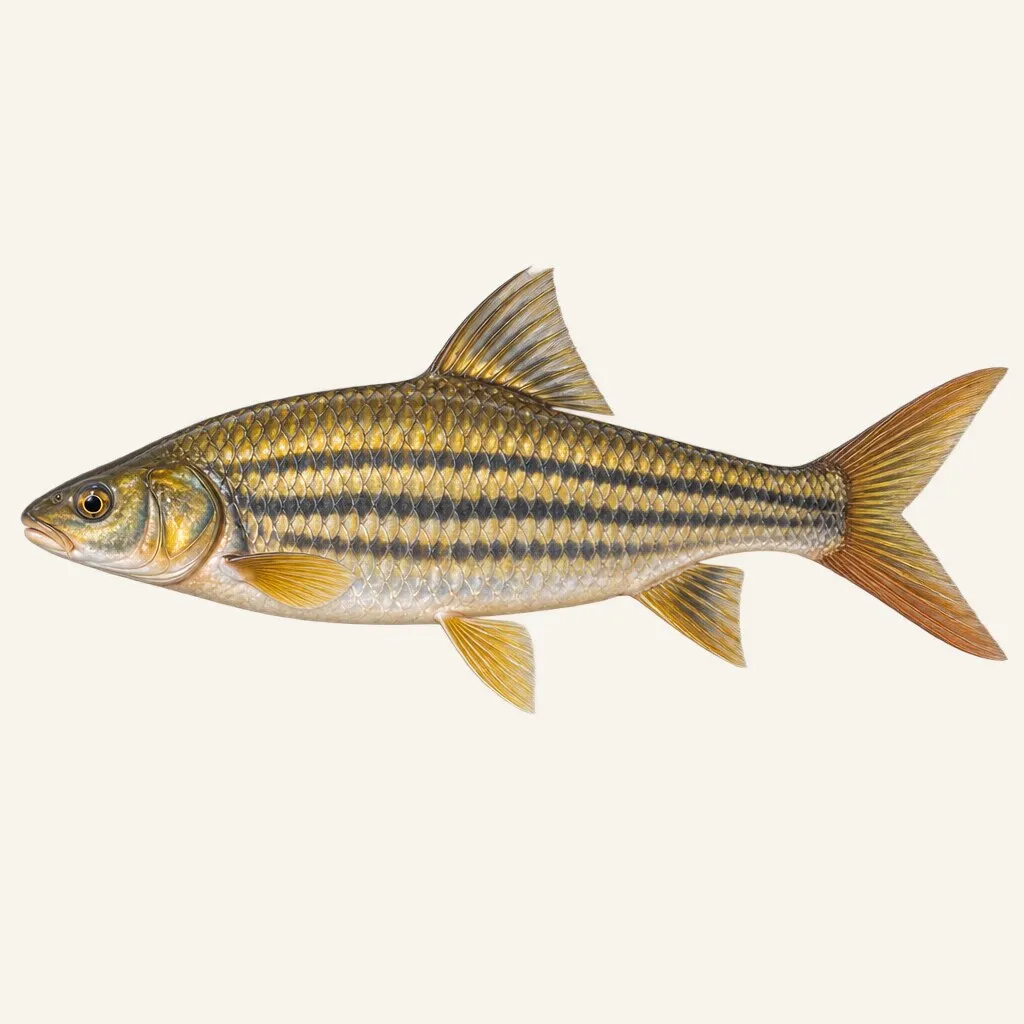
Four hardened rays lead the dorsal fin and eight soft ones follow; the anal carries two and five. No cyprinid has true spines — what a key calls a spine here is a soft ray that has ossified until it does the same job, and in this genus the leading ray is the stiffest thing on the fish.
The body is fusiform and laterally compressed. Both traits belong to the same design problem. The spindle keeps drag low in a current running head-on, and the flattened flank gives the purchase needed to hold an angle across a flow that is pushing sideways.
Breeding
The spawning window is defined by the shape of the hydrograph, not by a month.
Adults move up from the lower reaches into the middle ones, climb the streams, and lay over gravel and stones. Spawning takes place during the low phase of the flood — not the monsoon peak and not the dry-season minimum, but the trough between two rises. After spawning the adults drop back to permanent water, and the fry stay among the stones along the margins.
A regulated river has no such trough. Levelling a flow does not kill an adult or block a channel; it erases the signal the fish reads, and the population goes on living in a river it no longer recognises as ready. That is the quietest way an engineering work sterilises a stock, and it leaves nothing to count.
Maturity begins around 33 centimetres. Hold on to that number for the next section.
The water it needs
The usual depth on record for this fish is nought to one metre.
That single line is the most surprising entry in its file and the one that changes how a river is read. A large Himalayan cyprinid with a reputation built on heavy tackle spends its ordinary life in the top metre of fast rocky water, not down in the pools. A lead pinned to the bed in three metres is fishing under it.
Three water types appear in the record and the species needs all three at different points of the year: rapid streams with a rocky bottom, riverine pools, and lakes or perennial ponds that hold water through the dry season. A reach offering only one of the three does not keep the fish; it borrows it.
The rest of the envelope is broad and explains the altitude range. The pH band is 7.4 to 8.0, faintly alkaline, and the thermal range runs from 13 to 30 degrees — wide enough for one species to occupy a whole Himalayan flank from the foothills to well up the valleys.
Areas
- Pools below rapids
- Torrent confluences
- Rocky fast-flowing flats
- Mountain river bends
Techniques
- Bottom fishing with dough balls
- Wet fly fishing
- Drift fishing
- River feeder fishing
Baits
- Barley flour dough balls
- Maggots
- Freshwater crustaceans
- Fallen fruits
- Corn paste
What it eats
Omnivorous in the strict sense, and the composition of the diet turns over twice before adulthood.
The youngest fish live on plankton. Fingerlings feed mainly on algae. Adults take fish, zooplankton, dipteran larvae and plant matter — an animal that has kept the vegetable half of its juvenile diet while adding prey to it.
The consequence at the water's edge is that two entirely different approaches are both correct. Barley-flour dough balls, corn paste and fallen fruit address the plant fraction; maggots, freshwater crustaceans and anything resembling a small fish address the rest. Neither substitutes for the other, and a river that refuses one has not necessarily refused the other.
How to catch it
One line in the record describes the state of the fishery, and it should be read carefully: specimens above 30 centimetres and 5 kilograms are said to be rarely caught in recent times. The two figures in that sentence do not describe a single fish — a 30-centimetre barb is nowhere near five kilos — so what the sentence reports is scarcity at the large end, not a threshold.
Take the length on its own and set it against the maturity figure. Fish above 30 centimetres have become uncommon; first spawning begins at 33. A fishery meeting mostly fish below that mark is removing a population before it breeds, and the species being described in the same paragraph as the commonest mahseer of the Himalaya does not soften that. Common counts individuals. It says nothing about how many of them are adults.
Search the top metre. Rocky flats where the current runs fast and shallow, the tails of rapids, the throat where a tributary torrent meets the main river — with presentations that stay in the upper layer rather than anchoring below it. Wet fly and drifted baits belong in that water; a heavy feeder rig belongs in the pools, which is a different part of the year.
The calendar moves everything. During the spawning migration the fish are concentrated in the middle reaches and easy to find, which is exactly when they are worth leaving alone. Outside it they are scattered through pools and permanent ponds and much harder to predict.
Conservation · Endangered (IUCN) — This species is threatened with extinction. Always release it (no-kill), handle it with the utmost care and check local rules — fishing for it may be prohibited.
Conservation
Over-harvesting and habitat loss are the two pressures named, and they act at different points in the cycle.
The first removes the large breeders and shows up in the catch. The second removes the conditions for spawning and shows up nowhere: the fish are still present, still the right species, still the commonest mahseer on the slope.
Because the animal has to run up in one season and drop back in another, its requirement is a river that remains passable in both directions over tens of kilometres. A weir, an intake, a reach dewatered by a diversion — any of them cuts the route, and the loss appears one generation later, when the year class that should have grown into adults is not there.
Which is why the size distribution of a catch tells more here than the size of it. A stretch giving plenty of small fish and no large ones is already in trouble, however good the day's numbers look.
Regulations
Check the local regulations in force (legal size limits, closed seasons, bag limits).
For guidance only. Legal sizes, quotas and open seasons vary by location and season: always check the local regulations in force before fishing.
Other names
Two etymologies circulate for mahseer and neither has displaced the other. Mahi-sher, tiger-fish in Persian and Urdu, is the more widely repeated. Maha-sir, great head in Sanskrit, is the more descriptive of the animal. Both are old, and the literature uses them interchangeably without settling anything.
Tor and putitora are both South Asian vernaculars taken into the nomenclature untranslated, which is why the binomial reads like a name rather than a description.
The confusion an English reader has to guard against is in the other columns. This catalogue writes Putitor mahseer here and Tor barb for Tor tor, which keeps the two apart. Spanish and Portuguese do not: both give golden mahseer to this species and the identical name to its congener, so a record in either language cannot be resolved to a species at all. German and Italian avoid the collision the same way English does, by carrying the epithet into the common name. Where the vernacular is ambiguous, the binomial is the only thing that settles which mahseer is being reported.
Sources: fishbase.se · api.gbif.org