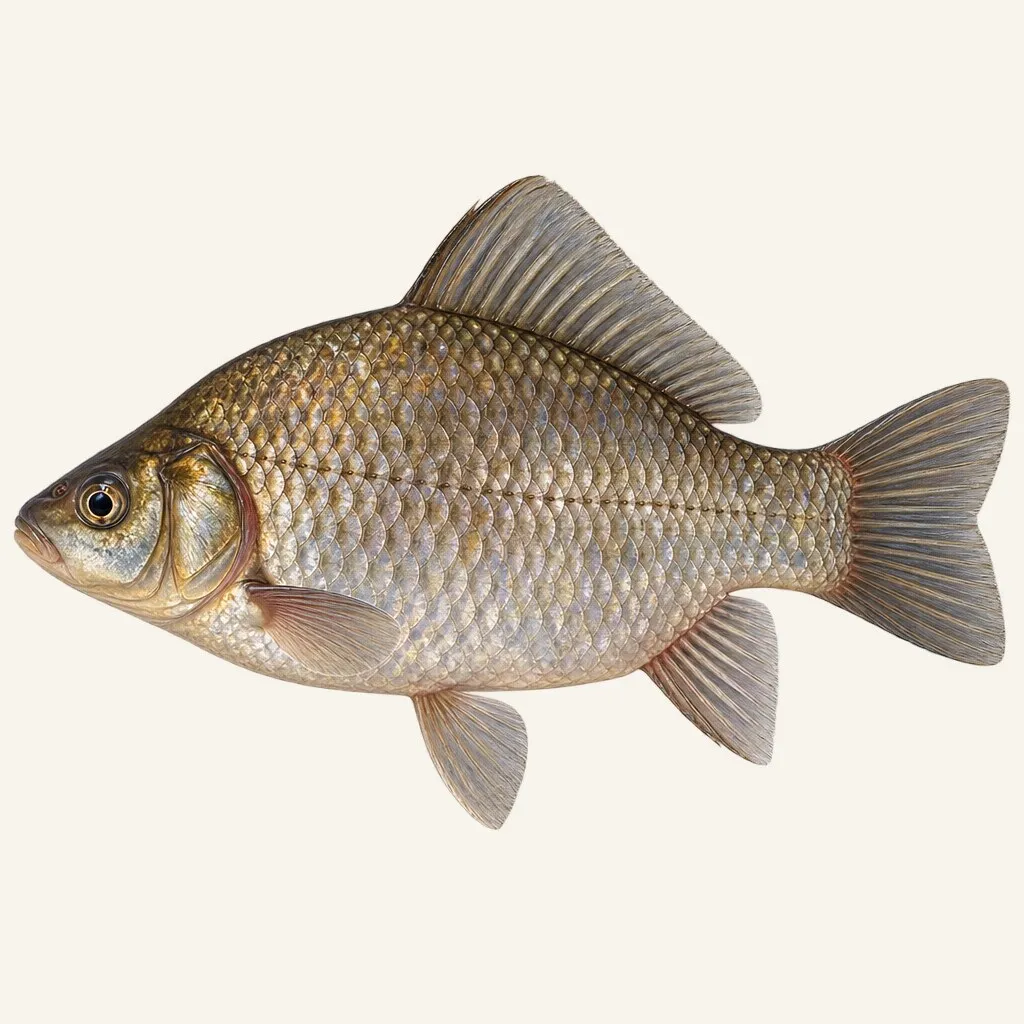
Prussian carp
Carassius gibelio · Cyprinidae
- Freshwater
- Carp & coarse
- Medium
- Size
20–47 cm
- Weight
0.1–4.8 kg
- Lifespan
10 years
- Water temp.
10–20 °C
Where to fish
- Canal
- Lake
- Pond
Habitat icons: Flaticon
Close relative of the crucian carp - Can reproduce by gynogenesis (without a male)
Calendar
Recorded in 39 countries
Armenia · Austria · Belarus · Belgium · Bosnia & Herzegovina · Bulgaria · Canada · China · Croatia · Czechia · Estonia · Finland · France · Georgia · Germany · Greece · Hungary · Italy · Japan · Kazakhstan · Latvia · Lithuania · Luxembourg · Moldova · Montenegro · Netherlands · North Macedonia · Poland · Portugal · Romania · Russia · Serbia · Slovakia · Slovenia · Sweden · Switzerland · Türkiye · Ukraine · Uzbekistan
GBIF occurrence records — native and introduced populations combined.
Its range
Nobody knows where it comes from. Authors treat it either as native from central Europe to Siberia or as an import from East Asia, and the documentation does not settle it. Three causes compound: old and repeated introductions, a long-standing confusion with the goldfish under whose name it was filed for decades, and a reproductive system that produces lineages hard to trace to a source.
The present state, by contrast, is clear. The fish now occupies most of the continent, carried by a very efficient vehicle: it travels with the common carp in stocking consignments, and carp go everywhere. Still missing are the northern Baltic basin, Iceland, Ireland, Scotland and the Mediterranean islands.
So the map is a record of the present, not of an origin. What it registers is a century of moving pond fish about.
Identifying it
Look at the gill arch first, because the count is decisive and it also explains the animal. There are 37 to 52 rakers on it — against no more than the low thirties in the crucian carp, so a sieve nearly twice as dense, and a much finer grade of particle retained.
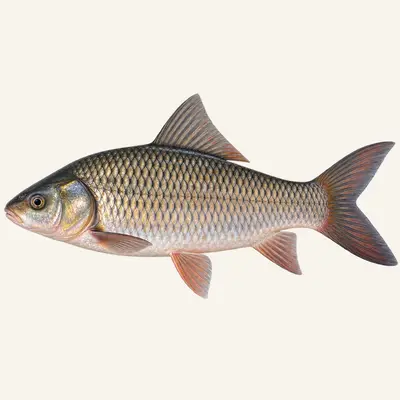
On a live fish, three things. The dorsal's outer margin is straight or slightly hollowed, not rounded. The last simple ray of the dorsal and of the anal is strongly serrated, rough enough to feel aggressive under a fingertip. And the ground colour is silvery-brown, not gold with a green sheen.
Cut the fish open and the question closes: the peritoneum is black. The lining of the body cavity is the single fastest character in the genus and it does not vary. Lateral line 29 to 33 scales, anal fin five and a half branched rays.
Breeding
The females breed without males of their own species. They shed their eggs in among other cyprinids — common carp, roach, bream, crucian carp — and the milt of those fish triggers development without the donor's genes entering the offspring at all. The young take after the mother and no one else. The process is gynogenesis, and the authors who describe it call it sperm parasitism.
European populations are generally triploid and consist of females only. Some depart from that pattern and contain up to a quarter males, diploid, capable of fertilising normally, so the reproductive mode is not fixed from one water to the next.
The rest of the spawning behaviour is unremarkable for the family: warm shallow shores, sticky eggs fastened to submerged plants or to sunken objects, males on the site before the females arrive, a good deal of surface commotion. Older fish spawn earlier in the season than younger ones. First maturity comes at around 10 cm.
Everything about the way this fish spreads follows from that mechanism. One live female founds a population, provided some cyprinid or other spawns in the same place at the same time — a condition met in very nearly every still water in Europe. Where an ordinary species needs a pair and a measure of luck, this one needs only itself and the neighbours.
The water it needs
Any still lowland water suits it, along with slow rivers, as long as there is submerged vegetation or regular flooding. Feeding larvae and juveniles want structurally complex habitat, reed belts above all.
Tolerance of low oxygen and of pollution is high, but it is exercised differently from the crucian carp's. Lake-dwelling individuals leave the deoxygenated water in winter and move up into river mouths: they relocate instead of absorbing the conditions. That difference in tactics says a good deal about how the two species divide the available water — one endures to the end, the other leaves and comes back.
Areas
- Eutrophic waters
- ponds
- canals
Techniques
- Float
- Feeder
Baits
- Worms
- Bread
- Corn
What it eats
Plankton, benthic invertebrates, plant material and detritus, with no marked hierarchy among them. A gill sieve of that density holds finer particles than a grubbing cyprinid can manage, which adds the plankton of a productive water to the resources of the bed.
How to catch it
This is the crucian that most anglers catch while believing they have caught the other one. It reaches a greater weight than the crucian carp does, and it is abundant in ponds, gravel pits and canals, where it comes to bottom baits meant for other cyprinids. Common length is about 20 cm and the maximum reported age about ten years.
Early maturity around 10 cm produces populations composed largely of small adults. A water that gives fifteen fish of the same length in a session is showing how the species works, not a fault in the baiting.
The point that really matters at the bankside is not the tackle, it is the bucket. Every female of this species is a potential founder: moving one alive from one water to another amounts to introducing an entire population, with no partner required. Livebaits, keepnets and returning fish anywhere other than the place of capture all have to be read in that light. Transporting live fish is regulated, and it is a question to settle before setting out rather than on the way home.
Conservation
The subject here is not what threatens this fish but what it displaces. The crucian carp is being squeezed out of the Danube drainage and central Europe, and competition from this species is the explanation most often advanced. The division goes by habitat: the older resident keeps the advantage only in extreme water, and this one takes everything else.
A practical consequence follows for management. A species whose females do without males cannot be controlled by the usual levers, since a single survivor can rebuild the whole population. Removing fish does not push back a lineage that clones itself, and the decisive stage is upstream of the water, in what gets put into it.
Its density also depends on the density of the species whose milt it borrows. It therefore profits from exactly the assemblages that stocking installs — carp and the cyprinids that accompany them — which makes its expansion a by-product of fishery management practice rather than any conquest of its own.
Regulations
Check the local regulations in force (legal size limits, closed seasons, bag limits).
For guidance only. Legal sizes, quotas and open seasons vary by location and season: always check the local regulations in force before fishing.
Other names
Prussian carp and gibel carp in English, both formed on the German Giebel, which is also the source of the scientific epithet. The two names are used interchangeably and neither is well established, which is part of the problem.
For most of its documented history it was treated as the wild eastern European form of the goldfish and published under that species' name. That makes a substantial part of the older literature unusable the moment the question is which of the two fish an author actually had in front of him. Anything written about goldfish in eastern European rivers before the separation should be assumed to be about this animal instead.
Sources: fishbase.se · api.gbif.org · fishbase.se