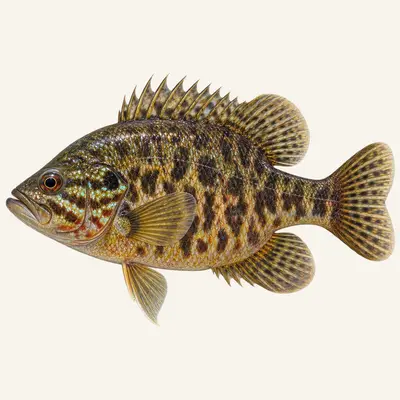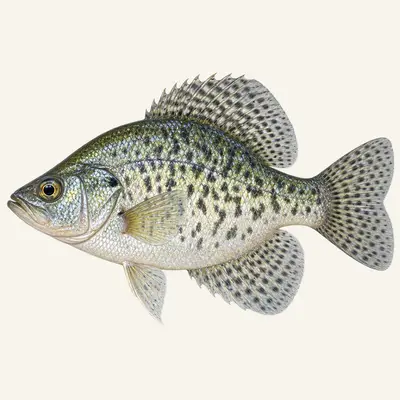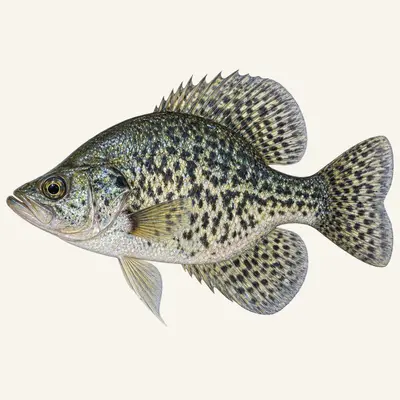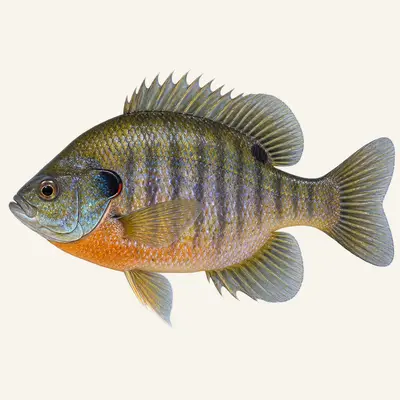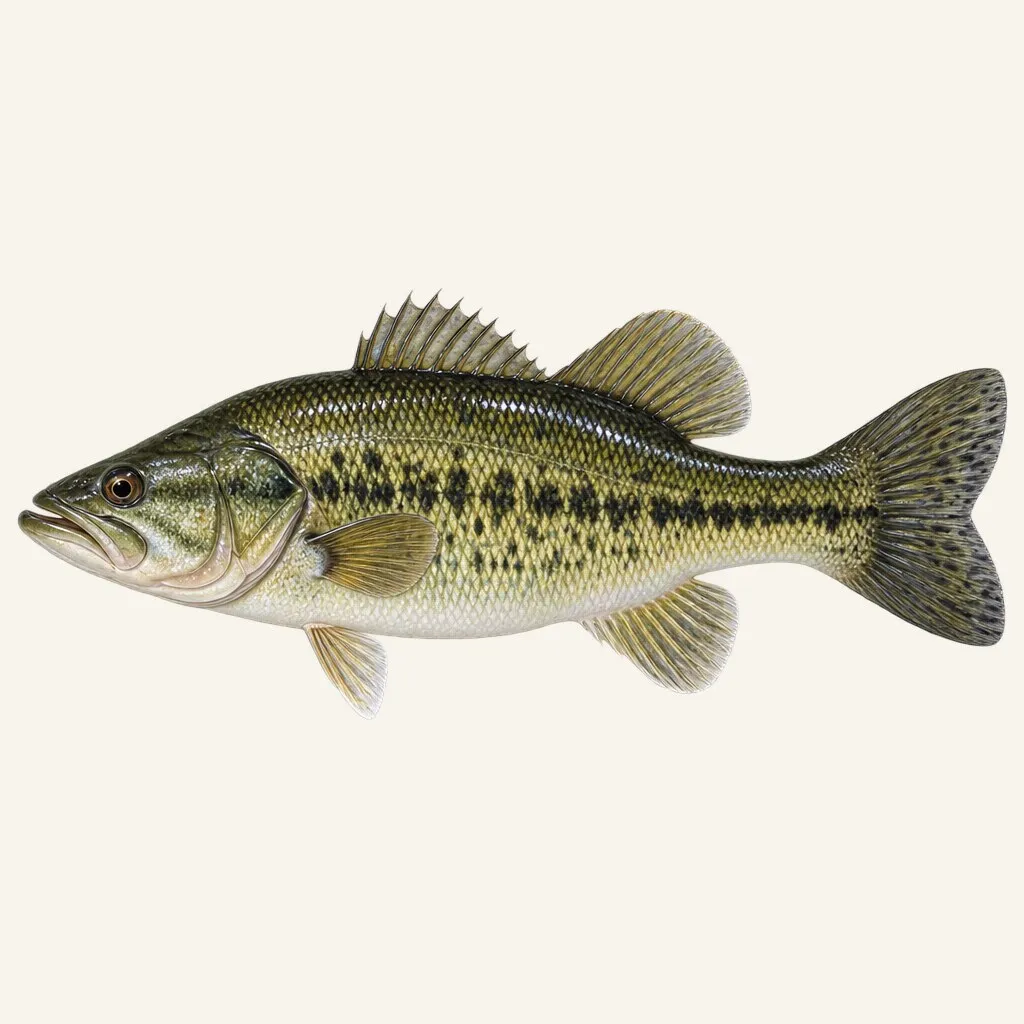
Suwannee bass
Micropterus notius · Centrarchidae
- Freshwater
- Predators
- Hard
- Size
21–40 cm
- Weight
0.1–1.8 kg
Where to fish
- River
Habitat icons: Flaticon
Rocky riffles, runs and pools, and large springs and spring runs
Calendar
Recorded in 1 country
GBIF occurrence records — native and introduced populations combined.
Its range
Two river systems hold the entire species: the Suwannee, in Florida, and the Ochlockonee, which is shared between Florida and Georgia. Nothing else, anywhere.
What those two have in common accounts for the rest of the page. Both drain karst — limestone riddled with cavities, through which water travels underground before surfacing again as springs. The distribution does not follow a region, a latitude or a climate. It follows a rock type, and it stops where the rock does.
The water it needs
Rocky riffles, runs and pools, together with large springs and the runs that flow out of them.
The last item is the one that defines the animal. Florida's big springs discharge clear water at a temperature that barely moves through the year, an unusual and highly localised phenomenon, and this bass is tied to it. That makes it a spring fish rather than a river fish in the ordinary sense, which is also why the range is so small: there are only so many places where such water reaches the surface.
The dependency runs both ways. Spring discharge comes out of an aquifer, and an aquifer responds to what is taken from it.
Areas
- Gravel-bottom river currents
- Tannin-stained water areas
- Submerged stumps and roots
- Stream confluences
Techniques
- Topwater surface lures
- Soft plastics (finesse)
- Small spinners
- Light jig
Baits
- Natural-colored soft lures
- Small spoons
- Crayfish
- Worms
How to catch it
Cool clear flow over stone identifies the water. In a state where the largemouth owns the warm, still, weeded lakes and the entire fishing culture that goes with them, this fish is found by looking for the opposite conditions: current, transparency and hard bottom in a spring run.
The scale is modest — 21.3 cm as a common length. Judged against the reservoir bass of the same state it looks like a small fish, which is a failure of the comparison rather than of the animal.
Water that clear and that constant makes the fish visible and correspondingly wary, so this is close-range, sighted fishing. Position matters more than distance, and a wading angler who has been seen has already finished with that pool.
Conservation · Near Threatened (IUCN) — This species is in decline. Release your catch quickly and handle it with care — wet hands, as little time out of the water as possible.
Conservation
Two basins, and an attachment to springs whose flow depends on a heavily used aquifer: the exposures compound rather than add. Reduced discharge does not shrink the habitat by degrees, it takes it away, because the constant temperature and clarity that the fish is tied to are properties of the spring rather than of the stream.
Surface pressures act on the same water from the other side. Nutrients reaching the aquifer come back out at the spring, and a spring run that changes character does so along its whole length at once.
Hybridisation with bass stocked into the same drainages adds to it, and here as elsewhere in the genus there is no population held in reserve somewhere else to make up for a diluted one.
Regulations
Check the local regulations in force (legal size limits, closed seasons, bag limits).
For guidance only. Legal sizes, quotas and open seasons vary by location and season: always check the local regulations in force before fishing.
Other names
Suwannee bass, after the river that holds most of the population — the same naming habit that produced the Guadalupe bass in Texas and several others across the Southeast, each carrying the name of its own drainage.
That habit has a practical cost. Two fish called bass in adjacent states can belong to different species, and the common name carries no information about which. Anyone reading a regulation, a survey or a management plan written elsewhere has only the scientific name to work from.
The species epithet means southern, which for a genus centred on the American Southeast is about as specific as a label can fail to be.
Sources: fishbase.se · api.gbif.org