White crappie
Pomoxis annularis · Centrarchidae
- Freshwater
- Predators
- Medium
- Size
25–53 cm
- Weight
0.2–2.4 kg
- Lifespan
10 years
Where to fish
- Estuary
- Lake
- River
Habitat icons: Flaticon
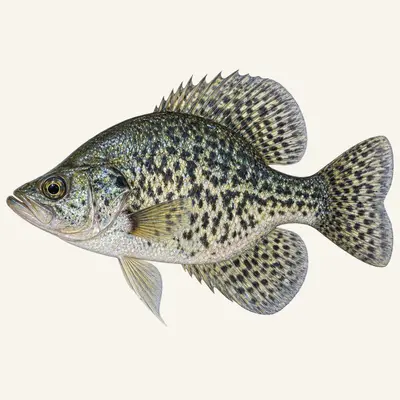
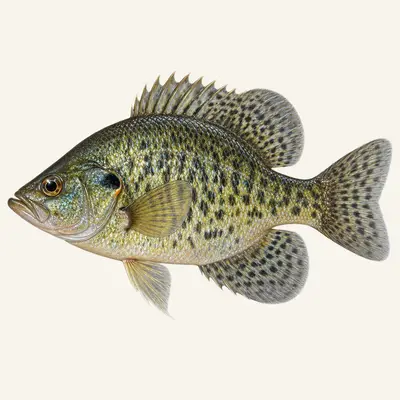
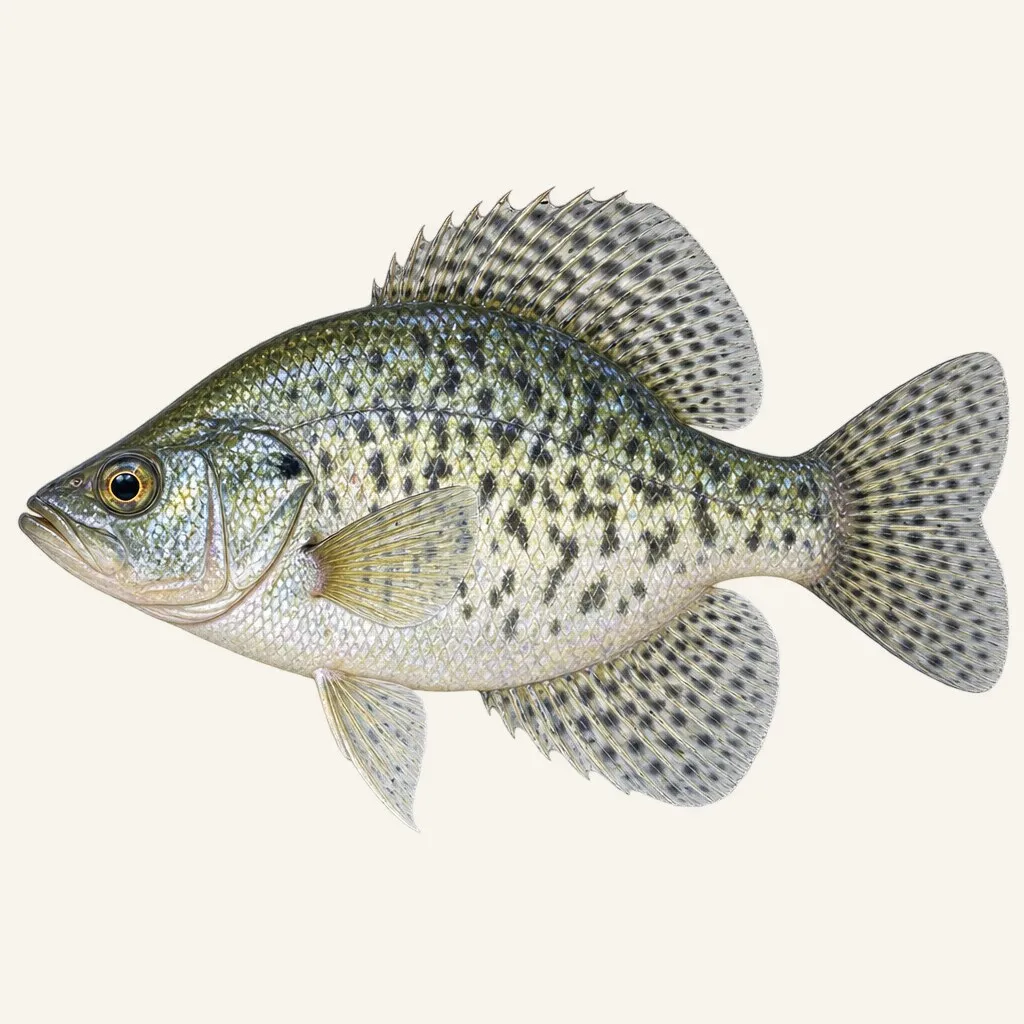
The white crappie is a centrarchid with a silvery body marked by more or less distinct vertical dark bars, less speckled than the black crappie, with an oblique upward-tilted mouth adapted for open-water hunting.
Calendar
Recorded in 3 countries
GBIF occurrence records — native and introduced populations combined.
Its range
The range is drawn with a precision the black crappie's has lost, down to named rivers at either end: the Nueces in Texas on one side, Mobile Bay in Georgia and Alabama on the other.
Its weight is continental. Great Lakes, Hudson Bay and Mississippi basins, from New York and Ontario west to Minnesota and South Dakota, then south to the Gulf, with the Gulf coastal drainages as an extension rather than a second centre. That is the outline of a large-river-basin animal, not a coastal one.
The clarity has a documentary cause. No wholesale programme of introduction is recorded for this species, so what is mapped is largely what was found — and that is exactly what separates the two crappies on paper.
Identifying it
The mouth is the character to look at, and it is tilted. The description carried on this page reads that upward slant as an adaptation to hunting in open water, and the adult diet on record agrees with it: a fish built to take prey above itself is working against the light, not against the bottom.
The flank carries vertical dark bars over silver, more or less distinct according to the individual. Bars rather than scattered speckling is the difference from the black crappie that a photograph will show; on a fish in the hand it is the dorsal spines that get counted, five or six here.
Past that the file is thin. No morphometric table is published in the summary behind this page, and the honest complement to a spine count is the water the fish came out of.
Breeding
Eggs go into aquatic plants, of various kinds. That is the entire published account of reproduction for the species: no incubation time, no nest, no guard, no fecundity.
Set beside its congener, which sweeps a bare patch on the bed before spawning, the difference is not a nuance. One of the two needs clean substrate and the other needs standing vegetation, and a single reservoir can supply one without the other.
There is a season to that. In a water body whose level is worked, a spring drawdown strands the marginal plants first, and the two species do not pay the same price for it.
The water it needs
Turbidity is the distinguishing preference. This species is often found in turbid water where its relative is most common in clear, so two very close fishes divide a continent between them on transparency.
The waters themselves are pools and backwaters over sand or mud, in creeks and in rivers up to large ones, plus lakes and ponds. Weak current and a soft bed are the constants.
Tolerating suspended sediment opens up the whole class of water bodies that submerged plants have largely left: loaded reservoirs, lowland rivers, everything downstream of worked ground. Which raises a question the record does not answer, since the eggs go into plants.
Areas
- Open water above deep holes
- Partially submerged structures
- Tributary mouths
- Sheltered coves and inlets
Techniques
- Suspended soft lure fishing
- Live bait fishing
- Vertical fishing
- Fly fishing
Baits
- Small luminous soft lures
- Small live fish
- Earthworms
- Light jigs
What it eats
The adult eats forage fish, and the source names shad. That is a pelagic diet rather than a benthic one — shad do not live on the bottom, and following them means leaving the margin behind.
Young fish live on small invertebrates, microcrustaceans and small insects, which keeps them wherever the zooplankton is.
The switch relocates the animal. A juvenile sits where production is; an adult travels with a shoal whose position changes daily. Two fish of one species in one lake can require two entirely different searches.
How to catch it
Find the shad and the crappie is found. That is the most direct consequence of the adult diet: the fish is tied to a moving resource rather than to a fixed lie, and a bait shoal marked on a sounder outranks a weed bed known for ten years.
Turbidity then decides the presentation. Where a silhouette carries only a few centimetres, the fish has to be drawn in by something other than sight — vibration, hard contrast, scent — and the search is run at the depth the forage is holding rather than along the margin.
Pools and backwaters over a soft bed are the setting, and weak current allows light terminal tackle. Twenty-five centimetres as an ordinary fish and 10 years as the ceiling on age set the scale of everything else.
The record files the species under subsistence fisheries, which says what it is in practice: a fish taken to be eaten, in quantity.
Conservation
A fish that spawns in plants and lives in turbid water carries a structural tension. Suspended sediment limits light, light limits submerged vegetation, and submerged vegetation is what receives the eggs.
Nothing in the published record follows that through, so it is set down here as a mechanism and not as a finding. It bears hardest on managed reservoirs, where the plants that would take a clutch are the same marginal band a spring drawdown puts on dry ground.
Otherwise the species is under no recorded pressure. Its range is large and continental, and no contraction is reported anywhere in it.
Regulations
Check the local regulations in force (legal size limits, closed seasons, bag limits).
For guidance only. Legal sizes, quotas and open seasons vary by location and season: always check the local regulations in force before fishing.
Other names
White crappie in English, where the adjective describes nothing useful. Annularis does better: it points at the vertical bars, read as rings running round the body.
In Louisiana the fish is sac-à-lait, a French name that survived in English-speaking use for a species France has never held. Quebec French says marigane blanche. Papermouth, and crappie itself, apply to both members of the genus, so anything that has to be exact — a survey, a rule, a record claim — uses the binomial instead.
Sources: fishbase.se · api.gbif.org