Bluegill
Lepomis macrochirus · Centrarchidae
- Freshwater
- Predators
- Medium
- Size
19–41 cm
- Weight
0.1–2.2 kg
- Lifespan
10 years
- Water temp.
1–36 °C
Where to fish
- Canal
- Lake
- Pond
- River
Habitat icons: Flaticon
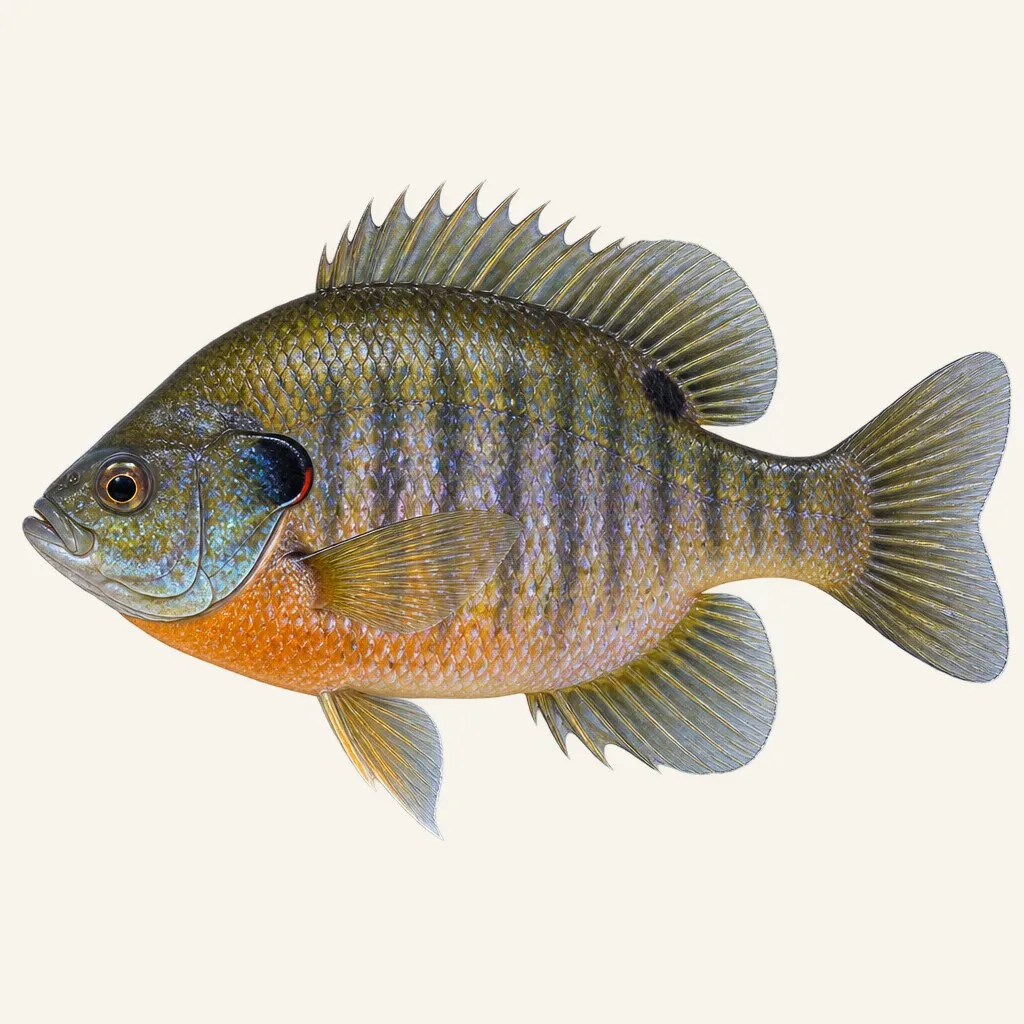
The bluegill is a small centrarchid with a highly laterally compressed body, iridescent blue-green flanks, and a distinctive black spot on the operculum; its small mouth and vertical bars make it easy to identify.
Calendar
Recorded in 6 countries
Canada · Japan · Mexico · South Africa · South Korea · United States
GBIF occurrence records — native and introduced populations combined.
Its range
The native range is the St Lawrence and Great Lakes system together with the whole Mississippi drainage, running from Quebec to northern Mexico — most of the eastern half of the continent, and for a great many anglers the first fish of their lives.
Beyond that, it has been moved about as widely as any freshwater fish on earth. It reached Hawaii, where it lives mainly in reservoirs, and several of the places it was taken to report harm to the fauna that was already present.
The reason the transfers worked so consistently is a single figure. The species holds from one degree to 36, a thermal span that almost nothing else in fresh water matches. Very few temperate or subtropical waters are closed to it, and a fish that survives both an ice-covered pond and a shallow southern reservoir in August will survive most of what a stocking programme can put it in.
Identifying it
Two dark marks settle it. The extension of the gill cover — the opercular flap, the "ear" — is deep blue to black and plain, with none of the pale or coloured edging several of its relatives carry there. And at the back of the dorsal fin, low down at its base near the tail, sits a distinct dark blotch.
Both marks are visible on a fish in the hand at arm's length, which matters in a genus where half the identifications turn on features that need a lens.
The ground colour is olive-green over the back, with a blue or purplish sheen down the flanks and sometimes a set of faint vertical bars that come and go with mood and water. Spawning males put on far more blue and orange than that description suggests, which is why a bed fish in June and a winter fish from the same lake can look like two species.
The body is the short, deep, laterally compressed disc of the genus.
Breeding
A week is what the record gives: the male holds over the eggs for roughly seven days, and the published account of this species stops there.
What that week amounts to is worth spelling out, because the bluegill is the fish most often found on a visible nest in early summer. The male does the whole job alone — fanning silt off the eggs, driving off anything that comes over them — and a nest without him on it does not last. Everything in a warm pond eats eggs, the pumpkinseeds working the same shallows included. A bed cleared of its guardian is not a nest with a setback, it is a nest that is finished.
The water it needs
Lakes, ponds, reservoirs and sluggish streams, and within them a clear preference: the deep weed bed. Not the inside strip of shallow stems but the outer part of it, where the growth thins and the bottom starts to fall away.
That preference is what lets two sunfish share one pond without competing for the same food. The pumpkinseed takes the shallow inside edge; the bluegill works the outside of the same weed, in water two or three times deeper. Two fish, one weed bed, divided vertically.
Feeding concentrates at dusk and at dawn. In the middle of a bright day the shoals sit down in the weed and the bites stop, and the answer is a change of hour rather than a change of bait.
Areas
- Vegetated margins
- Submerged wood areas
- Small ponds and still waters
- Sheltered lake coves
Techniques
- Ultra-light spinning
- Dry fly or light nymph
- Float fishing with worm
- Small surface lures
Baits
- Earthworms
- Insect larvae
- Crickets
- Small artificial flies
What it eats
Snails, small crayfish, insects, worms and small minnows for the adults; crustaceans, insects and worms for the young.
The first two items are the interesting ones. A mouth that small cannot bite through a snail shell or a crayfish, and the crushing is not done at the front of the head at all — it happens further back, on hard pads in the throat, which is standard equipment in this family and rare in a fish of this size.
That opens a food supply the small-mouthed insect feeders around it cannot touch. Where a pond runs short of insect life in high summer, the snail beds are still there, and the bluegill can go on eating.
How to catch it
Two windows and one place: first and last light, on the deep side of the weed. That single sentence covers most successful bluegill fishing, and it is also what separates the search for this fish from the search for a pumpkinseed, which is a bank-edge fish at any hour of the day.
The tackle is dictated by a mouth barely wider than the hook. Sizes that look absurd on the packet are the right ones, and a bait cut down to a fragment outfishes a whole worm. The published maxima are wildly out of scale with the roughly 19 cm of an ordinary adult, and gearing up on the strength of them is how a day gets wasted.
The shell-crushing changes what can go on the hook. Snail, mussel and crayfish flesh all work, and they last on the hook in a way that a maggot in a shoal of small fish does not.
In the United States this is the fish that carries family fishing, and it also carries a whole branch of light fly tackle built specifically around it: a two-weight rod, a size 10 popper, and a shoal that will keep coming back to the same square metre of water.
Conservation
Nothing threatens the species and it has no need of the section's usual contents. Its interest lies in what a very adaptable fish does to the water it is put into.
The classic failure is overcrowding. Left without a predator large enough to thin them, bluegills breed until the population consists of enormous numbers of stunted fish that eat every available invertebrate and never reach a size worth catching. The pond looks full of fish and holds nothing.
This is precisely why largemouth bass are stocked alongside them in North American pond management, and why the two species are treated as a single unit: one cannot be managed without the other. The bass eat the surplus young, the bluegills feed the bass, and the balance between them is what a pond manager actually manages.
Where the species was introduced outside that context, the same fertility becomes the complaint, and it is reported as a problem in a number of countries. The twentieth century is the aggravating factor: warm still water was manufactured on a colossal scale, as farm ponds, irrigation storage and impoundments, and all of it suits this species better than the rivers it came out of.
Regulations
Check the local regulations in force (legal size limits, closed seasons, bag limits).
For guidance only. Legal sizes, quotas and open seasons vary by location and season: always check the local regulations in force before fishing.
Other names
Bluegill is the name in general use, and the blue it refers to is on the gill cover rather than on the gills themselves. Copperbelly attaches to breeding males, after the orange underside. It is the state fish of Illinois, and one of the most heavily fished species on the continent.
Bream is the confusion that catches out anyone reading across the Atlantic. Across much of the American South this fish is a bream, often shortened to brim, and bream on its own at a southern bait shop means a sunfish of some kind. In Britain and Europe the same word belongs to Abramis brama, a large silver cyprinid with no relation to it whatever, and to a family of sea fish besides. Three unconnected animals, one word, and no way to tell from a written report which is meant.
The species name, macrochirus, means large hand, and points at the long pointed pectoral fin — which is, as it happens, another usable field character.
Sources: fishbase.se · api.gbif.org