Flier
Centrarchus macropterus · Centrarchidae
- Freshwater
- Predators
- Medium
- Size
13–29 cm
- Weight
0.0–0.6 kg
- Lifespan
6 years
- Water temp.
12–22 °C
Where to fish
- Lake
- River
Habitat icons: Flaticon
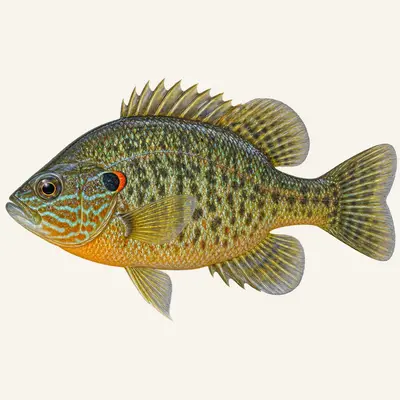
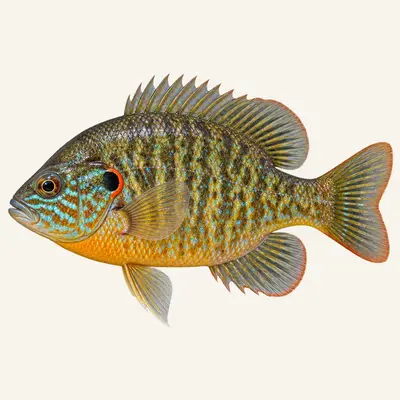
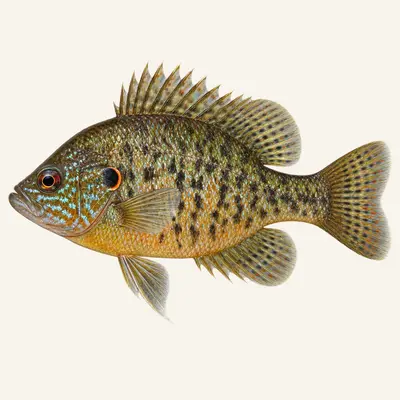
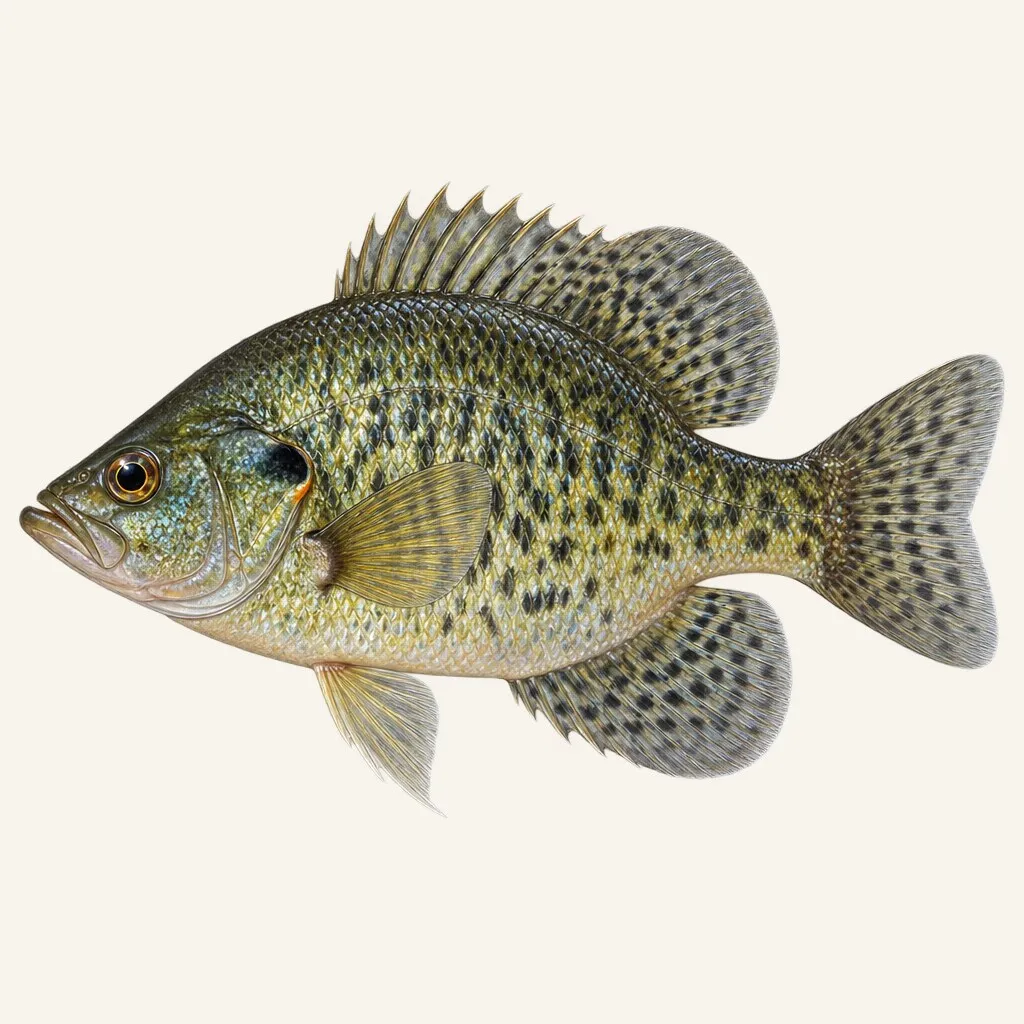
Medium-sized sunfish with an oval compressed body, a characteristically large dorsal fin and a spotted greenish livery typical of Centrarchidae.
Calendar
Recorded in 1 country
GBIF occurrence records — native and introduced populations combined.
Its range
One country, and a valley floor. The range runs from the Potomac drainage in Maryland to central Florida and west as far as the Trinity in Texas — then turns inland and goes north through the Former Mississippi Embayment to southern Illinois and southern Indiana.
That inland arm explains itself. The embayment is the old marine gulf that once reached up into the continent, and what it left behind is an alluvial valley: flat floor, fine sediment, water that spreads sideways when the river rises. The northern limit of the flier sits where that floor gives out. It is following a sediment boundary rather than a line of latitude, which is why the range reaches Indiana on one meridian and stops at the coast on another.
Identifying it
Macropterus means large-finned, and the fin is the whole of the description. The dorsal is out of proportion to the length of the animal, carried on an oval body flattened from the sides. The greenish speckling that goes with it is called typical of the family in the catalogue entry on this page, which is another way of saying it separates nothing.
Beyond that there is very little to go on. The morphology rubric of the FishBase summary is empty for this species: no ray counts, no scale rows, no vertebral count. The fin and the outline are what the record offers.
Breeding
A minimum of 200 eggs. That is the published account of reproduction in this species, entire: no upper figure, no nest, no season, no duration of guarding.
A floor with no ceiling is not a fecundity estimate. It is the smallest count somebody recorded and thought worth keeping, and it should be read as that. It should also be left alone rather than topped up from what is known of the family, where the length of the male's watch differs by an order of magnitude between one species and the next.
The water it needs
Swamps, vegetated lakes, ponds, sloughs, and the backwaters and pools of creeks and small rivers, generally over mud. Every entry on that list is water that stands still or nearly so.
None of it is permanent. A swamp rises with rain, shrinks through summer and breaks into disconnected pockets; its surface area in April is not its surface area in September. Six years of recorded life and a common length of 13 cm describe an animal built for that — a short cycle, completed inside the interval between two dry spells.
The logged pH runs 6.5 to 7.5, hardness 10 to 15, temperature 12 to 22 degrees. The upper temperature is the surprising figure for a range that reaches central Florida, and it is a reminder of what such a band is: a record of the water the fish has been measured in, not a statement of what it can stand.
Areas
- Swamps and bayous
- Areas under floating vegetation
- Shallow lily pad lakes
Techniques
- Surface lure fishing
- Live bait fishing
- Ultra-light spinning
Baits
- Earthworms
- Small live fish
- Insect larvae
- Small frogs
What it eats
Hemiptera, and within them the Corixidae. The biology rubric classes the flier as an invertivore and names no other prey group.
Corixids are water boatmen, and they are not bottom animals. They swim among stems in open water and carry an air store that has to be renewed at the surface, so their day is a series of vertical trips through the column. A fish living mainly on them is collecting its food off the bed it rests on.
That is worth setting against the rest of the page. The species is classed as a predator here and its bait list runs to small live fish and small frogs; the published diet names neither, and names nothing vertebrate at all.
How to catch it
Scale the tackle to a water boatman. Hooks and imitations sized for insects are what the recorded diet supports, and going up in size offers the animal something nobody has written down as its prey.
The water decides the rest. Lily pads, drowned branches, marsh weed: shade above, mud below, and the insects between the two. Ground gets covered a square metre at a time in that, dropping a bait into gaps in the growth rather than working a shoreline.
Two uses are logged for the species and both are commercial: a food fishery and the aquarium trade. The second follows from the size. A common length of 13 cm fits a tank, and an animal that keeps to still, warm, weedy water is one a tank can reproduce.
Regulations
Check the local regulations in force (legal size limits, closed seasons, bag limits).
For guidance only. Legal sizes, quotas and open seasons vary by location and season: always check the local regulations in force before fishing.
Other names
Flier is the accepted name, and it is a bare word. Most other sunfish names in English hand over something that can be checked against the animal — a colour, an ear, an eye, a mouth, a diet — while this one is a single term with no family word attached. A reader who does not already know the species learns nothing from it, not even that it is a sunfish.
Five of the six catalogue languages take the English word without altering a letter. German alone attaches its own family term, Flier-Sonnenbarsch, and is the only version that says what sort of fish is under discussion. French went the other way and translated the image instead of the word, as crapet volant.
Sources: fishbase.se · api.gbif.org