Black crappie
Pomoxis nigromaculatus · Centrarchidae
- Freshwater
- Predators
- Medium
- Size
28–49 cm
- Weight
0.3–2.7 kg
- Lifespan
15 years
- Water temp.
14–31 °C
Where to fish
- Estuary
- Lake
- Pond
- River
Habitat icons: Flaticon
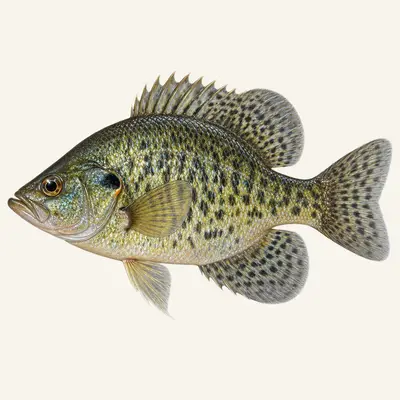
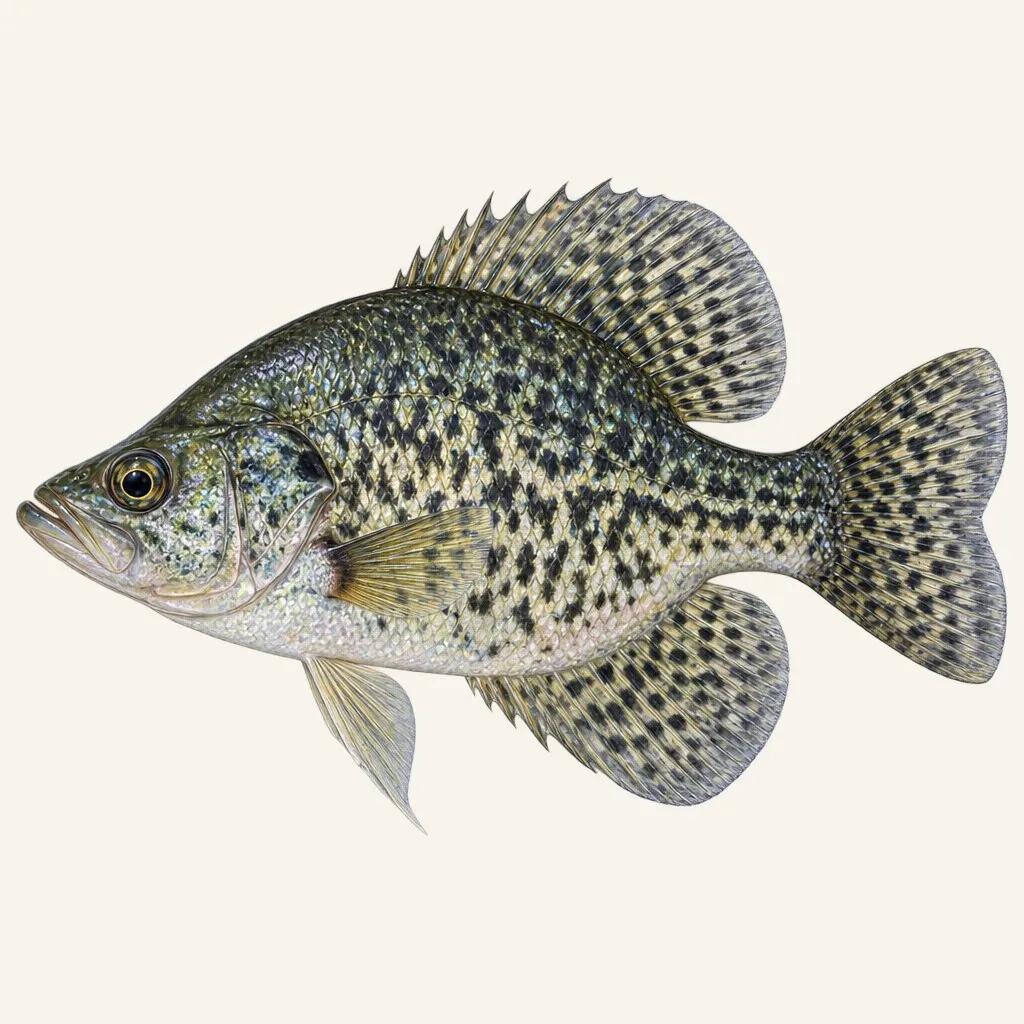
The black crappie is a laterally compressed centrarchid with silvery flanks speckled with irregular dark spots, featuring the long dorsal fin with spines and soft rays characteristic of the family.
Calendar
Recorded in 2 countries
GBIF occurrence records — native and introduced populations combined.
Its range
The record opens by declining the question. The native range can no longer be established, because the species was moved around the United States so widely that the map was overwritten before anyone drew it.
What stands in its place is explicitly presumed: the Atlantic slope from Virginia to Florida, the Gulf slope west into Texas, the St Lawrence and Great Lakes, Hudson Bay by way of the Red River, and the Mississippi basin from Quebec and Manitoba south to the Gulf.
A presumed range is not a false one, but it has to be read differently. Each basin boundary on it is a hypothesis about where the fish sat before the stocking era, not an observation of where it sits now.
Identifying it
Irregular dark speckling scattered over silver, with no pattern to it — that is what the name records, and it is the least dependable character on the fish. Speckling strengthens and fades with the individual, with the clarity of the water and with the condition of the animal, so two crappies out of one weed bed can present very differently.
The white crappie, which shares much of the same water, is barred instead: vertical dark bands down a paler flank, and a mouth set on an upward slant. Where both occur, the standard key is the number of dorsal spines, seven or eight against five or six. The summary consulted for this page carries no morphometric table for either species, so that count has to come from a field guide rather than from the record behind it.
The body itself is deep and flattened from the sides, carrying the long dorsal of spines and soft rays that runs through the whole family.
Breeding
The male clears; he does not dig. An area of sand, mud or gravel is swept bare and the eggs are laid on it, which on a soft bottom leaves a patch with no relief whatever — nothing that reads as a nest to anyone looking down at it.
What follows is recorded with a hedge that deserves to be kept intact. Females probably spawn with several different males, in more than one nest. The qualifier belongs to the source, and it is carrying real weight: the paternity of a single cleared patch has not been demonstrated, and a good deal of what gets said about this family assumes it has.
The male's watch lasts about five days. Its practical effect is on the calendar rather than on the brood — a male is off station and back in circulation inside a week, so the spawning season is a run of brief episodes instead of one long immobilisation.
The water it needs
Clear water is the preference the record states most firmly, and it is the cleanest way to separate this fish from the white crappie, which turns up in turbid water as a matter of course.
Around that: lakes, ponds, sloughs, and the backwaters and pools of streams, always slack or still, usually among vegetation over mud or sand. The published pH band is narrow, 6.0 to 7.5, which describes neutral to slightly acid water and excludes anything strongly calcareous. Recorded temperatures run from 14 to 31 degrees.
It schools, and that changes how a water is searched. A single fish located is a group located, and a weed bed holding one holds a dozen.
Areas
- Submerged structures and docks
- Dense weed beds
- Deep lake margins
- Creek mouths
Techniques
- Vertical soft lure fishing
- Live bait fishing
- Fly fishing
- Drop shot fishing
Baits
- Small shad-type soft lures
- Small live fish
- Earthworms
- Artificial minnows
What it eats
Sixteen centimetres divides the species into two animals. Under it, planktonic crustaceans and larvae; over it, small fishes. Nothing else about the fish changes that sharply.
The consequence runs through the whole population. A cohort competes with the zooplankton feeders of a lake for a season or two and then changes sides, becoming a predator of the fry produced by everything around it, its own species included. Growth does not continue at the same rate across that line either, since the two menus cost different amounts to collect.
The record also notes that other fishes prey on it, which is the ordinary condition of a deep-bodied fish spending its first years in weed.
How to catch it
Midnight to two in the morning. The feeding times published for this species are unusually specific, and one of them falls in the part of the night when almost nobody is fishing for it. The other is early morning.
Both windows follow from the diet rather than from any taste for darkness. Below 16 cm the fish lives on planktonic crustaceans and larvae — free-swimming, nocturnal and dipterous — and those are night animals; above it, the fish takes small fishes, which are workable at first light. A shoal of mixed sizes therefore has two clocks running inside it.
That threshold also chooses the bait. Sixteen centimetres is the line between an animal that eats plankton and one that eats fish, so imitations sized for the second are what select for the larger fish, while micro lures work for numbers.
The shoaling habit makes a take worth staying for. Prospecting ends at the first fish, and what follows is holding the spot rather than covering water. The last constraint is the mouth: the membrane is thin enough that the nickname American anglers use is really a warning about tackle, and steady pressure keeps a hook where a hard strike tears the hold open.
Conservation
Nothing presses on the species at the scale of the continent. The difficulty is the opposite one, and it is documentary rather than ecological: across much of the United States there is no telling an old population from a stocked one, and without that distinction a decline cannot be measured against anything.
At the scale of one lake the exposure is demographic. This species reaches 15 years where the white crappie stops at 10, so the large fish in a water are old fish and no single season will replace them. Take out a run of good year classes early and the water fishes thinly for a decade afterwards.
Handling follows from the same arithmetic. A fish worth returning is one that spent most of its life reaching the size that made it interesting.
Regulations
Check the local regulations in force (legal size limits, closed seasons, bag limits).
For guidance only. Legal sizes, quotas and open seasons vary by location and season: always check the local regulations in force before fishing.
Other names
Black crappie is the accepted name; nigromaculatus says black-spotted and points at the same feature. Calico bass and speckled perch circulate regionally in the United States, and neither travels reliably outside its own territory.
Papermouth is applied to both crappies indifferently, which makes it useless for identification and valuable as advice. French has a name of its own for the species, marigane noire, coined in Quebec; five of the six languages in this catalogue simply borrow crappie and add a colour to it.
Sources: fishbase.se · api.gbif.org