Tiger muskellunge
Esox lucius x masquinongy · Esocidae
- Freshwater
- Predators
- Hard
- Weight
28 kg
- Lifespan
30 years
- Water temp.
10–28 °C
- Depth
0–30 m
Where to fish
- Estuary
- Lake
- River
Habitat icons: Flaticon
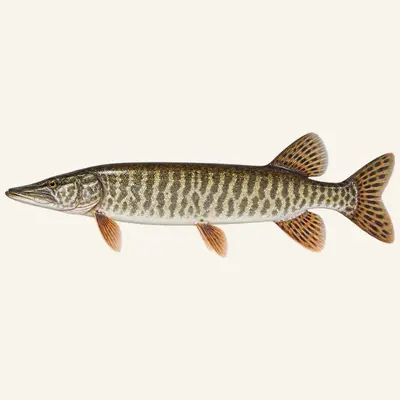
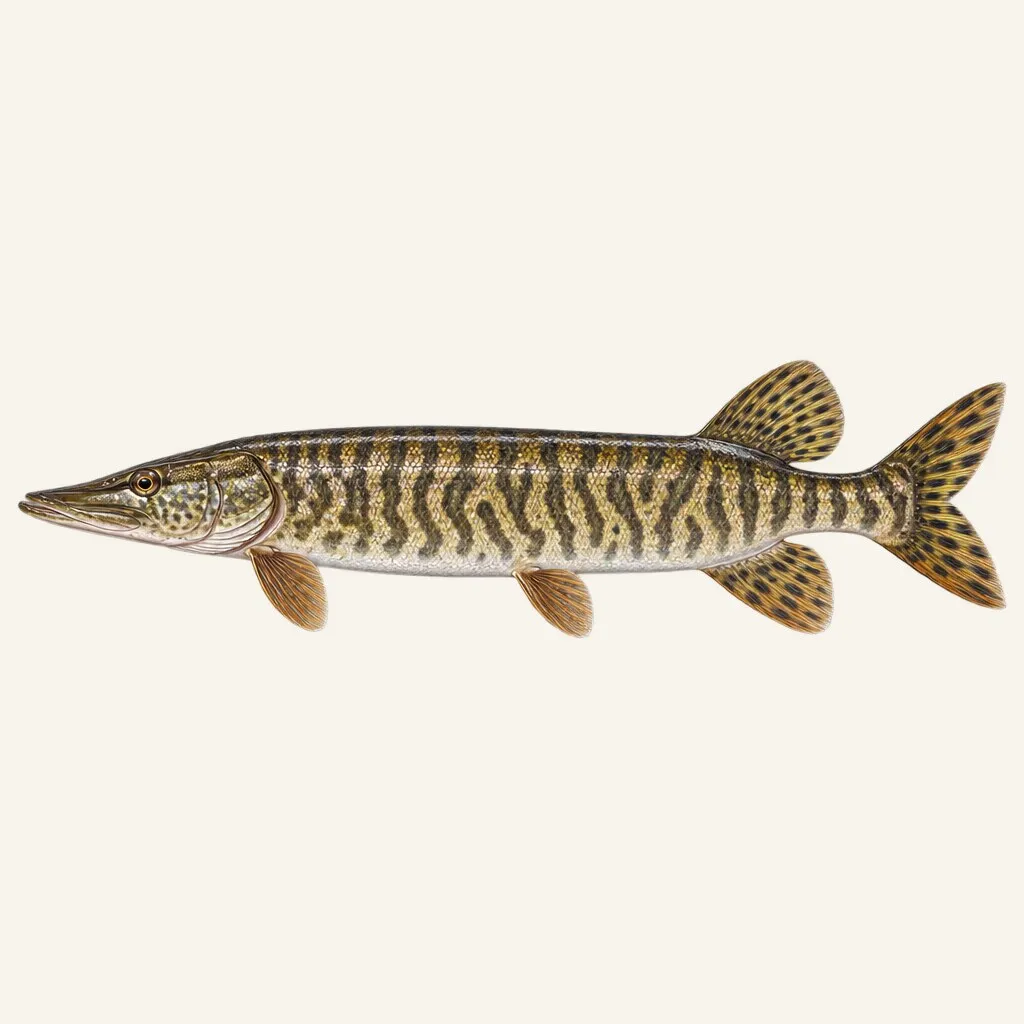
The tiger muskie (Esox lucius x masquinongy) is a hybrid of the northern pike and the muskellunge, displaying a silvery green body with distinctive dark vertical bars and spots that give it its name. It forms no self-sustaining population and nearly always comes from a hatchery. Robust and aggressive, it grows faster than either parent and is found in lakes and large rivers across North America.
Calendar
Breeding
The subject of this fish is a reproduction that goes nowhere. It comes from a cross between the northern pike and the muskellunge, and the cross does not carry on: nowhere is there a population of tiger muskellunge that maintains itself.
The pairing can happen without help, since both parents spawn in spring in vegetated shallows once the ice has gone, so they do meet on the same ground from time to time. Those meetings stay accidental and rare. Very nearly every fish caught came out of a hatchery, where the cross is made deliberately, fish by fish.
A rule with no exceptions follows from it. A water holds what was put into it, on the date it was put in: no recruitment, no intermediate year classes, no spontaneous refilling after a harvest. The population does not descend from itself. It is delivered.
Areas
- Lake weedbed edges
- Rocky points and structures
- River mouths
- Shallow bays
Techniques
- Topwater lures
- Spoons
- Articulated swimbaits
- Live bait drift
- Jerkbaits
Baits
- Medium-sized live fish
- Dead bait retrieve
- Large spinner
- Large soft plastic
- Buster bait
How to catch it
That origin changes how a water is read. The fish present form lots from successive stockings rather than the continuous pyramid of a natural population, so sizes bunch into waves instead of spreading out. The stocking record of a lake says more about what can be expected from it than any amount of observation through the season.
The absence of a self-supporting population is also why managers reach for it. It gives a predator that can be installed without establishing itself, whose numbers are adjusted from one year to the next and withdrawn as quickly as they were introduced. The other side of that belongs to the angler: a fish kept will not be replaced by the river, it will be replaced by a truck, or by nobody.
On the water it hunts as both of its parents do, set against cover and taking prey of a good size, with the jaws of one and of the other. Fast growth is exactly what it was made for, and it produces fish whose dimensions bear no relation to the time they have spent in the lake.
Regulations
Check the local regulations in force (legal size limits, closed seasons, bag limits).
For guidance only. Legal sizes, quotas and open seasons vary by location and season: always check the local regulations in force before fishing.
Other names
Tiger muskellunge in English, shortened to tiger muskie; Tigerhecht in German. All of them keep the dark barring of the flanks.
The formula Esox lucius × masquinongy is not a species name but the notation of a cross, and that explains an absence. Species inventories do not list hybrids, so this fish has no natural range and no conservation file of its own. It belongs to fisheries management rather than to biogeography.
Sources: fishbase.se · api.gbif.org