Yellowspotted trevally
Carangoides fulvoguttatus · Carangidae
- Saltwater
- Coastal
- Medium
- Size
90–120 cm
- Weight
7.2–18 kg
Where to fish
- Reef
- Rocky shore
Habitat icons: Flaticon
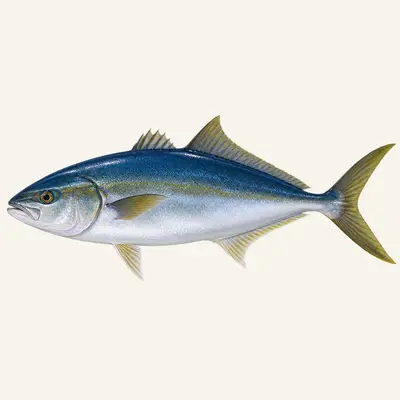
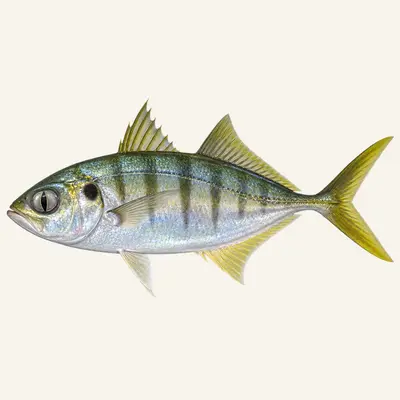
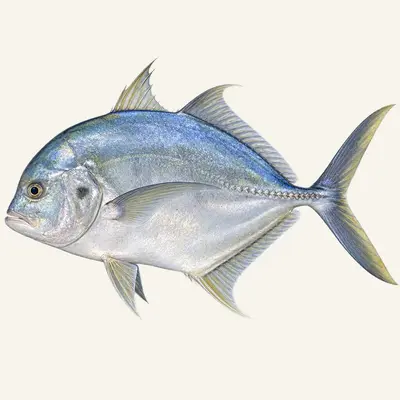
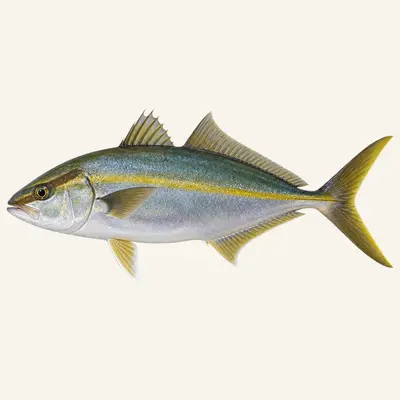
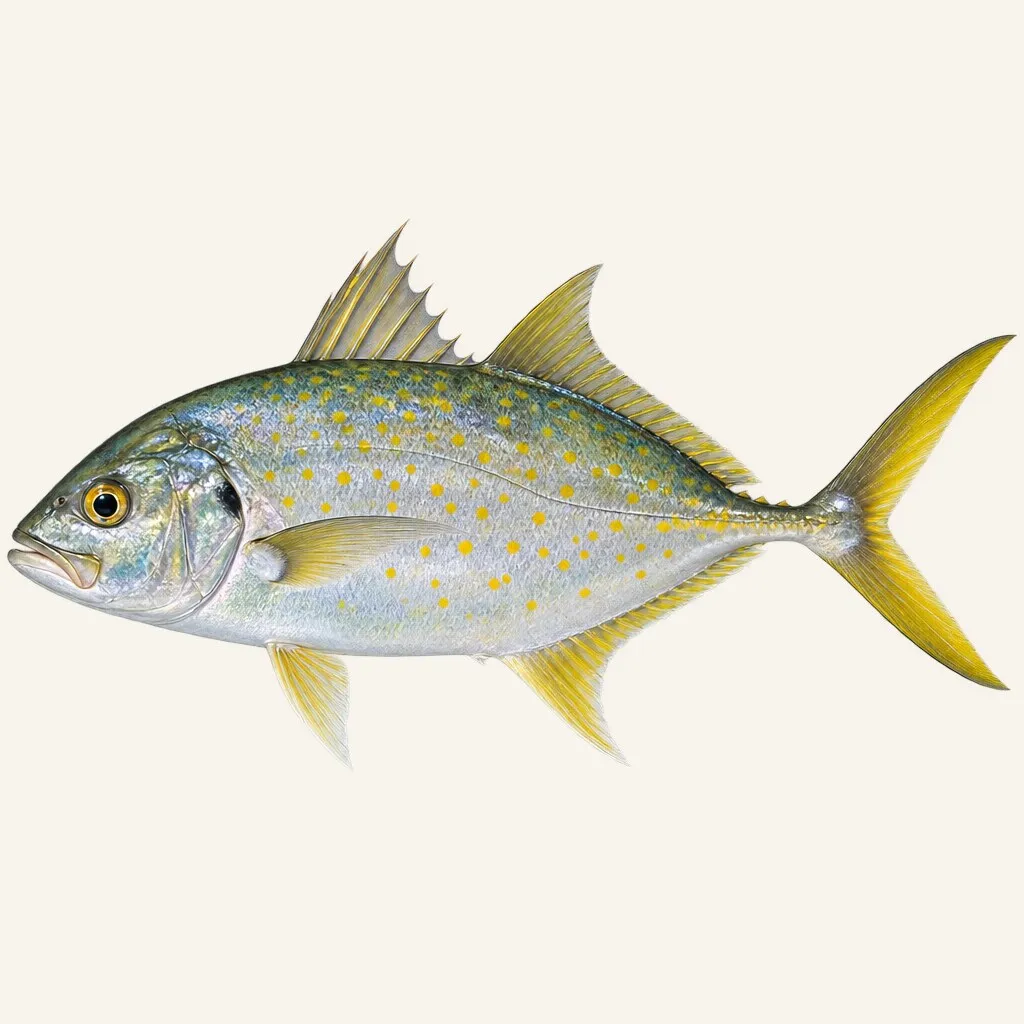
The yellowspotted trevally is distinguished by its numerous yellow-orange spots scattered over silvery flanks and belly, a distinctive mark among Indo-Pacific tropical Carangidae. Its stocky, powerful build makes it a hard-fighting species prized by shore anglers.
Calendar
Recorded in 2 countries
Australia · Mozambique
GBIF occurrence records — native and introduced populations combined.
Its range
The range covers the Indo-West Pacific, from the Red Sea and East Africa to Palau and New Caledonia, north to the Ryukyu and Ogasawara islands and the Yellow Sea, and east as far as Tonga.
The northern limit is the entry to note. Reaching the Yellow Sea takes the species to 36° north, off the coral entirely and onto a shallow continental shelf — which fits an animal the account also places on offshore banks, and not only on reefs.
Identifying it
The outline changes with age, which accounts for a good deal of the hesitation over this fish. The body starts subovate and compressed and becomes elongate-ovate and slightly subcylindrical as the animal grows. The profile of the head and nape begins slightly angular and steepens with age. A key built on silhouette therefore returns a different answer depending on the size of the specimen in hand.
One character is stated without qualification: in adults the cleft of the mouth sits distinctly below the level of the eye. That is a proportion, not a colour, and it survives the trip from water to deck.
A second proportion is worth having beside it. The lobe of the second dorsal fin is shorter than the head — a comparison made against a part of the same fish, so it needs no ruler.
Colour is where the caution belongs. Adults are iridescent blue-green above and silver below, with numerous small gold or brassy spots concentrated on the upper half of the body. Large adults carry three irregular black blotches on the flank, occasionally as many as five: the first under the lobe of the second dorsal, the second at the inflection of the lateral line, the third a little ahead of the midpoint of its straight portion. The description then adds that those blotches are sometimes very faint and sometimes missing altogether. Every colour statement in this account is tied to an age class, and the most conspicuous of them is optional.
Counts are more stable, provided the arithmetic is understood. The summary line credits the fish with nine dorsal spines; the detailed description writes eight in the first dorsal and one leading the second, which is the same total distributed over two fins. The anal works the same way — two detached spines standing ahead of the fin, then the one inside it. Behind them, 25 to 30 soft rays in the dorsal and 21 to 26 in the anal; 22 to 27 gill rakers including rudiments, six to eight above and 17 to 21 below; 24 vertebrae in ten plus 14.
The straight part of the lateral line carries 18 to 27 scales followed by 15 to 21 small scutes.
The breast is the character not to borrow from a relative. Its underside is naked back to well behind the origin of the pelvic fins, but the account describes the lateral scaling as variable within the species: either a band of scales, narrow to moderate, separating the bare breast from the naked base of the pectoral, or the bare area running through to that base without interruption. Where a naked breast decides an identification in Caranx, here the same region is described as varying from fish to fish, and it settles nothing.
The water it needs
Adults prefer rocky and coral reef ground and are also found on offshore banks.
They occur singly or in schools ranging from small to large. That is the entire social range with no preferred state given, and it is the single most awkward line in the account for anyone planning a session.
Areas
- Coral reefs
- Coastal shallows
- Passes and channels
- Submerged rocky areas
Techniques
- Light jigging
- Sinking metal lures
- Live bait fishing
- Surface popper
Baits
- Small live fish
- Shrimp
- Soft lures
- Metal jigs
What it eats
Small invertebrates and fishes.
The mouth gives the direction. A cleft set distinctly below the level of the eye belongs to an animal that takes prey beneath itself, on and around the substrate, rather than one that picks off baitfish silhouetted against the surface. The diet list agrees: invertebrates lead it, fish follow.
How to catch it
The ground is rock, coral and the offshore banks, and the presentation belongs near the bottom rather than on top of the water. That is the practical content of a downward-set mouth, and it is what separates fishing for this species from fishing for the surface-feeding jacks that share the same reefs.
The social range dictates persistence. A fish taken here may have been alone or may have been one of fifty, and nothing in the description allows the two cases to be told apart in advance. The only way to find out is to put the lure back, immediately, before whatever else is there moves on.
Common length is 90 cm. A fish of that size hooked over rocky ground gives the angler the shorter half of the problem, and the distance between the strike and the first hard structure is what decides the outcome rather than the drag setting.
Regulations
Check the local regulations in force (legal size limits, closed seasons, bag limits).
For guidance only. Legal sizes, quotas and open seasons vary by location and season: always check the local regulations in force before fishing.
Other names
Yellowspotted trevally is the standard English name; goldspotted trevally is also in circulation, and the description explains why both survive. It calls the spots gold or brassy rather than yellow, and English never settled on one of the three words.
The scientific name sides with the second reading. Fulvus is tawny, a brownish gold rather than a clear yellow, and guttatus is spotted: the epithet says tawny-spotted, which is closer to a brassy fish than the English name suggests.
The confusion that costs something is with the island trevally, the other Carangoides in this catalogue. Its own entry gives it small golden-yellow spots too, so the character that names this species does not identify it. What separates the two is where they live: this one on rock, coral and offshore banks, the other confined to oceanic islands and stated to be absent from neritic waters.
Sources: fishbase.se · api.gbif.org