Yellowtail amberjack
Seriola lalandi · Carangidae
- Saltwater
- Coastal
- Medium
- Size
80–250 cm
- Weight
7.0–97 kg
- Lifespan
12 years
- Water temp.
18–24 °C
- Depth
3–825 m
Where to fish
- Reef
- Rocky shore
Habitat icons: Flaticon
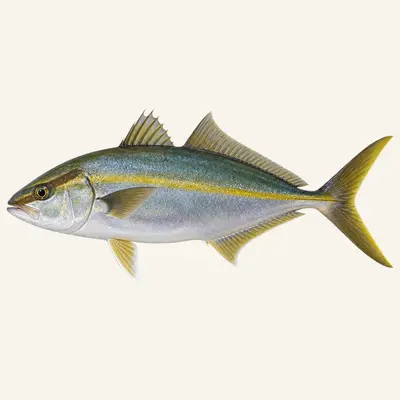
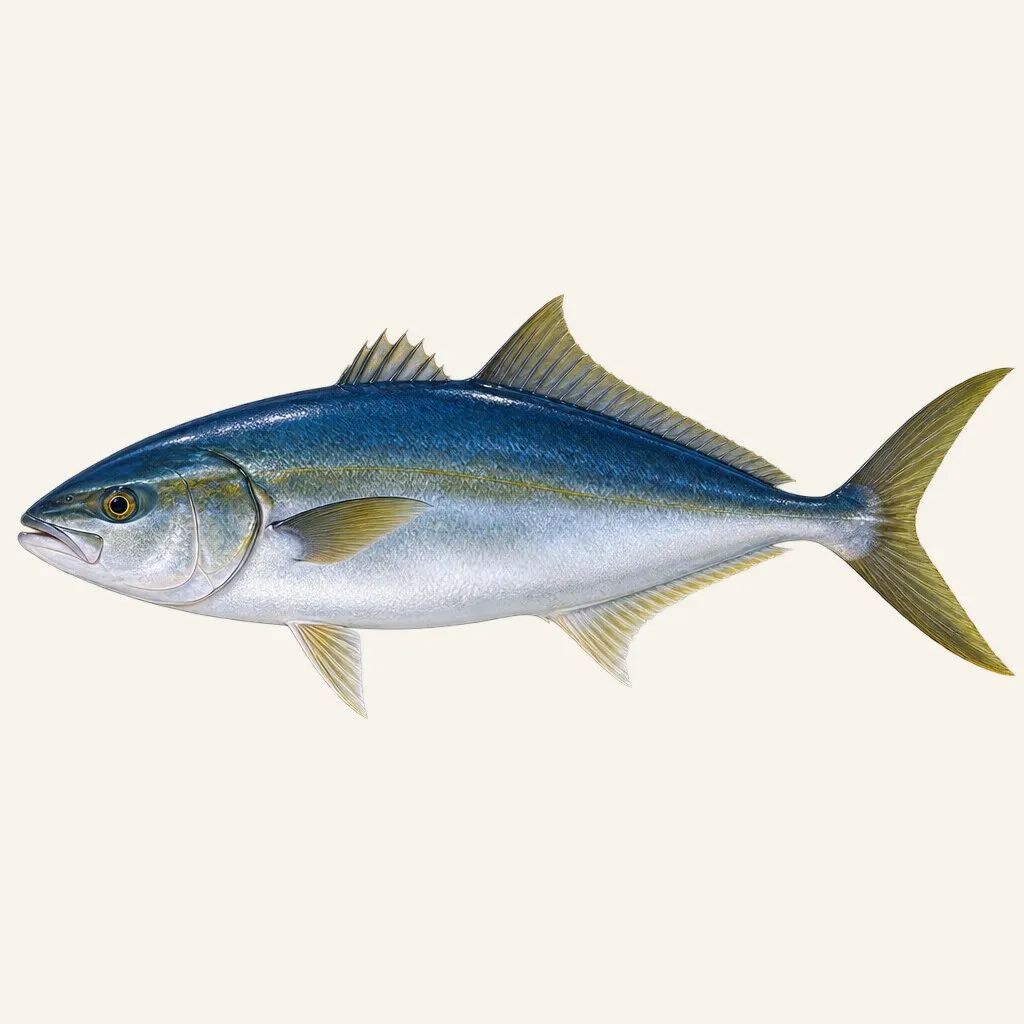
The yellowtail amberjack is a robust carangid with silvery flanks and a distinctive yellow stripe running from eye to the bright yellow caudal fin along the midline. A highly sought pelagic species of temperate and subtropical waters of the Pacific and South Atlantic.
Calendar
Recorded in 23 countries
Australia · Brazil · Cameroon · Chile · Colombia · Congo - Brazzaville · Côte d’Ivoire · Equatorial Guinea · Gabon · Ghana · Guinea · Guinea-Bissau · Japan · Liberia · Mexico · Mozambique · New Zealand · Nigeria · Norfolk Island · Senegal · Sierra Leone · South Africa · United States
GBIF occurrence records — native and introduced populations combined.
Its range
The species is circumglobal in subtropical water, in the form of a series of disjunct populations — the most important fact on its chart.
In the Indo-Pacific: South Africa, Walters Shoals, Amsterdam Island, Japan, Australia, New Zealand, New Caledonia, Hawaii, Rapa, Pitcairn and Easter Island. In the eastern Pacific: from British Columbia to Chile, taking in the Desventuradas and the Juan Fernández islands. In the eastern Atlantic: St Helena and South Africa.
These separated populations do not mix. A local extinction is therefore not made good by an influx from elsewhere, and the stocks have to be managed one by one despite sharing a species name.
Identifying it
The boundary between back and belly is sharp enough to serve as a character on its own. Dark blue above, almost white below, and a clean line of demarcation between the two rather than a gradual passage from one to the other.
The counts separate it as well: five or six dorsal spines, against eight in the greater amberjack, with 33 to 35 soft rays behind them; two or three anal spines and 20 to 21 rays.
The body is fusiform and compressed in section.
The record calls this the only jack without scutes on the caudal peduncle, and that is a diagnostic taken one step too far. The rest of the genus lacks them equally, and so do the pompanos. A smooth peduncle narrows the field; it does not close it.
The water it needs
Adults are benthopelagic in coastal and oceanic water, off kelp beds and rocky ground, and they enter estuaries at times — brackish water is within their tolerance. They are found close to rocky shores, reefs and islands, alone or in small groups.
Schools of juveniles hold offshore, often near the edge of the continental shelf or beyond it, which is the exact inverse of the adults' position.
The thermal preference is clear: 18 to 24 degrees, with occasional captures in cooler water. Recorded depth spans 3 to 825 m.
Areas
- Coastal rocky reefs
- Kelp forests
- Exposed drop-offs
- Strong current zones
Techniques
- Vertical jigging
- Drift live bait fishing
- Coastal trolling
- Fishing under birds
Baits
- Metal jigs
- Live bait (anchovies, sardines)
- Squid
- Soft plastic lures
What it eats
Adults take small fish, squid and crustaceans.
The real share held by cephalopods alongside fish matches where the species lives. In contact with rocky ground and kelp, squid and cuttlefish are abundant; out in open water, forage fish would dominate the list instead.
How to catch it
Kelp and rock are what mark the fish. This is the substantive difference from the greater amberjack, which holds deep reefs offshore: this one hunts against rocky shorelines and weed beds, in cooler water.
The 18 to 24 degree band frames the season better than any calendar, and it explains why the species is a spring and autumn fish across part of its range.
Adults are solitary or in small groups, so the fishing is played on structure rather than on intercepting a shoal. The juveniles, for their part, are offshore.
No amberjack is published larger, while the maximum reported age is only 12 years. Growth is consequently very fast, and a big fish here is not an old fish.
Conservation
The disjunct populations are the central point. A species present across the planet but cut into isolated stocks has no redundancy built into it: each population carries its own risk, and the overall health of the species says nothing at all about the state of a given sector.
Fast growth is the counterweight. A stock that reaches adult size within a few years rebuilds faster than a long-lived fish can, provided the spawners are still there. Maturity is recorded from 51 cm, which is early for the largest amberjack there is.
Regulations
Check the local regulations in force (legal size limits, closed seasons, bag limits).
For guidance only. Legal sizes, quotas and open seasons vary by location and season: always check the local regulations in force before fishing.
Other names
Yellowtail amberjack in the catalogue, yellowtail kingfish in Australia and New Zealand, where kingi is the working name, and hiramasa in Japanese.
Yellowtail is the word that causes trouble in English. In California it means this fish; on a sushi menu almost anywhere it means the Japanese amberjack instead; and the yellowtail snapper is an unrelated fish of the western Atlantic that shares nothing with either. Kingfish is no better, since the same word names a large mackerel on the American Atlantic coast.
Sources: fishbase.se · api.gbif.org