Yellowtail scad
Atule mate · Carangidae
- Saltwater
- Coastal
- Medium
- Size
26–30 cm
- Weight
0.2 kg
- Depth
1–80 m
Where to fish
- Reef
Habitat icons: Flaticon
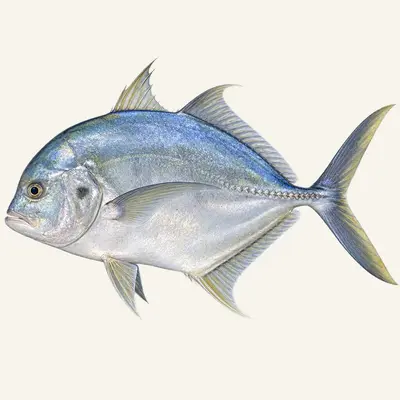
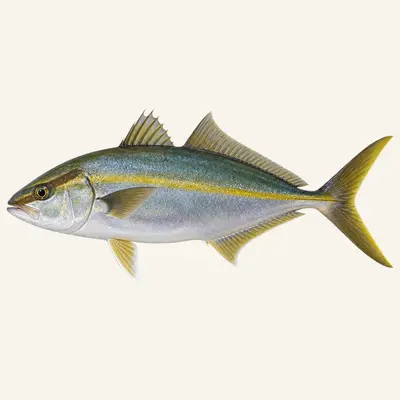
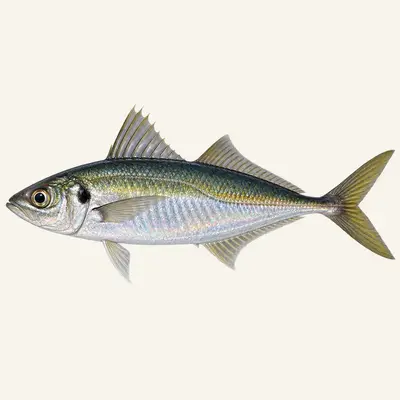
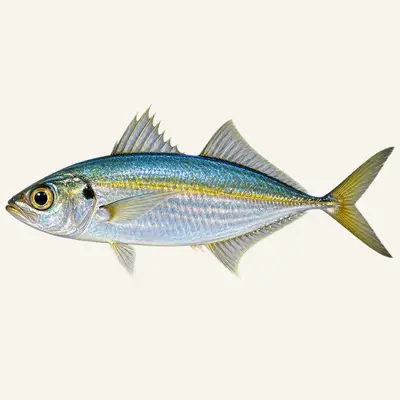
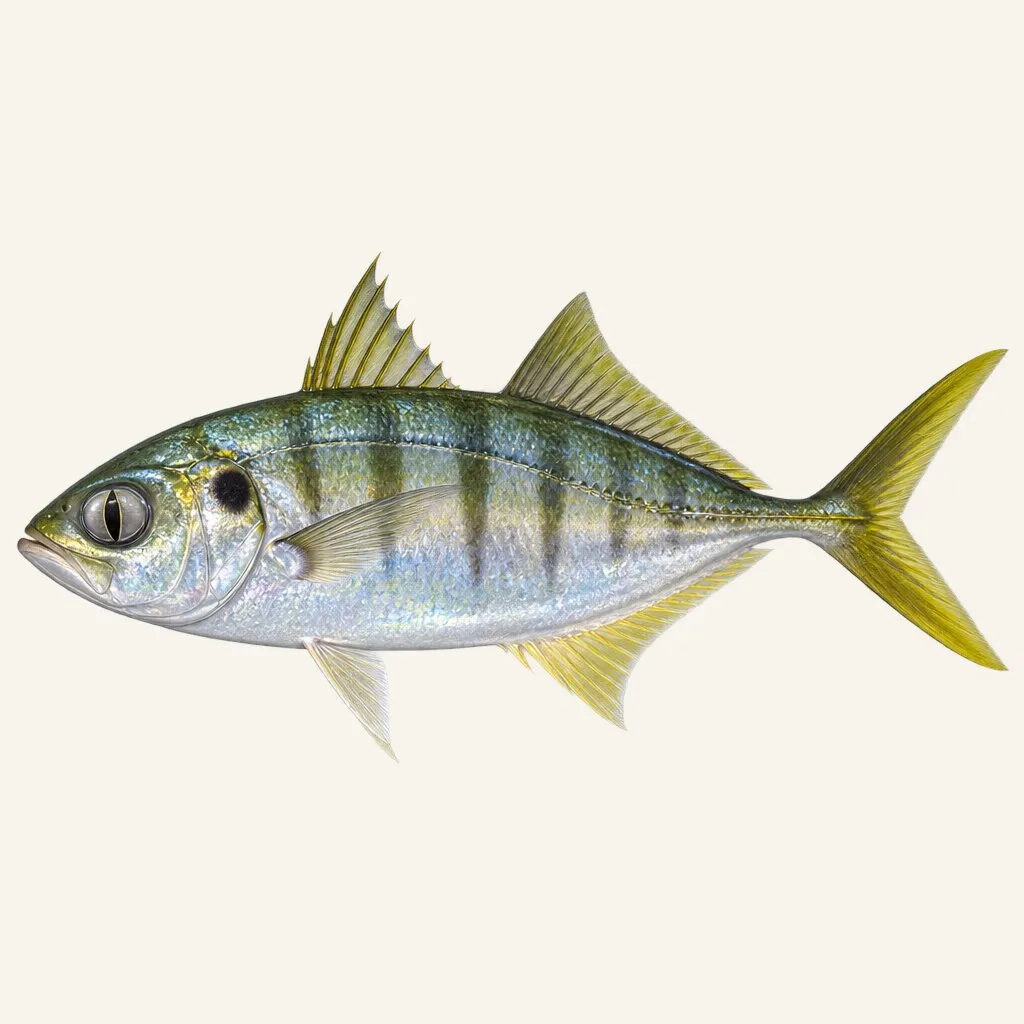
The yellowtail scad is a small coastal carangid of tropical seas across Asia, Africa and Oceania, identified by its bright yellow tail contrasting with a silver body and a gently arched lateral line. It forms large pelagic schools and frequents coral reefs as well as lagoonal areas.
Calendar
Recorded in 3 countries
Australia · Mozambique · Thailand
GBIF occurrence records — native and introduced populations combined.
Its range
The range is Indo-Pacific and it stops there: the Red Sea and the east African coast across to the Hawaiian Islands and Samoa, north to Japan, south to the Arafura Sea and northern Australia.
The eastern boundary is what to notice. Several small carangids of the same size and much the same habits are recorded as circumtropical or circumglobal, present in the Atlantic and the eastern Pacific as well. This one is not, and the difference is in the habitat rather than in the fish. An animal that lives in mangroves and coastal bays has no way across a stretch of open ocean thousands of kilometres wide, because there is nothing along the route that it can use. A plankton-feeder of the blue water crosses without noticing: the gap is its ordinary habitat.
Identifying it
The eye is shut. An adipose eyelid, well developed, covers it completely except for a vertical slit centred on the pupil, so the animal looks out through a letterbox cut in a transparent membrane. That one character names the species, and it survives on a dead fish.
The last rays of the second dorsal and of the anal are finlet-like in adults: about twice the length of the rays beside them, standing a little more separated, but still joined to the fin by the membrane between them. "Joined" is the word to hold on to. This is a finlet that has not finished detaching, and the membrane is what has to be looked for before the count is called.
The lateral line offers a landmark rather than a number. Its curved forward part meets its straight rear part below a vertical from the sixth to eighth soft ray of the second dorsal — a position on the body, readable without counting anything at all. Scales in the curved part run 39 to 57.
The margin of the shoulder girdle is smooth, with no papillae on it. A black spot a little smaller than the eye sits on the upper edge of the gill cover and spreads onto the shoulder behind it. Second dorsal and tail are dusky greenish yellow, the anal fin pale yellow.
Nine spines in the first dorsal, 22 to 25 rays in the second; three anal spines, 18 to 21 rays.
The water it needs
Mangroves and coastal bays, in the pelagic water above them, and the species tolerates brackish conditions. The inshore edge is the habitat, turbidity included, which is not where the family's reputation was made.
Schools form in inshore water down to about 50 m, and single fish occur as well. The recorded span is 1 to 80 m. A schooling species that is also met alone is a species whose behaviour on any given day is not a safe assumption.
Areas
- Coastal lagoons
- Reef edges
- Shallow sandy areas
- Sheltered bays
Techniques
- Ultralight sabiki
- Micro-lures
- Light surface fishing
- Light rod casting
Baits
- Small feathers
- Micro-jigs
- Pieces of shrimp
- Thin marine worms
What it eats
Crustaceans and planktonic invertebrates — copepods above all — with cephalopods among them.
The hunting method is on record, and it is the sentence that makes sense of the eye: the fish swims fast in midwater in pursuit of zooplankton. Chasing copepods at speed sounds like a contradiction and is not one. It describes a small predator closing on individual animals a millimetre or two long, in open water, and doing it by sight.
The species is mainly diurnal, which puts that work in bright surface water. The aperture in the eyelid sits directly over the pupil, along the line the fish is looking; the membrane covers what lies around it.
How to catch it
Fish the inshore edge by day: mangrove margins, the mouths of bays, shallow water over a located school, down to about 50 m.
The diet sets the size of everything else. A copepod-eater will not answer a lure that means anything to a larger jack, so it comes down to micro-lures, an ultralight sabiki, small surface work, or a light rod worked by hand. Every one of those is an adjustment downward from what the family normally asks for.
Its main employment is as live bait for the larger coastal predators, and the daytime habit is a practical advantage there. The bait can be caught during working hours, in shallow water, without waiting for dark or rigging lights.
One figure is worth holding against that use. Maturity begins at 17 cm and the common length is 26, so a bucket of ordinary bait is a bucket of fish that have already spawned at least once — an unusual position for a baitfish, and the only part of this species' reproduction the record describes at all.
Regulations
Check the local regulations in force (legal size limits, closed seasons, bag limits).
For guidance only. Legal sizes, quotas and open seasons vary by location and season: always check the local regulations in force before fishing.
Other names
Yellowtail scad in English, after the dusky greenish yellow of the tail.
The name is close to useless outside a market that already knows what it means. "Yellowtail" in English belongs first to Seriola lalandi, a carangid of an entirely different order of size, and it is attached to the yellowtail snapper as well. "Scad" is no narrower. A fish identified by an eyelid ends up carrying a name built out of a fin colour that several unrelated species share.
Atule is a Pacific vernacular for the fish, taken up as the name of the genus — the local word outlived the descriptive one and became the formal one.
Sources: fishbase.se · api.gbif.org