African pompano
Alectis ciliaris · Carangidae
- Saltwater
- Coastal
- Medium
- Size
100–150 cm
- Weight
11–23 kg
- Depth
60–100 m
Where to fish
- Reef
- Rocky shore
- Offshore
Habitat icons: Flaticon
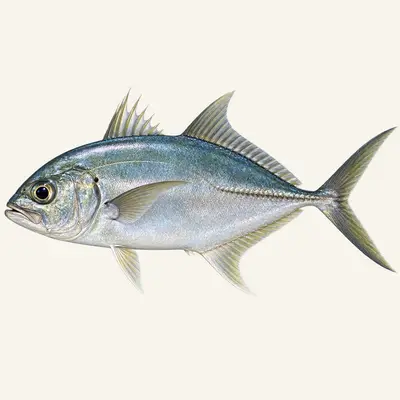
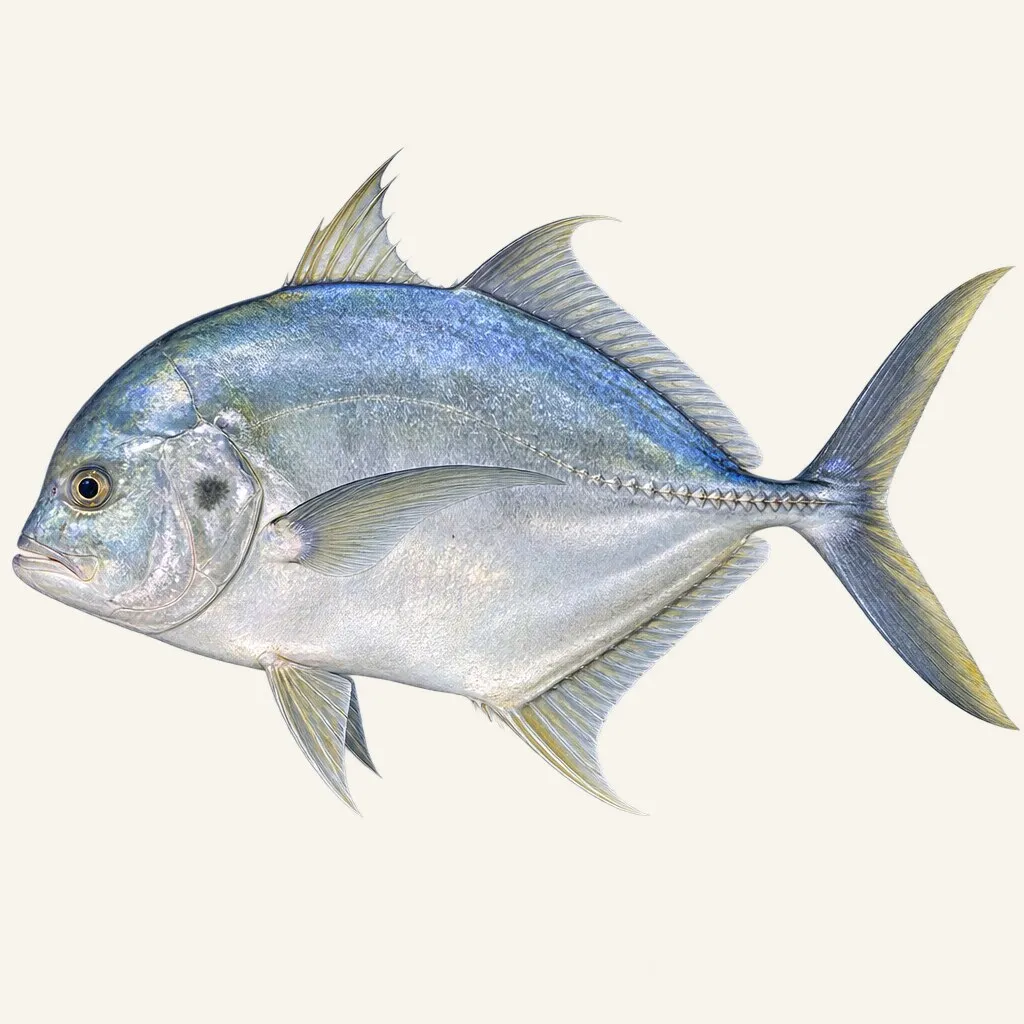
The African pompano is a large pelagic carangid with a very compressed, rhomboid body and distinctively elongated dorsal and anal fins. Found in tropical and subtropical waters of all oceans, it actively hunts in open water.
Calendar
Recorded in 20 countries
Australia · Cameroon · Colombia · Congo - Brazzaville · Côte d’Ivoire · Equatorial Guinea · Gabon · Ghana · Guinea · Guinea-Bissau · Japan · Liberia · Mexico · Mozambique · Nigeria · Panama · Puerto Rico · Senegal · Sierra Leone · United States
GBIF occurrence records — native and introduced populations combined.
Its range
The range is circumglobal and the list of seaboards shows no serious hole in it. Western Atlantic from Massachusetts and Bermuda to Santos in Brazil, Caribbean and Gulf of Mexico included. Eastern Atlantic from Senegal to Congo. Western Indian Ocean from the Red Sea to Algoa Bay and on to Sri Lanka. Eastern Pacific from Mexico to Peru.
One qualifier in that account is unusual for a warm-water fish: tropical, subtropical and temperate seas. The latitude limits back it up, 42° north against 34° south. This is an animal that runs off both ends of the warm belt, and the consequence turns up further down this page.
Identifying it
The formal description of this fish is remarkably thin for an animal nobody misidentifies. It gives one shape category and two lines of counts: body short and deep, compressed; seven or eight dorsal spines with 18 to 22 soft rays; three anal spines with 15 to 20 rays. Nothing on the fins of a small fish, nothing on the pattern.
The entry above fills the gap with the character every angler uses — a very compressed, rhomboid body carrying markedly drawn-out dorsal and anal fins. Two of the six common names record the same thing independently, which is the subject of the closing section. Where a description is silent and the naming is unanimous, the naming is the evidence available.
The water it needs
Two ages, two water bodies, and the break between them is clean. Small juveniles are found close to shore. Adults live near the bottom down to 60 m, inside a band the record brackets between 60 and 100.
Between those extremes the species is described as pelagic in neritic and in oceanic water alike, and sometimes in contact with the bottom. It belongs to neither the shelf nor the open sea in particular. It crosses between them, which is why an animal that spends its time in open water still eats what does not move: the swimming is done in mid-water, the feeding is done at the bottom of it.
Areas
- Deep reef drop-offs
- Tidal passes and channels
- Offshore pelagic waters
- Wrecks and seamounts
Techniques
- Heavy jigging
- Large live bait fishing
- Coastal trolling
- Giant surface popper
Baits
- Heavy lead jigs
- Medium-sized live fish
- Heavy poppers
- Whole dead fish
What it eats
Here is the fact that overturns the standard approach to this family. A fish of this size feeds on sedentary or slow-moving crustaceans, taking small crabs and fishes incidentally on top of that.
Sedentary or slow-moving. Nothing on that menu flees, no attack ends in acceleration, and no strike has to be timed against an escaping target. The predator needs searching ability rather than speed, and it collects at or near the bottom from animals that have neither the intention nor the means to leave.
How to catch it
The diet sets the presentation, and it sets it against everything the family suggests. A popper worked hard imitates a fish escaping; here nothing escapes. A lure fished slowly near the bottom, on a crustacean profile, corresponds to what the animal actually takes.
Depth points the same way. Looking for adults in contact with the bottom inside the first 60 m narrows the search enormously for a species whose range covers every warm ocean.
Slow work does not license light tackle. Common length approaches a metre, and the power of a carangid built on that plan has nothing to do with the speed at which it took the lure.
One consumption note belongs here, and it needs stating in the right unit. Ciguatera poisoning has been reported from this species, and the flesh is separately rated excellent and sold fresh, dried or salted. Both entries are filed against a single name — a name that, as the range shows, also covers fish taken off Massachusetts and off Senegal in temperate water where the poisoning does not occur. A species-level warning is the wrong scale for a hazard this local. The label travels the whole range; the risk does not, and only the people working a given piece of coast can say which of the two applies there.
Conservation
The documented pressure on this fish does not come from fishing at all. Juveniles supply an active aquarium trade, and the same record notes in the next breath that they do badly in captivity. Removing an animal for a use it does not survive is a simple mechanism, and its whole weight falls on the age class that lives closest to shore — the one within reach of anyone with a net.
That is also the age class with the least room to spare. Adults are spread through neritic and oceanic water across every warm ocean; the young are concentrated in a thin coastal strip, and a coastal strip is the part of the range that gets built on.
Regulations
Check the local regulations in force (legal size limits, closed seasons, bag limits).
For guidance only. Legal sizes, quotas and open seasons vary by location and season: always check the local regulations in force before fishing.
Other names
What the description leaves out, the names carry. The epithet ciliaris is built on Latin cilium, an eyelash: a word chosen for something fine and drawn out. German calls the fish Fadenmakrele, the thread mackerel. Brazilian Portuguese has pampo-galho, the branched pompano. Three naming acts, in three languages, at three different dates, all reaching for the same trailing structure.
Italian went elsewhere and named the other half of the animal. Pesce specchio, the mirror fish, describes a body so compressed and so silver that it works as a reflector — the same shape the diagnosis renders as "short and deep, compressed".
African pompano in English, palomète africaine in French. Both take their adjective from one of the four seaboards listed above, and it is not the one where most of these fish are caught.
Sources: fishbase.se · api.gbif.org