Yellowtail snapper
Ocyurus chrysurus · Lutjanidae
- Saltwater
- Coastal
- Medium
- Size
40–86 cm
- Weight
0.8–4.1 kg
- Lifespan
19 years
- Depth
0–180 m
Where to fish
- Reef
- Rocky shore
Habitat icons: Flaticon
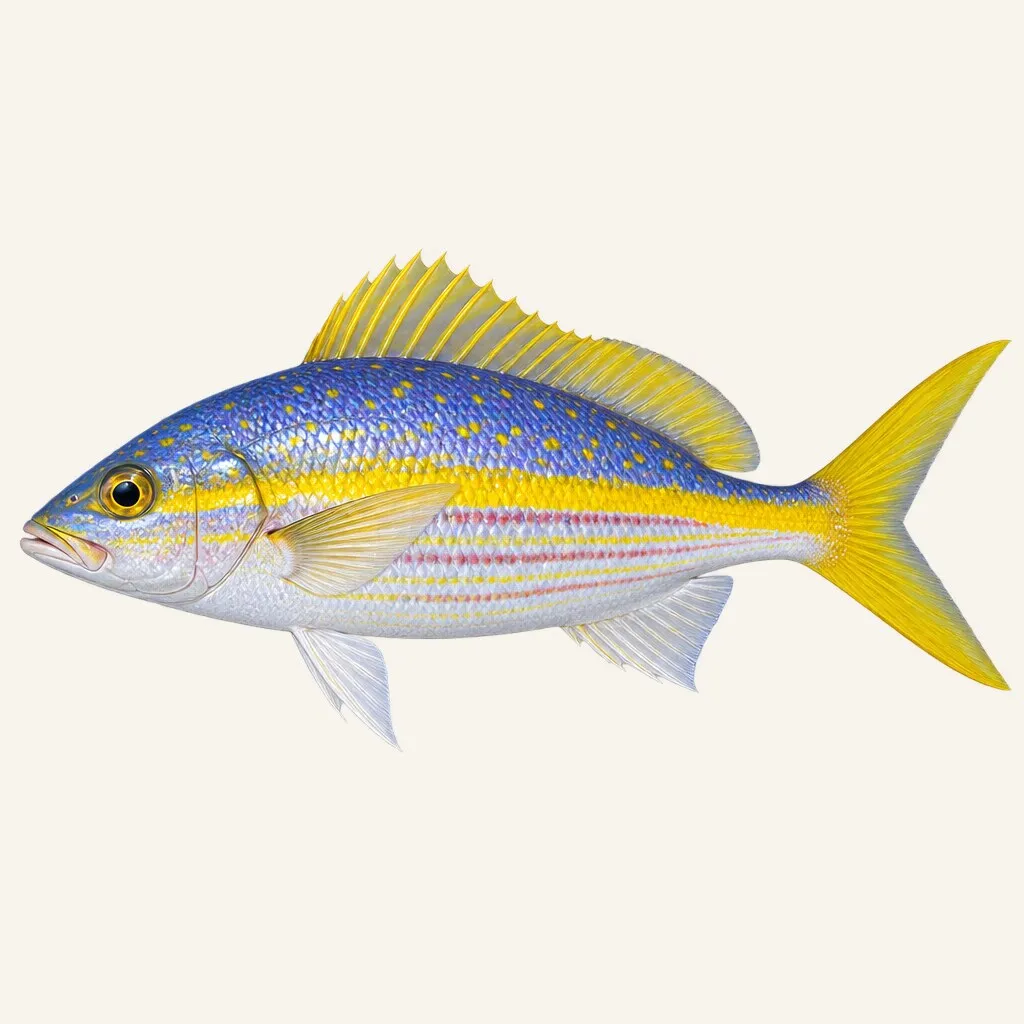
The yellowtail snapper is instantly recognizable by its deeply forked, bright yellow tail contrasting with bluish flanks dotted with yellow spots. This agile and fast lutjanid is highly popular in the tropical Atlantic, from the Caribbean to the Brazilian coast.
Calendar
Recorded in 28 countries
Antigua & Barbuda · Aruba · Bahamas · Belize · Bermuda · Brazil · British Virgin Islands · Caribbean Netherlands · Cayman Islands · Colombia · Cuba · Curaçao · Dominica · Dominican Republic · Guadeloupe · Honduras · Jamaica · Martinique · Mexico · Panama · Puerto Rico · Sint Maarten · St. Martin · Trinidad & Tobago · Turks & Caicos Islands · U.S. Virgin Islands · United States · Venezuela
GBIF occurrence records — native and introduced populations combined.
Identifying it
A yellow band runs the length of the fish from the snout to the base of the tail, widening as it goes back, and the whole caudal fin behind it is yellow. Nothing else in the Caribbean is marked that way, at any age.
The back and upper flanks are blue to violet, scattered with yellow spots; the lower body is pale, crossed by narrow red and yellow lines. The head is small for a snapper and the lower jaw projects slightly past the upper — a mouth built to take food from above rather than off the bottom. Ten dorsal spines, 12 to 14 soft rays, three anal spines, eight or nine.
One caveat belongs here. This species hybridises with the lane snapper, Lutjanus synagris, and the cross is documented: it is what the old name Lutjanus ambiguus actually covered. An intermediate-looking fish in Caribbean water is therefore not automatically an odd individual, and the genus boundary is no obstacle.
Breeding
Spawning runs all year, with peaks falling at different times in different areas.
For a reef fish that is unusual, and it has a consequence: there is no month in which the species is not breeding somewhere in its range, so no calendar closure covers the whole population and no season is the wrong one for finding ripe fish.
First maturity is early, at about 23.8 cm, recorded anywhere between 14 and 31, and the oldest fish aged was 19.
The water it needs
Coastal water around coral reef, from the surface down to 180 m with the usual band between 10 and 70. What matters is where in that water the fish sits: usually well above the bottom, frequently in aggregations, rather than tucked into the structure.
That is the whole difference between this snapper and the ledge-dwellers sharing its reef. Young fish keep to weed beds, which is a nursery habitat rather than a reef one, and they move out to the aggregations later.
Areas
- Shallow reef flats
- Seagrass beds
- Coastal sandy zones
- Coral reef drop-offs
Techniques
- Light handline fishing
- Fine soft lure fishing
- Live bait fishing
- Slow trolling
Baits
- Live shrimp
- Small live fish
- Squid pieces
- Marine worms
- Frozen shrimp
What it eats
The diet mixes plankton with benthic animals — fishes, crustaceans, worms, gastropods, cephalopods — taken mainly at night.
Juveniles feed primarily on plankton, and the adult keeps part of the habit. That is what the small head, the slightly projecting lower jaw and the mid-water position are for. A snapper grazing the drift is not competing for the food of one that hunts crabs in a crevice, which is how both of them live on the same reef.
How to catch it
The fish holds in the water column, so gear pinned to the bottom fishes underneath it. Baits and lures presented on a drift, high in the water, produce where a lead-heavy bottom rig produces nothing at all.
Fine traces matter for the same reason. This is clear water and the fish feeds on small items, so a light presentation is the method rather than a refinement of it. A common fish runs 40 cm, which keeps the whole business on light tackle.
Identification is instant thanks to the band and the tail, and that is worth something on a coast where nearly a dozen snappers look alike at a distance. The species has also been reared in captivity and is farmed commercially, which is uncommon among Atlantic snappers.
Conservation
Two features of the biology point in opposite directions and belong in the same paragraph.
In its favour: maturity at around 24 cm against a common capture length of 40 means most fish taken have spawned, and year-round breeding spreads reproduction across the calendar instead of packing it into a few exploitable nights.
Against it: the aggregations sit above the reef in open water, visible and reachable, and no closed season can be built around a spawning date because there is no single date to build on. Whatever protects this species has to work in space rather than in time, and how much of it would be needed is not something the available data answers.
Regulations
Check the local regulations in force (legal size limits, closed seasons, bag limits).
For guidance only. Legal sizes, quotas and open seasons vary by location and season: always check the local regulations in force before fishing.
Other names
Yellowtail snapper is unambiguous only inside the Caribbean. Elsewhere in English, yellowtail is one of the most overloaded words in the language of fish: it names an amberjack off California and a kingfish in Australia, both Seriola, a flounder on the North Atlantic banks, and a long list of reef fish with a pale tail. The qualifier snapper does all the work in the label.
Within the family the name is at least earned. Ocyurus holds this one species and nothing else, which is why no other snapper looks like it — and why the documented hybrid with a Lutjanus deserves the second look it gets from taxonomists. The epithet chrysurus says golden tail, describing the same fin the English name does, and Cuban Spanish builds rabirrubia on it as well. Three naming traditions, one feature, and a rare case of everybody agreeing.
Sources: fishbase.se · api.gbif.org