Amur pike
Esox reichertii · Esocidae
- Freshwater
- Predators
- Hard
- Size
55–115 cm
- Weight
1.4–20 kg
Where to fish
- Estuary
- Lake
- River
Habitat icons: Flaticon
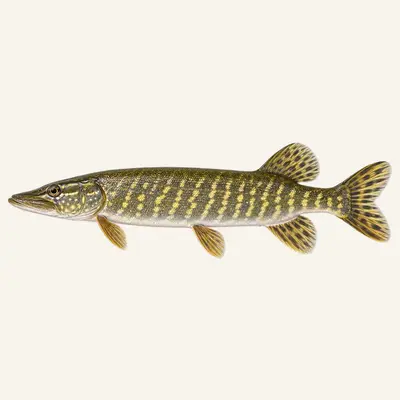
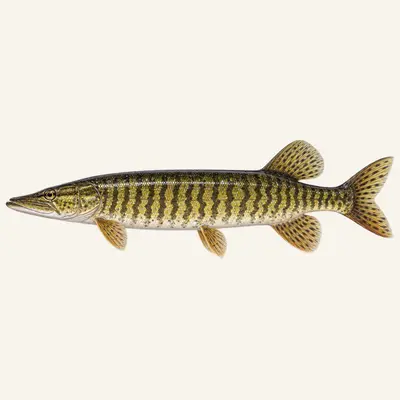
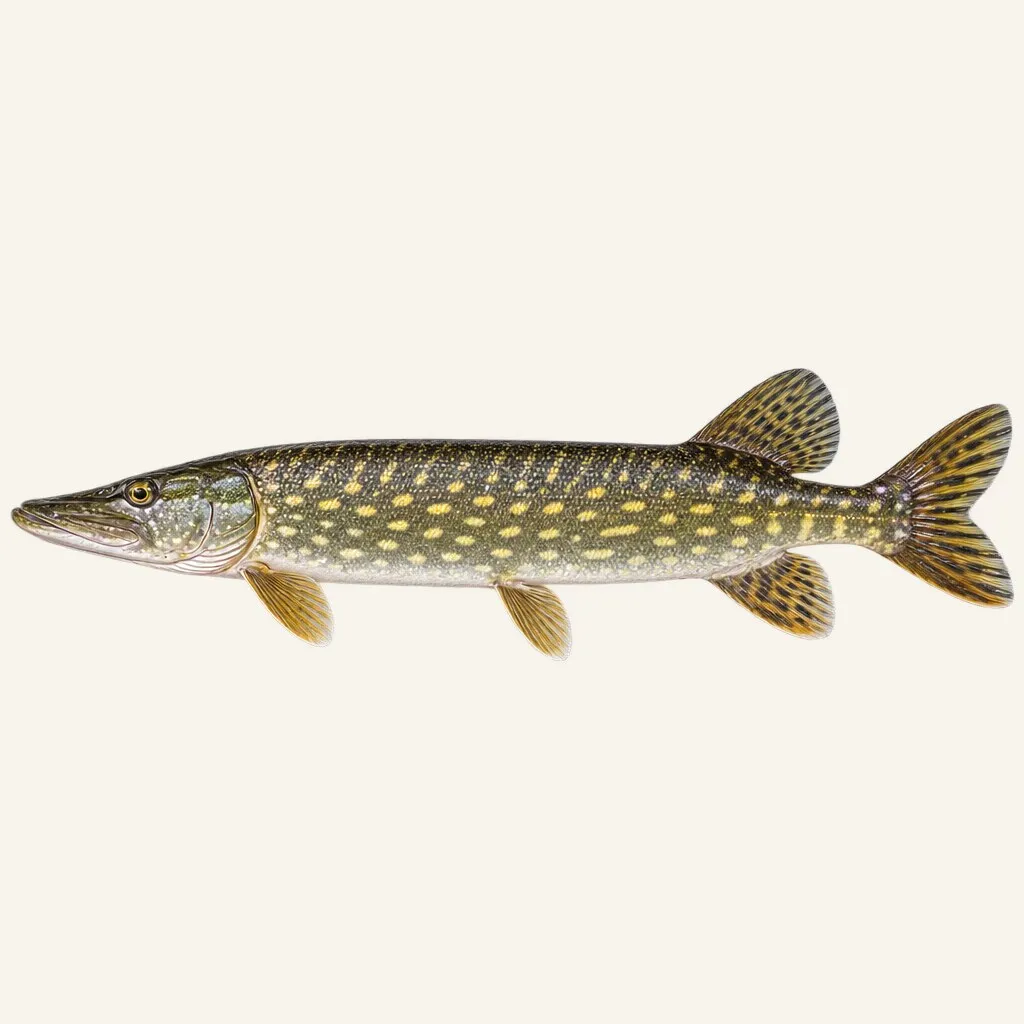
The Amur pike (Esox reichertii) is a large freshwater predator native to the Amur River basin in East Asia, sporting a silvery body scattered with small dark spots and the elongated build typical of the Esocidae family. An active and powerful hunter, it inhabits moderate-current rivers and lowland lakes across the region.
Calendar
Recorded in 3 countries
China · Germany · Russia
GBIF occurrence records — native and introduced populations combined.
Its range
One river system carries the species. It occupies the Amur basin and Sakhalin Island, together with the Onon and Kherlen drainages in Mongolia, upstream in the same region. No natural population exists anywhere else on earth.
That concentration is out of keeping with the rest of the genus, where one member holds an entire belt of the northern hemisphere and another three basins of a continent. Here the range fits inside a single river and its tributaries, with a direct consequence: whatever affects the Amur affects the whole species, and there is no reserve population in a second basin to restart it from.
Areas
- Large rivers with moderate current
- Lowland lakes with weed beds
- Tributary mouths
- Current seams along island edges
Techniques
- Heavy spoons
- Large soft plastic lures
- Live bait drift fishing
- Dead bait retrieve
- Large jerkbaits
Baits
- Large local live fish
- Dead bait retrieve
- Spoon lure
- Large soft plastic
- Surface live bait
What it eats
It feeds on fish of no commercial or angling value. The detail looks incidental and is not. A predator converting an unexploited biomass into its own flesh takes nothing from the species the local fishery lives on, and its abundance costs the other fisheries of the basin nothing at all. Large freshwater carnivores are rarely so cheap to keep.
How to catch it
The usual format is more modest than the reputation of the genus suggests. Maturity is reached at about 40 cm and the size commonly encountered is around 55. A metre fish is the exception here, and the bulk of the catch sits near half of that.
The gap between the ordinary format and the maximum has a practical use. Middling tackle covers most outings, and over-gearing is paid for in takes that are never felt. The species supports a commercial fishery and a sport fishery across its range.
Those two figures sit in an order worth noticing. Maturity is crossed at 40 cm and the ordinary catch runs to 55, so the fish met on a normal day has already bred at least once. Pressure falling mainly on spawned individuals is a comfortable position for a large predator, and here it is a product of the growth curve rather than of anything decided by a management body.
Regulations
Check the local regulations in force (legal size limits, closed seasons, bag limits).
For guidance only. Legal sizes, quotas and open seasons vary by location and season: always check the local regulations in force before fishing.
Other names
Amur pike names the fish after its river, which is a reasonable way to name something that lives in one and nowhere else. Blackspotted pike is the English alternative and points instead at the markings; of the two, the second is the more useful, since a river is only a help to a reader who already knows where the fish came from.
The epithet honours a nineteenth-century anatomist, in the manner of the period, and says nothing whatever about the animal.
Sources: fishbase.se · api.gbif.org