Northern pike
Esox lucius · Esocidae
- Freshwater
- Predators
- Medium
- Size
40–137 cm
- Weight
0.4–28 kg
- Lifespan
30 years
- Water temp.
10–28 °C
- Depth
0–30 m
Where to fish
- River
- Lake
- Pond
- Canal
Habitat icons: Flaticon
Iconic freshwater predator recognizable by its streamlined body and broad jaws lined with razor-sharp teeth
Calendar
Spawning: fish are vulnerable. Check local rules — closed seasons vary by country.
Recorded in 34 countries
Åland Islands · Austria · Belarus · Belgium · Bulgaria · Canada · Croatia · Czechia · Denmark · Estonia · Finland · France · Germany · Hungary · Ireland · Italy · Kazakhstan · Latvia · Lithuania · Luxembourg · Netherlands · Norway · Poland · Portugal · Romania · Russia · Slovakia · Slovenia · Spain · Sweden · Switzerland · Ukraine · United Kingdom · United States
GBIF occurrence records — native and introduced populations combined.
Its range
Pike are circumpolar. A single species occupies the belt of cool and temperate fresh water across the northern hemisphere, from Alaska to Labrador, from the Mississippi basin to the Anadyr in eastern Siberia, taking in the Caspian, the Baltic and the White Sea on the way. Few freshwater fish cover so much ground without splitting into separate species.
That ubiquity hides a rougher history. Pike were historically absent from several regions where they are fished today: the Iberian Peninsula, Mediterranean France, central Italy, southern and western Greece, the eastern Adriatic, Iceland, western Norway and northern Scotland. They were introduced there, often in the nineteenth or twentieth century and sometimes far more recently.
Those introductions are not neutral. Several countries report adverse ecological effects where the species arrived: a predator of this size, released into a lake that held none, redraws the whole fish community within a few years. The map above therefore shows two things at once, native range and conquered water, without separating them.
Identifying it
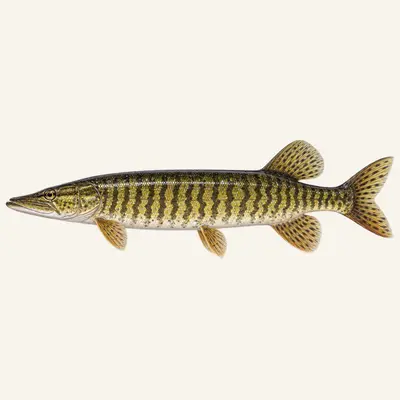
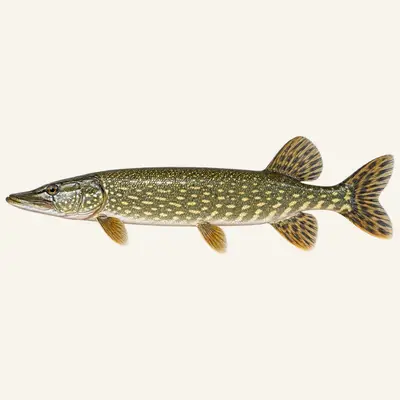
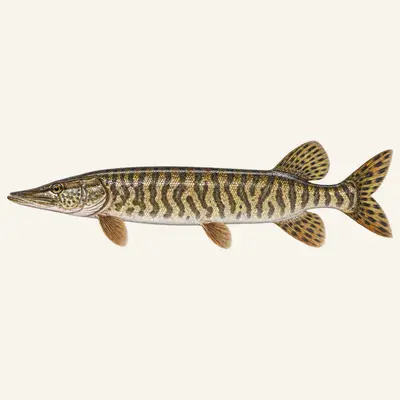
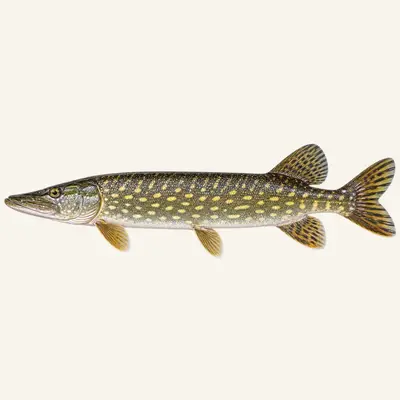
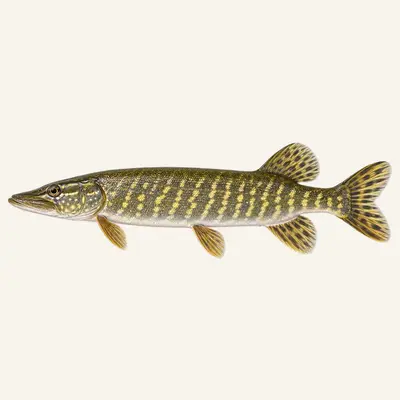
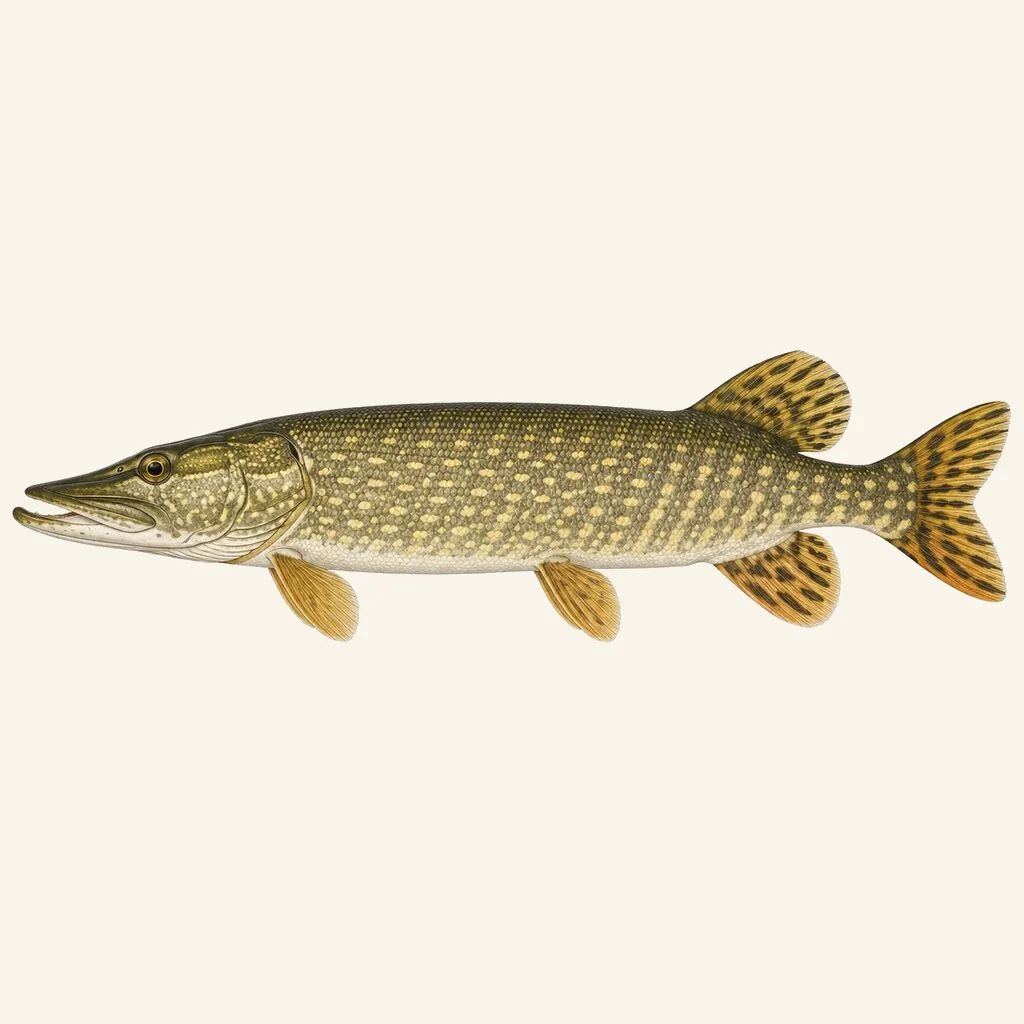
Nothing else looks like a pike, and one feature settles it: the snout. Long, flattened, shaped like a duck's bill, it has no equivalent among European freshwater fish. Open, it reveals an outsized mouth lined with many sharp teeth angled backwards — prey that goes in cannot back out.
The second giveaway is where the fins sit. Dorsal and anal are pushed right to the back of the body, almost against the tail. That is not a detail for anatomists: it is what makes a pike a catapult. All the propulsive surface sits behind the centre of gravity, which buys ferocious acceleration over a few metres and costs almost all stamina. A pike does not chase. It launches.
Everything else follows the same logic. The body is long and near-cylindrical, the paired fins low and rounded, the lateral line carries a hundred-odd large scales and notches towards the rear. The gill arches bear no rakers, only patches of small teeth — another sign of a fish that swallows prey whole and alive.
Colour shifts with the water. In a clear river it runs olive-green marbled with yellow; in peat-stained water or a silted canal it darkens towards bronze. That marbling is not decoration: it breaks the outline against weed, and a motionless pike in a weed bed stays invisible until it moves.
Breeding
Pike spawn in a few centimetres of water, which comes as a surprise for a fish that size. Breeders leave their lies and push into flooded ground — marshes, backwaters, meadows drowned by rising water. Spawning happens in daylight, unlike that of many species.
The pairing is lopsided and stays that way: one larger female attended by one or two distinctly smaller males. The group swims through and over submerged vegetation, often under twenty centimetres of water, releasing eggs and milt in small bursts. Five to sixty eggs at a time, no more, repeated every few minutes for hours, then a rest, then a resumption. The full sequence takes two to five days, and partners sometimes change between bouts.
Adults do not leave straight away. Most are off the spawning grounds within six weeks, some stay for fourteen. This is when the species is at its most exposed: concentrated, in shallow water, and busy with something other than watching its surroundings.
A pike matures at around forty centimetres, with considerable latitude — anywhere from twenty-five to over sixty. That spread comes down to temperature and available food: in a poor northern lake a fish takes years to reach a size a fertile pond delivers in two seasons.
The water it needs
What a pike wants comes down to three things: structure, visibility, and prey within reach. It holds in still or slow water — vegetated margins, weed beds, backwaters, the quiet pools of rivers — and rarely sits in open water. It needs something to hide against, and submerged vegetation does that better than anything.
This is a solitary and strongly territorial fish, which has a practical consequence: two good pike do not share a lie. A favourable spot holds one, occasionally two of very different sizes, never a group. It does refill, though: a spot emptied one day is often taken again within weeks by a fish from nearby.
Pike tolerate slight salinity and enter the brackish water of the Baltic, where they are caught within metres of properly marine fish. That tolerance is the exception; everywhere else this is a strict freshwater species.
One oddity throws light on how it uses territory. Pike faeces carry alarm pheromones that other fish avoid, and the pike deposits them well away from where it hunts. A predator that takes care not to advertise itself to its prey says a good deal about how it makes a living.
Areas
- Vegetated margins
- weed beds
- cluttered areas
- backwaters
Techniques
- Lure
- Live bait
- Deadbait jigging
Baits
- Spinnerbait
- Swimbait
- Jerkbait
- Soft lures
- Spoons
What it eats
Pike eat fish, and once adult they eat little else. Frogs and crayfish fill in at times, but the diet stays overwhelmingly piscivorous. That specialism explains fast growth where forage is plentiful and slow growth where it is not.
Cannibalism is common and starts early. Juveniles eat each other as soon as sizes diverge, which regulates numbers long before any outside predator gets involved. In some arctic lakes pike are the only species present: the young live on invertebrates and terrestrial creatures that fall in, and the large fish feed almost entirely on their juniors. A whole population can sustain itself on itself.
Eggs and fry, for their part, are eaten by everyone — other fish, aquatic insect larvae, birds, mammals. The number of eggs laid reads differently once you know what proportion survives.
How to catch it
Everything about fishing for pike follows from its build. An ambush predator is not chased down: something has to pass within range of its launch, which means within a few metres of its lie, at a speed that leaves no time to inspect. A lure worked ten metres from the right spot catches nothing, however good; the same lure brought past the weed edge draws a strike.
It hunts by sight, which explains the best windows of the day. At dawn and dusk the predator can still see when its prey already sees less, and that gap works in its favour. Overcast skies extend the advantage across the whole day. Under a midday sun it settles on the bottom or under cover, and the answer then is to slow down and fish accurately rather than cover ground.
The teeth dictate the terminal tackle. An abrasion-resistant trace ahead of the lure is not a precaution but the condition for seeing it again, and line should be checked after every fish: pike dentition scores nylon over several centimetres without cutting it through, and the next take is what pays for the saving.
Finally, it strikes out of aggression as much as hunger. A well-fed fish will charge a lure crossing its territory, which is why a lie that refuses the first pass sometimes produces on the third, with a different retrieve. Patience on a good spot beats distance covered.
Conservation
Nothing threatens pike at the scale of the planet, and the scale is exactly what misleads. One verdict covers an intact Siberian population and a western European river whose spawning grounds vanished under embankment work.
That is where the pressure lies. Pike depend on temporarily flooded ground to breed, and those are precisely the habitats that river engineering removed first: drained wet meadows, straightened banks, regulated levels that no longer flood anything in spring. A population can collapse in water that remains excellent for adults.
Handling matters too. A pike is held firmly under the gill cover, never by the eyes, and the operculum will open an unprotected hand. A fish meant to go back should spend as little time as possible out of the water and be supported until it takes hold of itself.
One last point belongs to health rather than conservation: pike frequently carry parasites, including the broad tapeworm, which can pass to humans through undercooked flesh. Thorough cooking settles it, as does prolonged freezing.
Regulations
Minimum size 50-60cm depending on the country / Spawning closure (France: Jan 29 - Apr 27)
For guidance only. Legal sizes, quotas and open seasons vary by location and season: always check the local regulations in force before fishing.
Other names
Northern pike is the full English name, which distinguishes the species from the chain and redfin pickerels sharing its waters in North America. French speakers say brochet, Germans Hecht, Swedes gädda. The freshwater shark nickname, common across languages, says enough about the place anglers give it.
Sources: fishbase.se · api.gbif.org