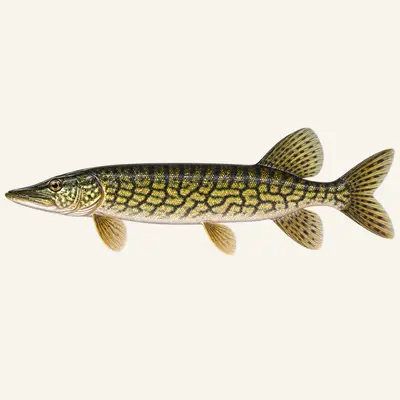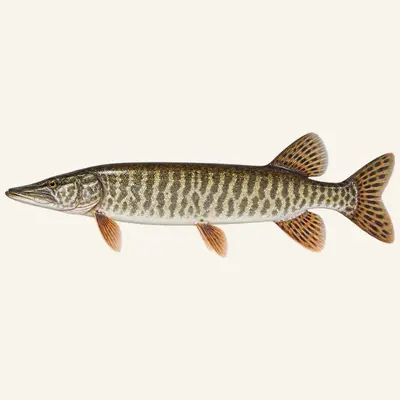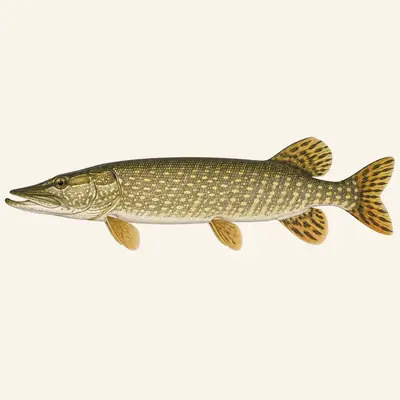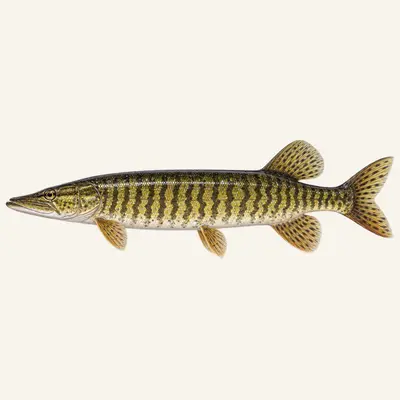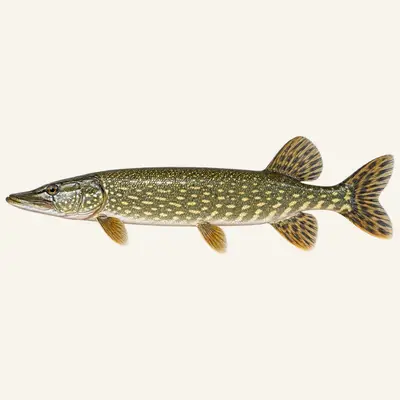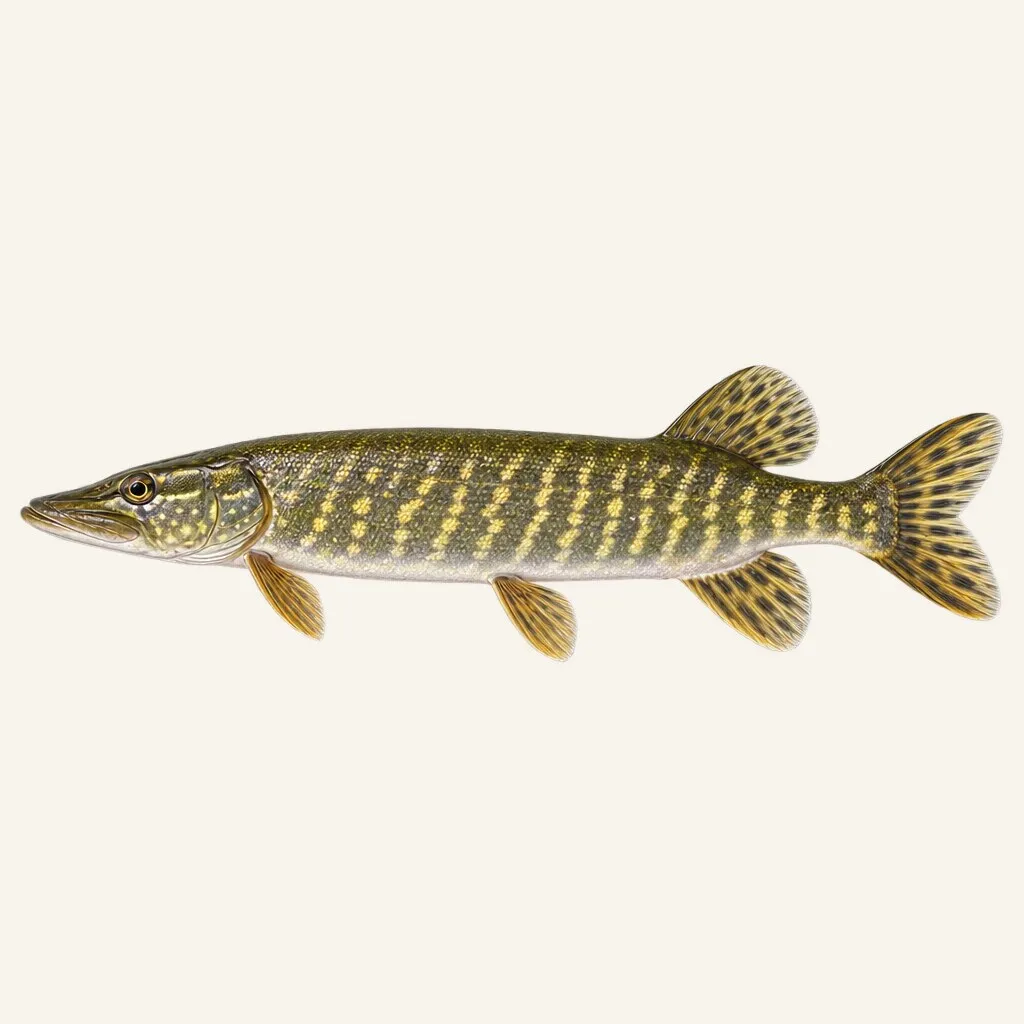
Aquitanian pike
Esox aquitanicus · Esocidae
- Freshwater
- Predators
- Hard
- Size
50–100 cm
- Weight
0.8–10 kg
Where to fish
- Estuary
- River
Habitat icons: Flaticon
A species distinct from the common pike - Recently identified genetically
Calendar
Recorded in 1 country
GBIF occurrence records — native and introduced populations combined.
Its range
Four Atlantic drainages in the southwest of France carry it: the Charente, the Dordogne, the Eyre and the Adour. Lake Mouriscot marks the southern limit known so far.
The empty parts of the chart are as informative as the filled ones. The Garonne ought to hold it — the biogeographic history of the French Atlantic rivers says so — and the absence of any record there is itself a result, since the population may have regressed following releases of northern pike. The same reasoning applies to the Loire, where only northern pike were caught, and to the Sèvre Niortaise basin, where its presence stays possible without a specimen having been taken.
A rule for prospecting comes out of that. The best odds lie in the small tributaries, the ones nobody stocks, and the worst in the large rivers that restocking has served for decades. The exact outline of the range remains to be drawn, and the work needed for it has not been done.
Breeding
One ecological difference separates this fish from the northern pike, and it is a matter of the calendar: it spawns in February, where French populations of the other species wait for March or April. On habitat, on behaviour and on predation, no divergence has been recorded at all.
A month's head start is not enough to keep the two apart. Where they meet, they interbreed, and the fact was established by the very work that described this species. A partial offset between two spawning periods always leaves an overlap, and an overlap is all that is needed.
That is the point everything else here follows from. A species that nothing prevents from crossing with another one, more numerous and poured regularly into the same water, does not disappear by being caught. It is diluted.
Areas
- Vegetated river banks
- Undercut bank pools
- Tributary confluences
- Lily pad and macrophyte areas
Techniques
- Lures
- Live baits
Baits
- Local live fish
- Dead bait retrieve
- Light spoon
- Linear soft plastic lure
- Compact jerkbait
How to catch it
Fishing for this pike is fishing for a pike: the lie, the hour and the lure do not change, since no behaviour of its own has ever been described. What changes comes after the capture.
A fish taken here is not moved elsewhere, and the water it came out of is not restocked with fish from another basin. The traffic runs both ways. Farms in the southwest may well be rearing and selling this species under the name of the northern pike, for restocking in France and abroad, with neither buyer nor seller any the wiser.
A word on size. The reference specimens are small — 41.6 cm standard length, and 37.2 for a female — but they are museum material, not maxima. In the field the species passes a metre, and an individual of 1,370 mm was reported from Lake Cazeau, in the middle of its range, with the reservation that old releases of northern pike cannot be ruled out of that record.
Conservation · Near Threatened (IUCN) — This species is in decline. Release your catch quickly and handle it with care — wet hands, as little time out of the water as possible.
Conservation
The threat comes neither from the rod nor from the net. It comes from the bucket. Every stocking of northern pike into an Aquitanian basin introduces a compatible breeding partner in greater numbers, and the mixed descent gradually erases whatever distinguished the local population. A species can go extinct while the count of pike in the river has not dropped by one fish.
To that is added the state of the rivers themselves, whose quality and floodable area have shrunk as they have everywhere else. The appraisal of December 2023 holds both causes together and notes that neither has stopped operating.
The remedy is administrative before it has anything to do with angling, and it turns on a question nobody asks in front of a tank of fry: where did these come from.
Regulations
Check the local regulations in force (legal size limits, closed seasons, bag limits).
For guidance only. Legal sizes, quotas and open seasons vary by location and season: always check the local regulations in force before fishing.
Other names
Aquitanian pike in English, brochet aquitain in French; the scientific name and the common ones all point at Aquitaine, the source of the material in the description published in 2014.
Before that date, the pikes of southwestern France were counted with the others. Every piece of literature written earlier conflates them, which means an English-language account of pike in the Adour or the Dordogne from before 2014 cannot be assumed to concern Esox lucius — and cannot be assumed to concern this fish either.
Sources: fishbase.se · api.gbif.org