Arapaima
Arapaima gigas · Arapaimidae
- Freshwater
- Predators
- Hard
- Regulated
- Size
200–450 cm
- Weight
64–200 kg
- Water temp.
25–29 °C
Where to fish
- Lake
- River
Habitat icons: Flaticon
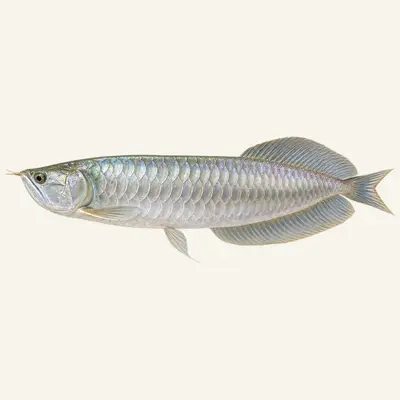
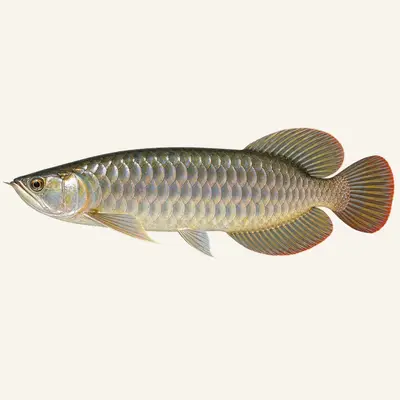
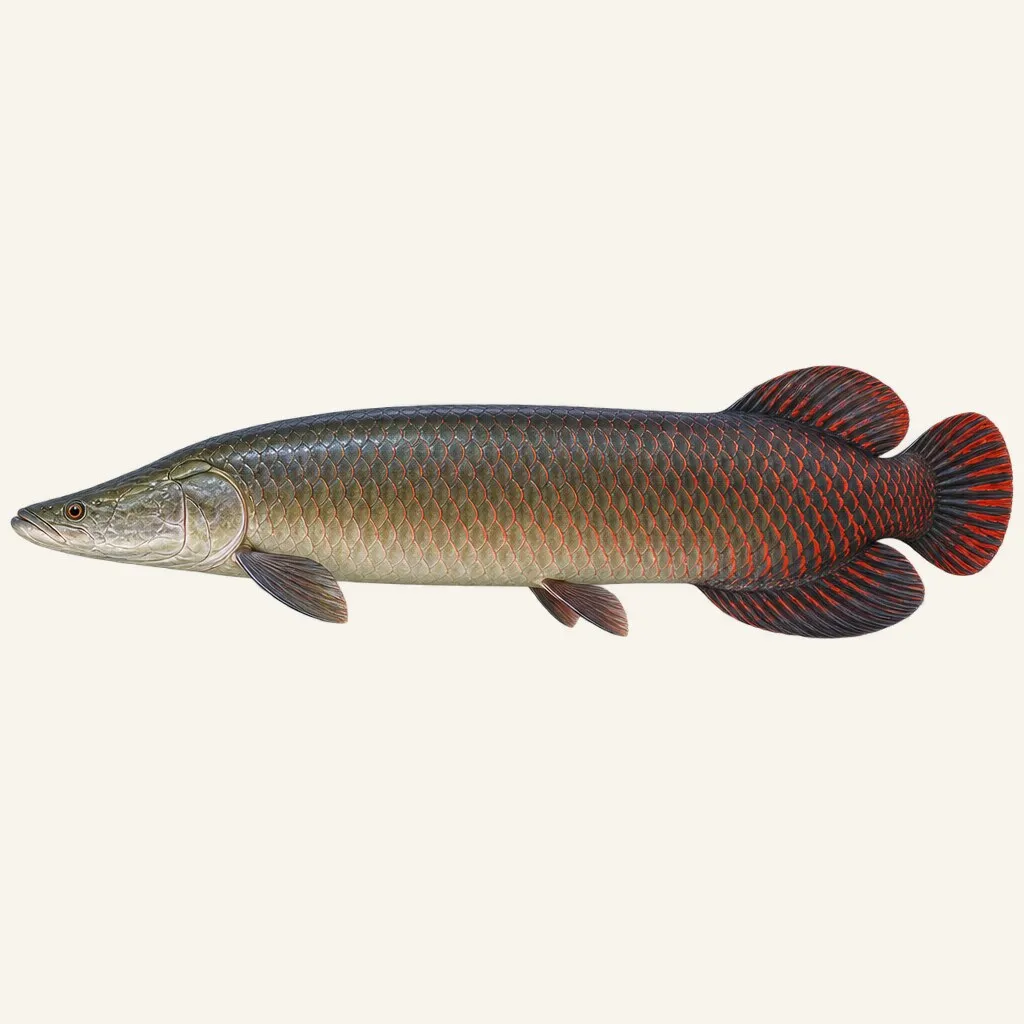
The arapaima is one of the largest freshwater fish in the world, capable of exceeding 2 metres in length, with a streamlined body covered in large, hard scales with green and red metallic sheen. An air-breathing predator, it hunts fish and small animals near the surface in Amazonian waters.
Calendar
Its range
A single basin holds the species, between five degrees north and 11 degrees south. Nothing in that band works as a barrier; the animal's requirements draw it. Water held between 25 and 29 °C, and an acidity narrow enough to state in half a unit: pH 6.0 to 6.5.
The documentation then adds something no map renders. Fishing has cut both the number of fish and the presence of big ones, and it did so first around the populated parts of the Amazon. The gaps in the real distribution follow towns and river traffic, not hydrology.
Breeding
The nest is a pit dug in sand, roughly 15 cm deep and 50 cm across. Laying falls in April and May, and the parents do not leave: the eggs are guarded, then the young are.
Two requirements come out of that, and neither is easily met. The bottom has to be open sand, which only some reaches of the network offer. And an adult has to hold station over a shallow scrape for weeks on end, doing nothing but watch it.
The size at which any of this becomes possible is the figure to carry away. Published first maturity sits close to 150 cm, inside a narrow band of 145 to 154. Nothing here spawns before passing a length most freshwater fish never see at all, and the fish ordinarily met — common length is two metres — has cleared that threshold by a margin of tens of centimetres rather than metres.
The water it needs
Two addresses, one year. As the water rises the species moves up into the higher floodplain; as it falls, it withdraws to lacustrine habitats and sits out the dry season there.
That commute alternates two opposite situations. In high water the fish are spread through an immense flooded volume, under cover. In low water they are shut inside lakes with a shoreline you can walk round.
The lung is what makes the second half of the year tenable. A shrinking dry-season lake, hot and crowded, is where dissolved oxygen goes first, and an obligate air breather is indifferent to that. What limits where this animal can live is written in temperature and in pH — not in oxygen, which is the reverse of the usual order for a large predator.
Areas
- Amazonian flooded plains
- Oxbow lakes (cochas)
- Large riverbanks
- Shallow areas with floating vegetation
Techniques
- Live bait surface fishing
- Large surface lures
- Dead bait fishing
- Large popper lures
Baits
- Large live fish
- XXL soft plastic lures
- Surface poppers
- Natural dead fish
How to catch it
One piece of physiology governs everything: this fish breathes air and has no option about it. Gills alone will not keep it alive, a modified swim bladder does the work of a lung, and the animal has to reach the surface to go on living.
Take that from the fish's side rather than the fisherman's. A predator tied to the surface cannot use depth as an escape. It cannot sound and stay down, it cannot wait out a fight in deep water, and it cannot hold in a layer where nothing is able to follow it. Its whole life happens in a column it is obliged to keep crossing. That is why the methods listed above are surface methods — large live baits, big surface lures, poppers worked in the open — and why nothing about this fish is fished deep.
Low water is the practical window, and for a plain reason: the animal has come back to the lakes, and a lake has an edge. The search stops being a search through a flooded forest and becomes the working of a closed piece of water.
Tackle is sized on the two metres of a common fish rather than on the record claims that circulate around this species. Those claims disagree with one another, and the published maxima vary from one source to the next; the common length is the figure that describes what actually comes to the surface.
Regulated — Often governed by quotas, size limits, seasons, or reporting rules.
Conservation
Over-harvesting is named outright in the sources, and what it has left behind is not a uniform decline. What the range description actually records is the loss of large individuals, concentrated around the populated regions.
That shape follows from the reproduction. Nothing spawns below about 150 cm, so the breeding fraction of this population is by definition its large fraction — the same fraction any fishery takes first. A stock can go on yielding metre-long fish and stop yielding anything that breeds.
The nest supplies the second exposure. In April and May a guarding adult is fixed above a shallow sand scrape for weeks, in little water, attending to something other than its own safety. It does not move off, and not moving off is the whole point of guarding.
The species is listed on Appendix II of CITES, which places its international trade under monitoring. An appendix governs what crosses a border; the fishery described here works on the river. The two instruments do not meet, and only one of them is aimed at what is happening.
Regulations
Check the local regulations in force (legal size limits, closed seasons, bag limits).
For guidance only. Legal sizes, quotas and open seasons vary by location and season: always check the local regulations in force before fishing.
Other names
Arapaima serves as both the English name and the scientific genus, and five of the six languages in this catalogue keep some form of it. Only Portuguese changes the word: in Brazil the fish is pirarucu, which is also the entry this site carries in Brazilian Portuguese. In Peru and the upper basin it is paiche.
That matters for reading anything written about the fishery. Pirarucu on a Brazilian market and paiche in a Peruvian one are the same animal taken at opposite ends of a single basin, and landings recorded under the two names are not two stocks.
The epithet gigas is the only part of the scientific name that describes the animal, and it describes the one thing everybody already knows about it.
Sources: fishbase.se · api.gbif.org