Muskellunge
Esox masquinongy · Esocidae
- Freshwater
- Predators
- Medium
- Size
95–183 cm
- Weight
6.0–32 kg
- Lifespan
30 years
Where to fish
- Estuary
- Lake
- River
Habitat icons: Flaticon
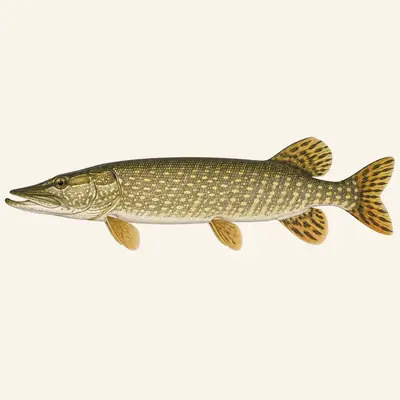
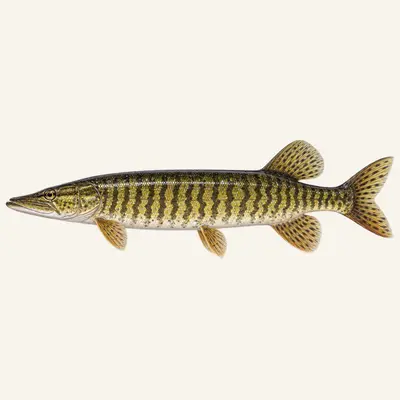
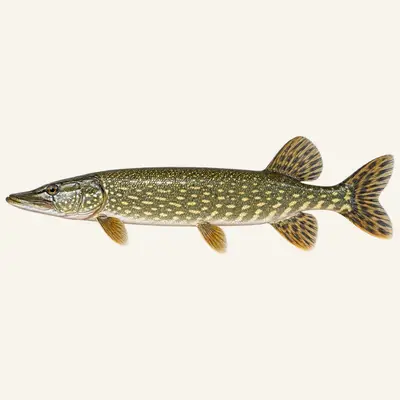
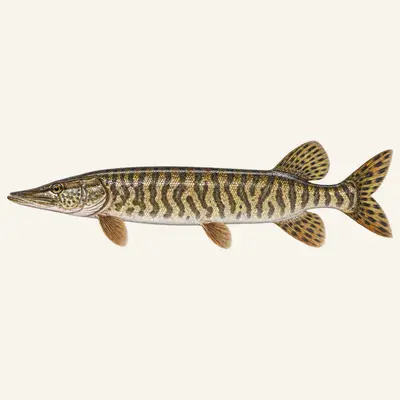
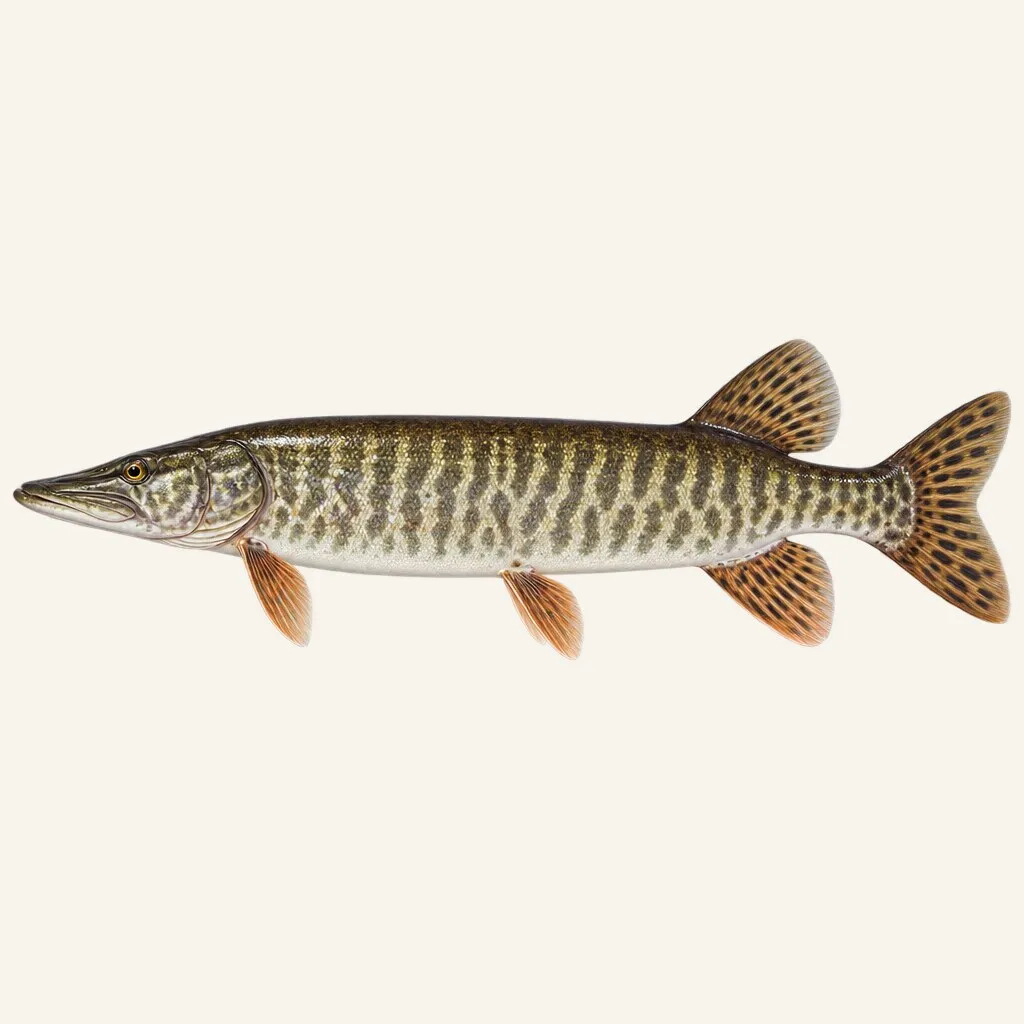
The muskellunge is the largest member of the Esocidae family, recognizable by its light body marked with dark spots or vertical bars and a prominent lower jaw lined with sharp teeth.
Calendar
Recorded in 2 countries
GBIF occurrence records — native and introduced populations combined.
Its range
Three river systems make up the cradle of the species: the St Lawrence with the Great Lakes, Hudson Bay by way of the Red River, and the Mississippi. Everywhere else in the United States, its presence follows a release.
That distinction carries more weight than it looks when a map is being read. On one side are populations in place since long before anyone was counting, some of them under protection in portions of Tennessee and Ohio. On the other are waters where the fish was put down and where its presence sometimes depends entirely on successive stockings. One colour covers two situations that are not worth the same.
A comparison lights up the range. Where its Eurasian and American relative holds a whole belt of the northern hemisphere, this fish never crossed the limits of one continent under its own power. It is an animal of three basins rather than of a hemisphere, and its size opened nothing for it.
Breeding
The specialists do not agree on what happens at spawning, and the disagreement is better set out than settled. Some describe a form of copulation: the female rolls onto her side to expose her abdomen, the male drives against her in a forceful movement, she then rests and lays her eggs on sand, and the sequence is presumably gone through once more. Others see nothing beyond a simple simultaneous discharge of gametes, with no organised contact at all.
Two points are established. Spawning starts in spring, as the ice withdraws, in water that has only just come free of it. And maturity is late: it settles at around 77 cm. A fish of 70 cm, already respectable in a net, has in all likelihood never spawned once.
The water it needs
Clear water is the condition. It occupies limpid vegetated lakes, quiet pools and backwaters in creeks and rivers of every size, and the common factor is visibility: a hunter that picks its prey out at a distance loses the whole of its advantage in loaded water.
The second trait is isolation. The animal lives alone, on the lurk, posted against a weed bed or a piece of submerged structure. A favourable spot holds one fish and not a group, which gives prospecting an arithmetic character — the number of tenable lies on a water fixes, near enough, the number of large fish it carries.
Areas
- Aquatic weedbed edges
- Rocky points and headlands
- Shallow bays
- River mouths
Techniques
- Topwater lures
- Large swimbaits
- Heavy spoons
- Live bait drift fishing
- Articulated jigs
Baits
- Large live fish (perch, cisco)
- Dead bait retrieve
- Muskie bucktail
- Buster bait
- Large soft plastic
What it eats
Other fish make up the bulk of the diet, but the list of recorded prey leaves the water outright: ducklings, muskrats, snakes. Few freshwater predators take air-breathing animals as regularly, and the detail says more about what fits down the throat than any measurement of the gape would.
How to catch it
The measurements give the scale of patience required. Common length runs to 95 cm, and an individual can reach thirty years. Reaching the top of that scale occupies a large share of an entire life, and fish of that class are not numerous and never will be.
The hunting method dictates the approach. An animal that waits instead of pursuing is taken by putting something within immediate reach of its ambush, against the weed edge or along the structure, and not by covering open water at random. Clear water adds a constraint of its own: the approach is visible, and a fish that has seen the boat has stopped feeding.
The diet, finally, licenses lures that reason would hesitate to tie on. Something that takes ducklings and muskrats is not impressed by a bulky surface bait. It is imitation rather than provocation, and what works on top here is working in the right place.
Conservation
A fish that does not breed before 80 cm and can live thirty years rebuilds on a timescale unconnected to a fishing season. Every large individual represents an accumulation of years that no stocking replaces: cohorts can be manufactured, old animals cannot.
Add the solitary, territorial habit. Taking the fish off a lie does not leave a gap that closes within days, as it would in a shoaling population, and restoring a lake's stock of large individuals is counted in decades. That is what led several states to protect their original nuclei instead of relying on restocking.
The most recent global appraisal dates from December 2011, which is old for an animal whose sporting exploitation has intensified since. The species is also reared commercially and kept in public aquariums.
Regulations
Check the local regulations in force (legal size limits, closed seasons, bag limits).
For guidance only. Legal sizes, quotas and open seasons vary by location and season: always check the local regulations in force before fishing.
Other names
The English word comes from an Ojibwe term by way of Canadian French, where it is maskinongé; from there English took muskellunge, and anglers shortened it to muskie. No other language translated it — Spanish, Italian and Portuguese use the French form, German the English one — which is unusual for a freshwater fish of this size and this reputation.
Angling literature added a name of its own: the fish of ten thousand casts. It reads as a boast, but it is also arithmetic, since a water holds as many large muskellunge as it has lies to hold them in, and not one more.
Sources: fishbase.se · api.gbif.org