Chain pickerel
Esox niger · Esocidae
- Freshwater
- Predators
- Medium
- Size
42–99 cm
- Weight
0.5–4.3 kg
- Lifespan
9 years
- Water temp.
10–20 °C
Where to fish
- Pond
- River
Habitat icons: Flaticon
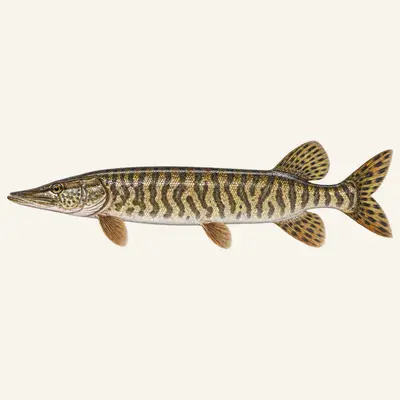
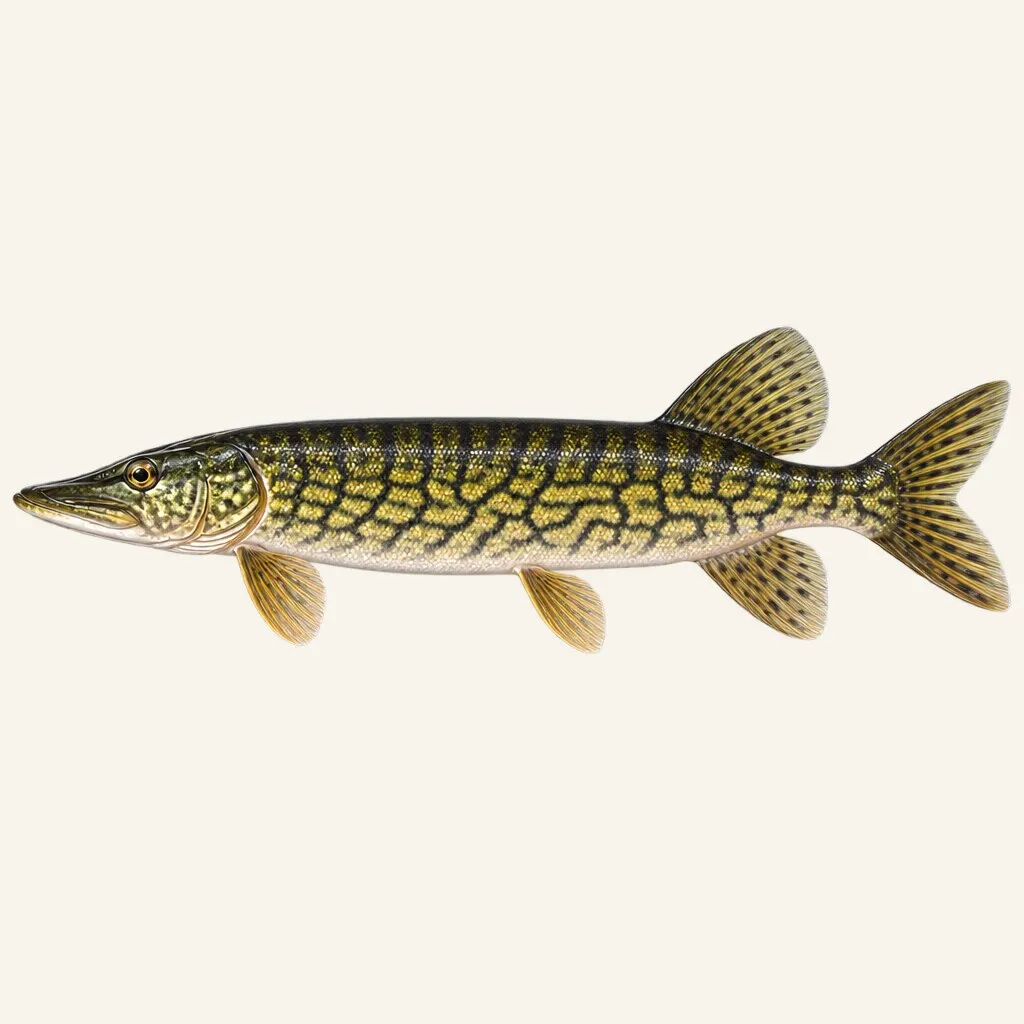
The chain pickerel (Esox niger) is a small North American freshwater pike easily identified by the dark chain-like markings covering its greenish-brown sides. An ambush predator, it lurks motionless among aquatic vegetation in ponds, swamps, and slow-moving streams.
Calendar
Recorded in 2 countries
GBIF occurrence records — native and introduced populations combined.
Its range
The range follows a temperature band rather than a geography. The species lives between 10 and 20 degrees, and that bracket puts it down the Atlantic slope as far as southern Florida, along the Gulf coast west to the Sabine Lake drainage in Louisiana, and up the Mississippi basin into Kentucky and Missouri.
So this is a southern esocid, which separates it from all the others. Where its relatives hold cold water, this one holds the American Southeast, a region the big pikes never settled. Two recent extensions have to be read apart: Nova Scotia, where the fish was introduced rather than found, and the Lake Ontario and Lake Erie drainages, reached the same way.
Identifying it
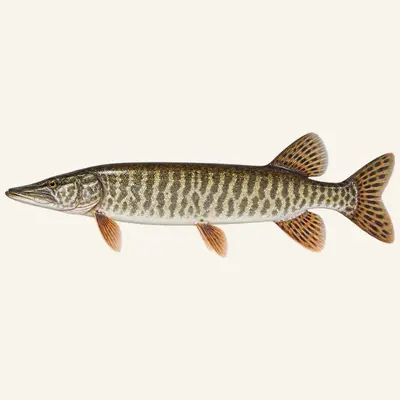
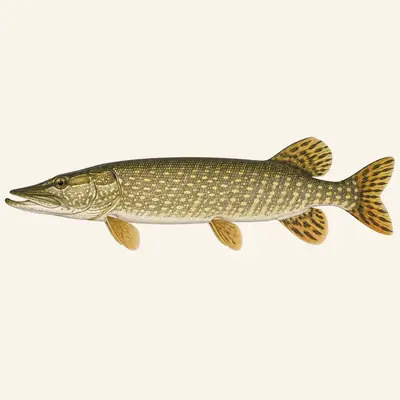
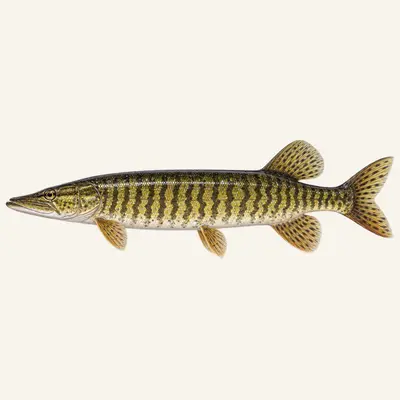
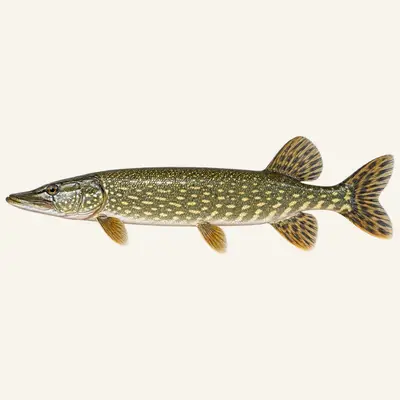
The flank pattern names the species in nearly every language: pale areas fenced in by a dark tracery, making a net of regular links. It is constant, and it reads at a distance, including on a wet fish in the meshes of a net. Over the back the ground colour is dark and cut by lighter vertical bars, and the scales above carry a golden lustre.
The second mark sits below the eye. The suborbital bar drops almost vertically, at most tipped a little backwards, and the orientation is worth checking wherever several small esocids share the same water.
The third is the scaling of the head. Cheek and gill cover are scaled over their whole surface, with no bare patch left anywhere on either. The skull itself stays naked and flattened on top, the profile slightly concave above the snout; that snout is long, broad and rounded, the mouth large and nearly horizontal, the lower jaw projecting, and the maxillary reaches the front edge of the pupil or passes it slightly.
Then the counts: 17 to 21 soft rays in the dorsal, 11 to 13 in the anal, 49 to 54 vertebrae, and no spines anywhere. The lateral teeth of the lower jaw and of the vomer are conspicuously enlarged, the pupil is yellow, the base of the tail is marbled with dark pigment and its tips are dusky.
Breeding
The eggs are pelagic. That is what sets this fish apart from most of its close relatives: instead of sticking to drowned vegetation, they drift free in the water column, which releases the spawning from any need for a particular support and exposes it entirely to current and to predators.
The calendar amounts to a single movement. Adults winter in deeper water and then run for the bank as soon as the ice has gone. The move is quick, and it concentrates the fish close to the edge at the end of winter.
The early stages play for erasure. Larvae conceal themselves in vegetation; juveniles lie motionless near the shore or bury themselves in mud under debris. Nothing about them is built for flight, and everything is staked on not moving.
The water it needs
Quiet water cluttered with plants makes up most of its ground — vegetated lakes, swamps, backwaters, the calm pools of creeks and medium rivers. Depth stays low, a few metres, six at the most in the available records.
One exception is worth keeping because it contradicts the portrait. The fish is also found in deep, cold water carrying little or no vegetation. A bare water is therefore not to be written off out of hand: the absence of weed does not exclude the species, only the usual way of looking for it.
Areas
- Lily pad beds
- Shallow swamps
- Vegetated coves and bays
- Slow-moving streams
Techniques
- Light spinning spoons
- Compact spinnerbaits
- Surface lures
- Dead bait retrieve
- Light jigs
Baits
- Small live fish
- Artificial frog
- Small crayfish
- Dead bait
- Small soft plastic
What it eats
The behaviour of the juveniles predicts that of the adults. A fish that learns to hunt by staying still under a piece of debris keeps that manner once it is grown: it waits, and lets prey come to it. Hunting is done from ambush inside the vegetation, hard against cover, rather than by running anything down in open water.
How to catch it
Everything turns on a question of scale. The size commonly met is around 42 cm, and the greatest age recorded is nine years. Tackle calibrated for the large esocids does not transmit the take of a fish in this class, and does still less justice to how it fights.
That figure of nine years has a second consequence. The species is short-lived, so an individual well above the common size is not merely big: it is old, and it is rare in a population that turns over fast.
The clearest appointment of the year is the end of winter. The move from deep water to the bank, just after the thaw, gathers the fish into a narrow shallow strip at a moment when they are reachable from dry land. The rest of the season means working the gaps in the weed one at a time, with the lure presented a short distance from cover.
Conservation
This small esocid is now present in waters that never carried it. Nova Scotia and the Lake Ontario and Lake Erie drainages received it by release, and its presence there is the result of a human decision rather than of any expansion of its own.
Adding one more predator to an assemblage where others already fill that role produces an adjustment whose direction is only legible afterwards. The fish is neither scarce nor commercially sought — it feeds a subsistence fishery and a sport fishery — so the question it raises is not one of protection but one of transport.
Regulations
Check the local regulations in force (legal size limits, closed seasons, bag limits).
For guidance only. Legal sizes, quotas and open seasons vary by location and season: always check the local regulations in force before fishing.
Other names
Chain pickerel in English, for the tracery on the flank, and the pattern names it in most other languages too.
Pickerel is the word to be careful with. In North America it covers this fish along with the smaller redfin and grass pickerels; in Canadian speech the same word is commonly applied to the walleye, a perch relative with nothing esocid about it; and in older British usage a pickerel was a young pike. A catch report that uses the word on its own has not identified anything.
The epithet is the Latin for black, which suits a back that can indeed be very dark, and suits nothing else about the animal.
Sources: fishbase.se · api.gbif.org