Azul peacock bass
Cichla piquiti · Cichlidae
- Freshwater
- Predators
- Medium
- Size
48 cm
- Weight
1.8 kg
Where to fish
- Lake
Habitat icons: Flaticon
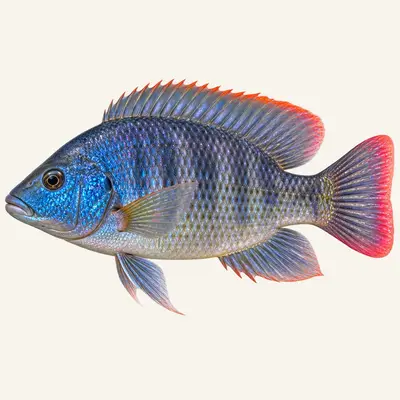
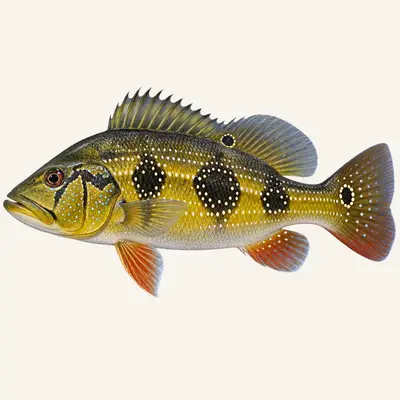
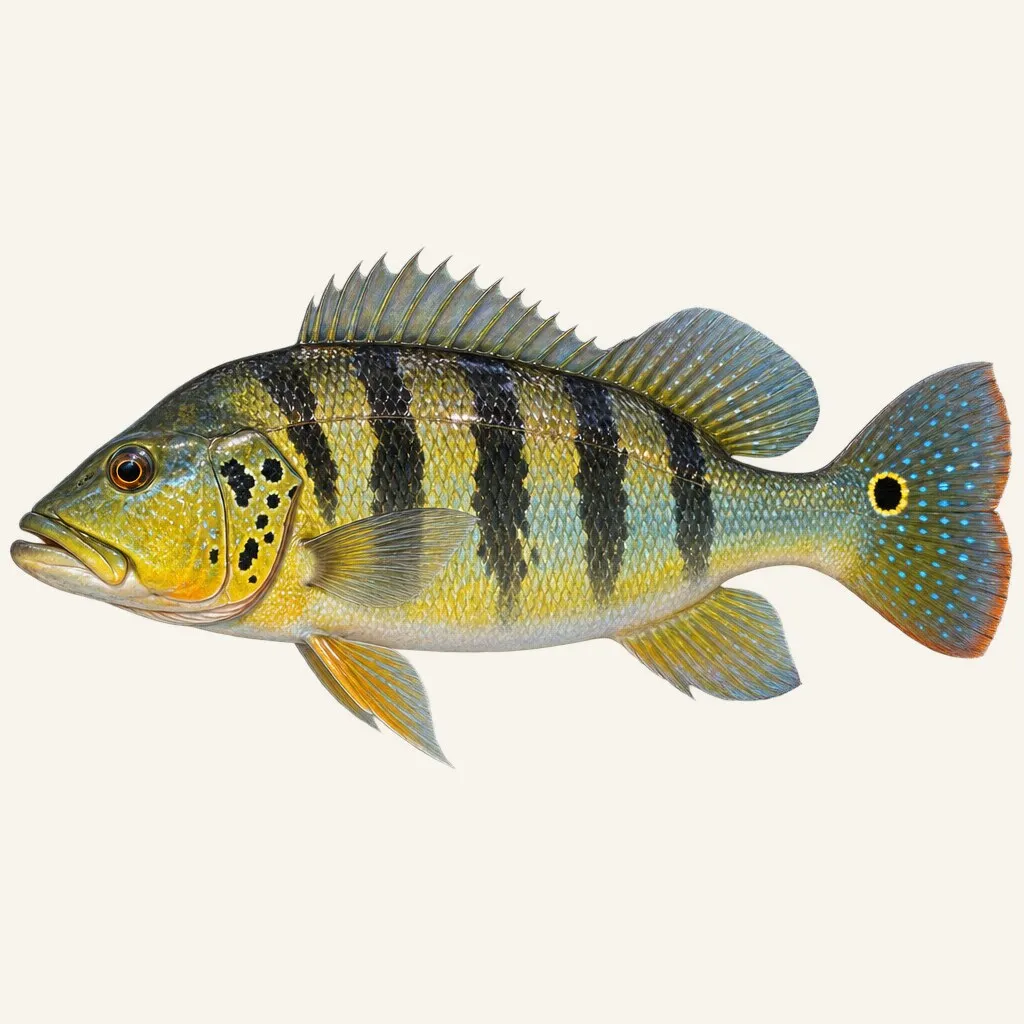
The blue peacock bass is a predatory cichlid native to the Tocantins-Araguaia basin, recognizable by its intense bluish iridescence and well-defined dark ocellated spots. It inhabits the clear to slightly turbid waters of rivers and reservoirs in central Amazonia.
Calendar
Recorded in 2 countries
Brazil · Singapore
GBIF occurrence records — native and introduced populations combined.
Identifying it
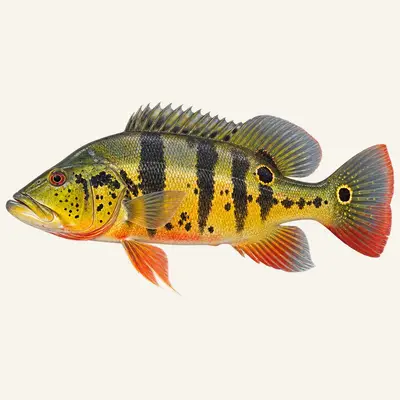
Five broad dark bars cross the flank below the dorsal fin in the adult: bars 1 to 3, with the intercalary pair 1a and 2a filling the gaps between them. Five wide bars, where its nearest relatives show three, or show narrow ones.
The scale count places the species in the middle of the genus, 83 to 104 in the E1 row. That rules out both ends at once — the species counting under 70, and those running past 110.
The intercalary pair is not unique to it. Four congeners carry bars 1a and 2a, and the useful part is how they carry them. In C. melaniae and C. intermedia the pair is described as fine and narrow; here all five bars are broad and belong to one even series. The count is shared, the width is not.
The body is fusiform, and there the diagnosis stops.
Areas
- Hydroelectric reservoirs
- Deep submerged structures
- Fast/calm water transition zones
- Reservoir shorelines
Techniques
- Deep vertical jigging
- Cast and retrieve with minnow lures
- Surface fishing
- Slow trolling
Baits
- Weighted jigs
- Deep-diving minnow lures
- Soft plastic lures
- Wobbling spoons
- Live fish
How to catch it
What to expect is framed by sex, which is unusual in this genus: the published lengths are listed for males and for females apart, and the males run the longer of the two. This is a small peacock bass, and the sexes differ enough for the record to bother splitting them, which most of its relatives' files do not.
That has a consequence at the net. If that split holds on the water, the larger fish in a catch are males, and the ones worth handling carefully for the population's sake are the smaller ones.
Nothing else is recorded. The sheet holds a key and a set of measurements; the water this fish occupies, the prey it takes and the season it breeds in are all blank. Nor can any of it be borrowed from its congeners, which live in other basins: a diet measured in one river system describes that river system.
Regulations
Check the local regulations in force (legal size limits, closed seasons, bag limits).
For guidance only. Legal sizes, quotas and open seasons vary by location and season: always check the local regulations in force before fishing.
Other names
Tucunaré azul in Brazil, the qualifier for the blue cast the flanks take between the bars, and peacock bass in English like the rest of the genus.
Five wide bars over a blue flank make this one of the few members of the genus whose vernacular name describes something a person can actually see. Elsewhere the Brazilian names separate species that English lumps together, and here they separate them on a visible character rather than a scale count.
Sources: fishbase.se · api.gbif.org