Blue tilapia
Oreochromis aureus · Cichlidae
- Freshwater
- Other
- Medium
- Size
16–46 cm
- Weight
0.1–2.0 kg
- Water temp.
8–30 °C
Where to fish
- Lake
- River
Habitat icons: Flaticon
Blue tilapia - white fish, Africa/Worldwide
Calendar
Recorded in 2 countries
GBIF occurrence records — native and introduced populations combined.
Its range
The natural range is the most northerly in the genus, between the 10th and 35th parallels north: the Jordan Valley, the lower Nile, the Chad basin, the Benue, the middle and upper Niger, the Senegal. No African tilapia goes higher without having been carried there.
That position explains the rest. A fish already living at the margin of the tropical domain withstands winters that stop its relatives, which is why it was picked for the warm-water ponds of the United States, of Central and South America and of South-East Asia. It has also been released into the Azraq oasis in Jordan.
At least one country has documented ecological damage after that establishment.
Identifying it
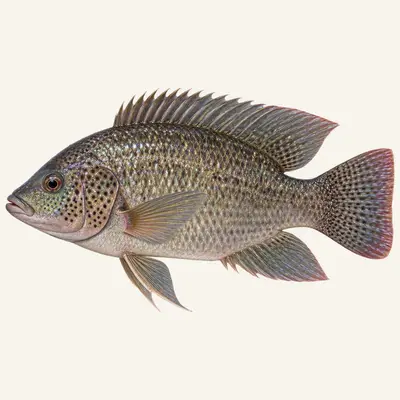
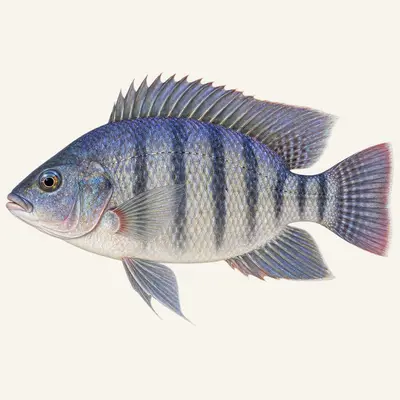
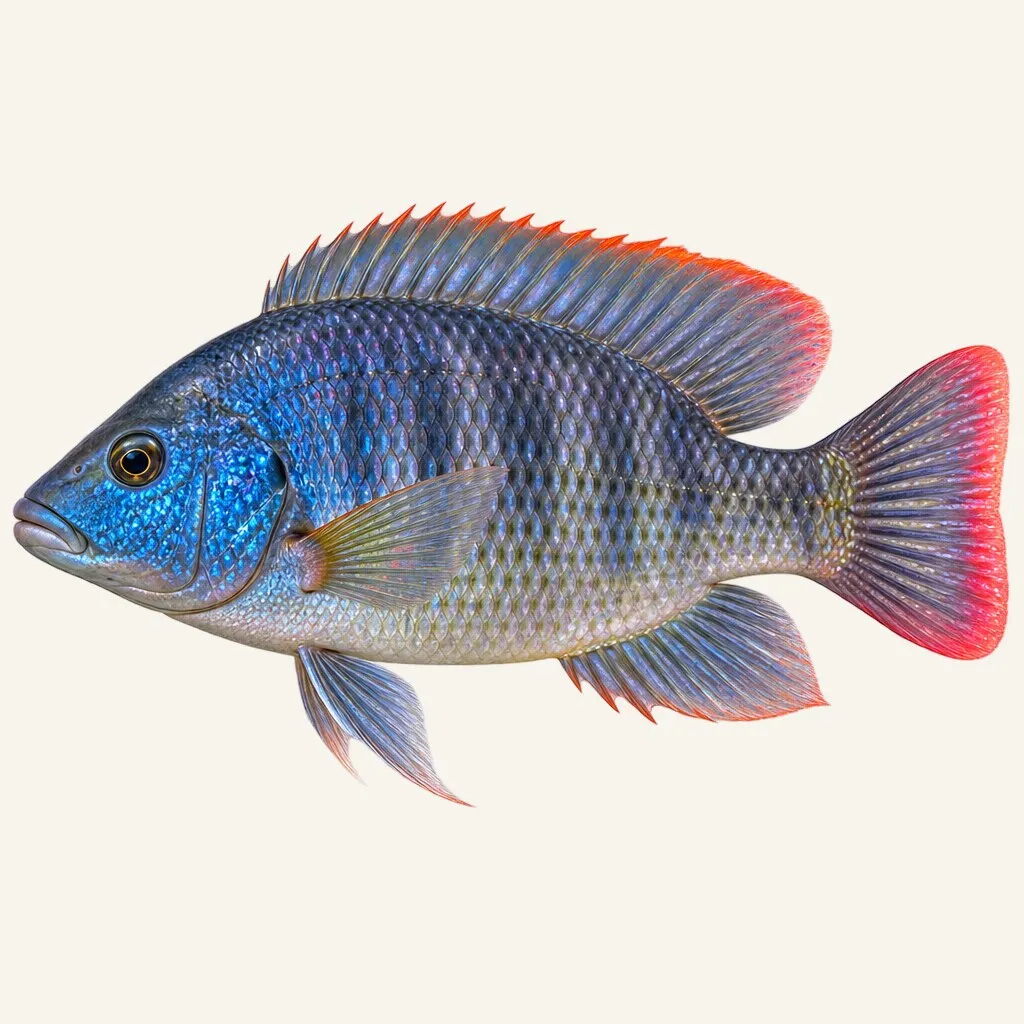
Look at the caudal fin and nothing else to begin with. It carries no regular dark vertical bars; instead its outer edge widens into a broad pink to bright red margin. The Nile tilapia, with which it is constantly confused wherever both have been introduced, shows precisely the reverse.
A breeding male leaves less doubt still. The head takes an intense metallic blue, the dorsal edges in vermilion, the caudal margin saturates to pink. A spawning female shows the same borders in a paler, more orange shade.
Two skeletal characters lock the identification down: the preorbital bone is narrow, at most 21.5 per cent of head length in fish up to 21.3 cm standard length, and the lower pharyngeal jaw has a short blade. In the adult the jaws do not hypertrophy, the lower one rarely exceeding 36.8 per cent of head length.
Juveniles are determined differently. The upper head profile rises from the snout at a sharp angle, the lower pharyngeal bone is nearly triangular, the teeth numerous without being crowded. The body is dark, dorsal and anal striped — obliquely on the soft dorsal, longitudinally on the caudal — and the black tilapia mark is present on the soft dorsal. The lower lip develops from beneath. Counts: 14 to 17 dorsal spines, 11 to 15 soft rays, eight to 11 anal rays, 28 to 31 vertebrae.
Breeding
Day length commands here, not warmth alone. Long photoperiods release breeding, short days inhibit it, and the spawning peak falls between the ninth and eleventh hour of light. A threshold near 20 °C is still required, but a hot short spring will not do if the light does not come with it.
The pits are out of scale with the animal. A male digs one with mouth and fins reaching 60 cm deep and four to six metres across, usually in shallow weedy ground, and territories are often clustered. They are held by lateral display, flank biting and mouth-to-mouth combat.
The male goes to fetch females out of their schools. In the nest the display is symmetrical: both fish present flank-on, nip, and beat their tails. The clutch falls in a single batch, several dozen to 100 eggs, fertilised at once and taken straight back into the female's mouth. One female may carry up to 2,000 in total.
She then moves off into deeper water with her load while the male starts again with another. Hatching comes three days after laying; total incubation depends on temperature, 13 to 14 days at 25 to 27 °C, eight to 10 days at 29. The young emerge at about 1.1 cm, stay grouped near the mother's head and return to her mouth at any alarm or on a gesture from her. The bond breaks after five days, which is short for the genus.
In ponds, maturity is reached at five or six months.
The water it needs
Eight degrees: that is the observed floor, where the Nile tilapia needs nearly twice as much and the Mozambique fish 17 °C under natural conditions. The ceiling sits near 30 in ordinary use, with tolerance running to 41. This downward margin is the most useful trait the species has, in culture and in the wild alike.
Adults accept fairly brackish conditions, and breeding proceeds in fresh and in lightly saline water alike. The fish uses warm ponds and impoundments as much as lakes and streams, in open water as much as among stones and vegetation, from five metres down.
Social behaviour has two modes: it schools, and it turns territorial in phases. The switch follows the breeding season.
Areas
- Shallow lakes and reservoirs
- Shaded banks
- Calm stream areas
Techniques
- Feeder fishing
- Match fishing
- Seed fishing
Baits
- Corn
- Bread
- Earthworms
- Vegetable pellets
What it eats
Phytoplankton dominates, with small quantities of zooplankton alongside. Young fish have a wider menu, rich in copepods and cladocerans, with fragments of small invertebrates.
That slide from zooplankton to phytoplankton with growth is worth knowing at the bank. A small fish is chasing a moving target, a large one is filtering a vegetable soup, and the two are not decided by the same stimulus.
How to catch it
A located school beats a chosen swim. The species moves in groups, which makes covering ground pay and makes camping useless: a stretch that produces nothing in 10 minutes will not produce more in an hour. During spawning the arrangement changes completely, and the clusters of pits fix the males in shallow weedy ground.
Size stays modest for the genus. Common length is around 16 cm. A 40 cm fish is exceptional, not the standard for a good one.
Two secondary uses are worth noting. The species is treated as a sport fish where it has been introduced, and it is routinely used as bait: its young serve to catch something other than itself.
Conservation
The cold it tolerates is also what makes it a problem. A fish that holds at eight degrees passes through cold seasons its tropical relatives do not survive, and a population released under a temperate climate has a far better chance of persisting than any other African tilapia. That is why it is identified as a potential pest, and why keeping and transporting it are controlled in several countries.
Monitoring of its original populations, on the other hand, does not exist. No public account says what has become of it on the Niger, the Benue or the lower Nile, while its establishment outside Africa has already cost at least one country documented ecological damage. Attention goes to this fish where it is a nuisance, not where it comes from.
Regulations
Check the local regulations in force (legal size limits, closed seasons, bag limits).
For guidance only. Legal sizes, quotas and open seasons vary by location and season: always check the local regulations in force before fishing.
Other names
The scientific name and the English one contradict each other. Aureus says gold; English, French and Spanish all settle on blue — blue tilapia, tilapia bleu, tilapia azul. Both have their reason: the breeding male carries a brilliant metallic blue over the head, while his fin margins run from vermilion to bright pink, and a spawning female shows them frankly orange.
Under a market name the distinction disappears altogether. This species and the Nile tilapia are sold interchangeably, and where both have been stocked into the same water they cross, so a fish that keys out cleanly on its caudal fin is worth more than any label attached to it.
Sources: fishbase.se · api.gbif.org