Mango tilapia
Sarotherodon galilaeus · Cichlidae
- Freshwater
- Other
- Medium
- Size
40 cm
- Weight
1.6 kg
- Water temp.
22–28 °C
Where to fish
- Estuary
- Lake
Habitat icons: Flaticon
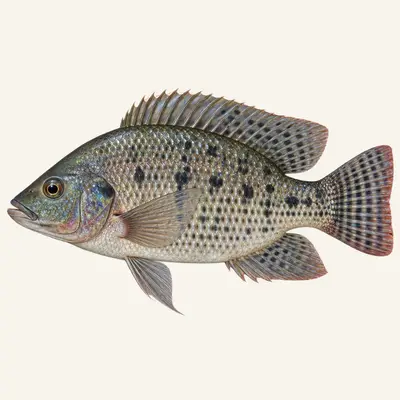
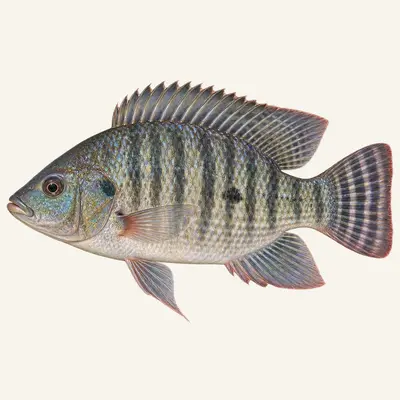
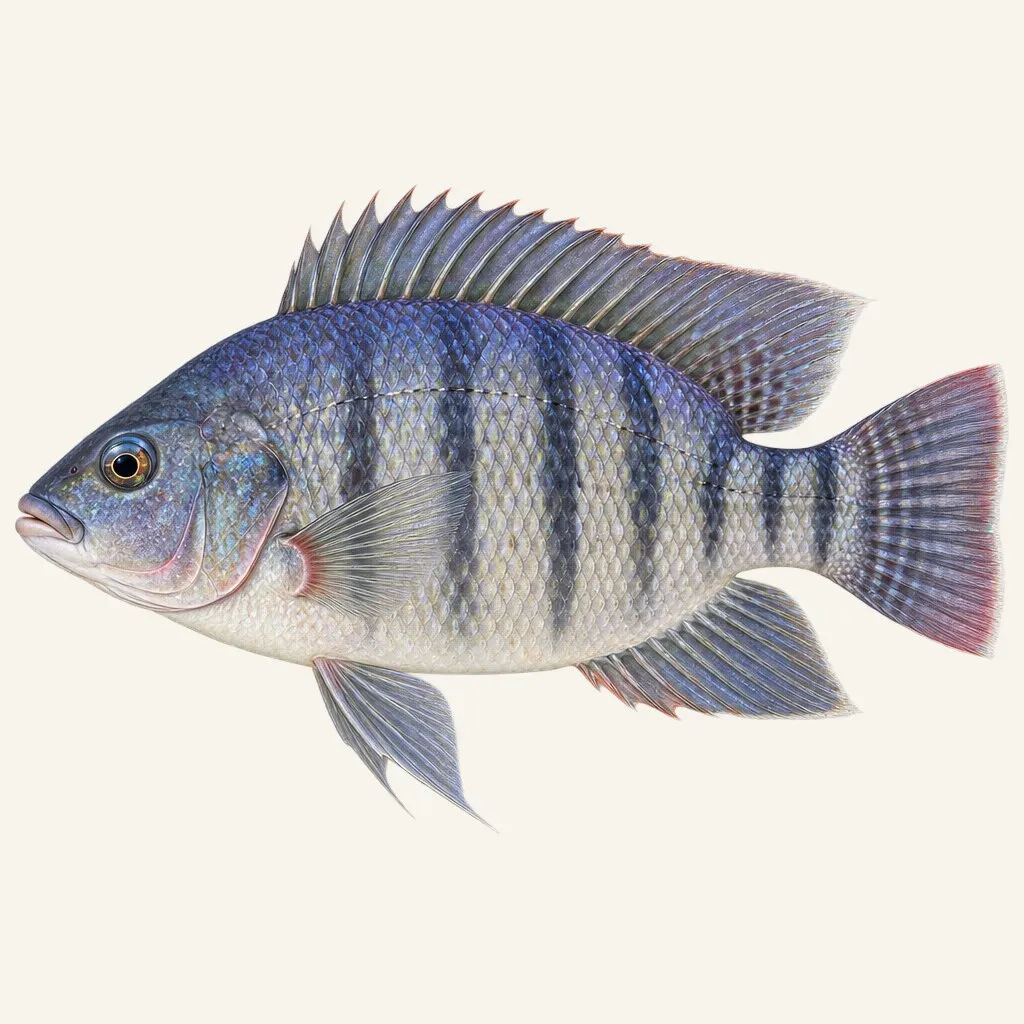
The mango tilapia is a medium-sized cichlid with silvery-olivaceous hues, found in the lakes and rivers of Africa and the Levant, most notably in the Sea of Galilee. It is distinguished by its biparental mouthbrooding behaviour, with both parents incubating the eggs.
Calendar
Recorded in 7 countries
Cameroon · China · Côte d’Ivoire · Gambia · Ghana · Mali · Nigeria
GBIF occurrence records — native and introduced populations combined.
Its range
Three entries in the range list carry more weight than all the rest: the Draa in Morocco, the Adrar in Mauritania, and the Saharan oases of Borkou, Ennedi and Tibesti in northern Chad.
Those are leftovers. The Sahara once held lakes and drainages connected to the Nile and to Chad, and when the rest of it dried, fish survived in the water that stayed permanent. A tilapia population in the Tibesti was not carried up there by anyone. It simply never left.
The continuous part of the range runs from the Atlantic rivers of West Africa — Senegal, Gambia, Casamance, Géba, Konkouré, Sassandra, Bandama, Comoé, Niger, Volta, Tano, Lake Bosumtwi, Mono, Ouémé, Ogun, Cross, Benue, Logone, Shari and Lake Chad — through the Sanaga and Nyong in Cameroon, then the whole Nile system with its delta lakes and Lakes Albert and Turkana, and finally the Jordan system and the coastal rivers of Israel, where the fish is mostly found in lakes.
Five subspecies are recognised, two of them in the Congo basin alone. Across a range of that size the meaningful unit is the local population, not the species.
Identifying it
Colour will not tell you the sex of this fish. A specimen in full reproductive condition is grey over the back and silvery underneath, with a pinkish margin on the dorsal and the caudal — and that description covers the male as well as the female. The rubric records no marked sexual dichromatism while the animal is sexually active. The single visible difference is in the fins: the male's last soft rays in the dorsal and the anal run longer.
The tail is naked except at its base, where a few rows of scales climb onto it. Melanin patches, where they occur, turn up in the odd individual and never across a whole population, so a spotted fish here defines nothing at all.
The proportions close the determination. The body is short and deep, compressed from the sides, its depth given as 43 to 56.5 per cent of standard length and usually over 45. The snout profile is straight or barely arched. The pectorals are long, 36 to 50 per cent of standard length, reaching back to above the vent or the spinous part of the anal fin. Head length runs 32.5 to 39 per cent of the same measure.
The counts: 14 to 17 dorsal spines with 11 to 14 soft rays, giving 27 to 30 dorsal rays in total and most often 28 or 29; three anal spines and nine to 12 rays; 27 to 31 vertebrae; and 20 to 27 rakers on the lower limb of the first arch.
Breeding
Both parents brood. Mouth incubation in this species is reported as biparental, with the father and the mother each carrying a share of the eggs — where the mouth-brooding tilapias of Oreochromis leave the whole clutch to the female while the male goes back to his pit and starts again.
The female also leads. She takes the initiative through courtship and mating, does most of the excavation of the nest, and defends the spawning territory. That is the reverse of the division of labour those other tilapias run on.
A pair bond does form, and then it dissolves at a precise moment: as soon as the eggs are in the parents' mouths. Everything the courtship built serves one clutch, and nothing of the association survives it.
Splitting the brood between two mouths has a consequence worth stating. Two adults stop feeding at the same time, so the population's whole reproductive effort goes quiet at once — but the clutch is insured twice over, and the loss of one parent costs half of it rather than all.
For anybody handling fish in the season, that cuts both ways. A specimen taken then may be holding eggs in its throat whatever its sex, and handling makes it spit them. First maturity is reached at 16.3 cm.
The water it needs
Adults hold open water while juveniles and breeding adults are found inshore. One lake therefore keeps its population in two separate places, and what decides which is the time of year rather than the depth available.
The species lives from five metres down, in water between 22 and 28 °C, and moves readily into brackish conditions.
The most useful line is the outlier. It has been recorded at 9 °C, well below its ordinary band, which is why it persists in water that its latitude alone would not lead you to expect. In the Sudd lakes on the White Nile it associates with beds of submerged vegetation. Social behaviour is intermittent — occasional schools, territoriality in periods. This is neither a permanent shoal fish nor a solitary one.
Areas
- Grassy banks
- Shallow sunny areas
- Estuaries
- Shallow lakes
Techniques
- Float fishing
- Light feeder
- Pole fishing
- Simple bottom rig
Baits
- Bread
- Green algae
- Sweet corn
- Vegetable pellets
- Bloodworm
What it eats
Algae and fine organic debris. This animal grazes and filters; it pursues nothing, and the gill apparatus confirms it. Twenty to 27 rakers on the lower limb of the first arch hold back material too small to be seized individually.
The lower pharyngeal jaw is short, its length going two to three times into that of its keel. That is the equipment of a fish processing soft abundant matter, not shells or carapaces, and it sets a hard limit on what will ever interest it.
How to catch it
Two seasons, two fish. Outside the breeding period the adults are out in open water and are prospected as a mobile shoal; during it they come back onto the shallows, turn territorial, and can then be taken out of irritation as readily as out of hunger.
The diet dictates the bait. An animal living on algae and fine debris does not commit itself to an imitation of prey. Vegetable pastes, fine groundbait and small bottom offerings match what it actually eats, and the hook is sized to the mouth of a mid-sized cichlid rather than to the idea of an African one.
First maturity at 16.3 cm is the marker to keep. Anything much above it has bred at least once, and the tackle is scaled to the animal in front of you.
Then there is the period of full mouths. A brooding parent does not feed, which quietly empties a swim of its largest fish, and either sex may be the one carrying. Those that are hooked anyway lose the clutch at the net. The spawning season is when this species is easiest to find and most expensive to disturb, and those two facts arrive together.
Conservation
What weighs on this fish is spread thin and does not show up in a single figure.
Three commercial uses run at once: a capture fishery, aquaculture, and the ornamental trade. None of them is the whole story on its own.
The fragmentation matters more. Five recognised subspecies stretch from the Atlantic to the Jordan, and the animal in the Tibesti is not interchangeable with the animal in the Volta. An account drawn across the whole band tells you very little about either end of it.
The relict populations are where the exposure is sharpest. Isolated permanent water in the Sahara has no route back: a population that goes has no source to recolonise from, because the network that would have supplied it dried thousands of years ago. Water abstraction and a bad year weigh differently in an oasis than they do on the Niger, and the same species is not in the same position in the two places.
Regulations
Check the local regulations in force (legal size limits, closed seasons, bag limits).
For guidance only. Legal sizes, quotas and open seasons vary by location and season: always check the local regulations in force before fishing.
Other names
Mango tilapia is the name in the file. The one that actually travelled is a table name — the fish served on the shores of the Sea of Galilee as St Peter's fish is this species, and the association with that lake is what put its epithet on it.
Older literature has it as Tilapia galilaea, so anything written before the genera were sorted out files it elsewhere.
Sarotherodon names the teeth: sarothron, a broom, and odous, a tooth, for a brush-like dentition. And the genus was separated from Tilapia and Oreochromis on reproductive grounds rather than on appearance. What defines it is who carries the eggs — which is why two fish that look much alike on a market slab can sit in different genera, and why the longest section of this page is about parents.
Sources: fishbase.se · api.gbif.org