Longfin tilapia
Oreochromis macrochir · Cichlidae
- Freshwater
- Other
- Medium
- Size
43 cm
- Water temp.
18–35 °C
- Depth
5–14 m
Where to fish
- Lake
- River
Habitat icons: Flaticon
Longfin tilapia - white fish, Southern Africa
Calendar
Recorded in 7 countries
Botswana · Mozambique · Namibia · Réunion · United States · Wallis & Futuna · Zambia
GBIF occurrence records — native and introduced populations combined.
Its range
The home range is that of three large inland networks: the Kafue, the upper Zambezi and the Congo basin, with the Okavango and the Ngami region, the Cunene basin, the Chambeshi and the Bangweulu region. Nothing coastal, nothing estuarine.
One physiological constraint explains that shape. Salinity tolerance in this species is very low, the lowest among the southern African tilapias, so its range stops where fresh water stops. Its relatives run up estuaries and follow the shoreline; this one stays shut inside the basins.
Transfers have put it elsewhere in Africa, and in the Hawaiian Islands.
Identifying it
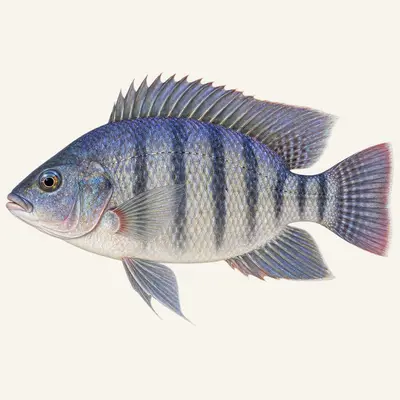
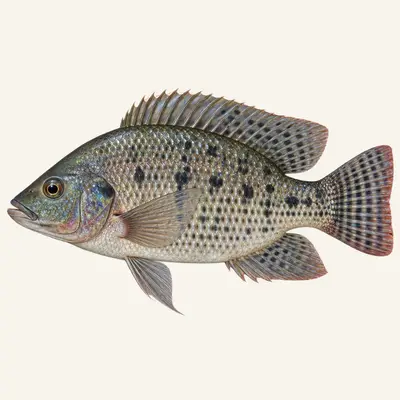
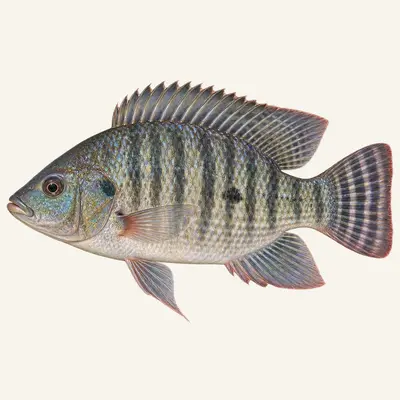
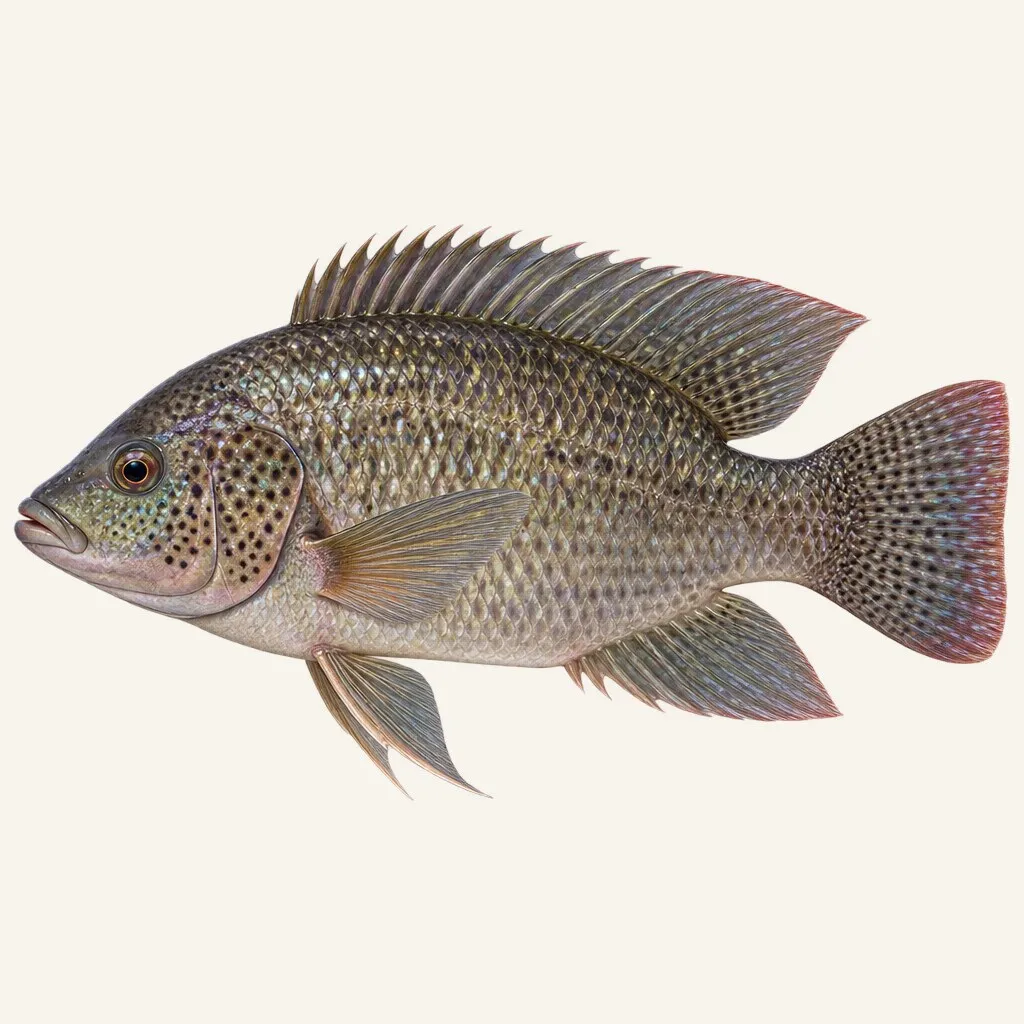
Black or dark brown flecks occupy the temporal region, the gill cover and the area below the eye in adults, most of them sitting on the pores of the lateral-line system. That scatter of dots on the cheek is the field character, and it comes with an absence: no conspicuous blotch along the middle of the flank, where the Mozambique tilapia lines up two to five and the three-spotted fish three or four.
The head profile is steep and rounded, which gives the animal a domed face recognisable in side view.
Three details finish the determination under a lens. The lobes of the toothed area on the lower pharyngeal bone are broadly rounded. Cheek scales run in two to three rows. Caudal scaling is variable but does not invade the interradial membranes except at the base, so it never stiffens the fin.
The counts fit on one line: 15 to 17 dorsal spines, 11 to 14 soft rays, three anal spines, nine to 12 anal rays, 29 to 32 vertebrae.
Breeding
The nest is a volcano. At the centre of his territory the male raises a cone of sediment whose top, flat or slightly hollowed, serves as the mating platform; the whole is ringed by a ditch and a rampart, and the cone stands higher than that boundary wall. No other tilapia of the region builds anything like it, and it is precisely what separates the species from Oreochromis mweruensis, which excavates instead of building.
These structures are often grouped into arenas along lake or river banks, under 150 to 300 cm of water. The season runs September to March in the southern part of the range.
Mating goes through a singular organ. The male's genital papilla extends into tassels about 25 mm long. Once the female has laid on top of the cone, the male passes over it, and she touches those tassels with her lips: the contact triggers release. Some of the milt fertilises eggs already in her mouth, but most of the fertilisation happens outside, in the crater. The literature hesitated for a long time over what the organ is — Wickler described a spermatophore-like structure in 1966, which Trewavas later put down to a filament of the papilla, having never observed spermatophores under natural conditions.
Quantities are small per spawning and large in total. Ten to 50 eggs go down at each pass, but up to 1,300 are carried in the mouth depending on the female's size, each three millimetres across and greenish brown. No pair bond forms: partners are together only for the laying, and a female works through several males in one season, so she ends up brooding the offspring of more than one. A brood roughly every five weeks.
Brooding females hide in dense vegetation. The fry may leave the mouth before the yolk sac is fully absorbed; they stay bunched and are taken back in at night and at every alarm. At around 21 days, at some 20 mm, they break away, hold the shallow bank and the sheltered ground first, then move out as they grow.
The water it needs
Adults look for quiet, deep, vegetated water between five and 14 m, though captures are recorded in other configurations too. The observed thermal range is 18 to 35 °C.
Schools form occasionally and activity is by day. An animal that cannot handle salt, avoids current and prefers cluttered bottoms is looked for in the same places a carp would be: the quiet holes, the edges of weed beds and the shallow ends of impoundments.
Areas
- Vegetated banks
- Deltas and floodplains
- Calm river zones
- Large lake shores
Techniques
- Feeder fishing
- Float fishing
- Pole fishing
- Light float rig
Baits
- Sweet corn
- Algae
- Bread
- Vegetable pellets
- Bloodworm
What it eats
Detritus supplies the bulk of the ration, with blue-green algae and diatoms alongside. These are abundant, immobile foods, harvested off the bed without spending energy chasing anything.
Juveniles take small invertebrates and zooplankton in addition, and lose the habit as they grow. The diet therefore narrows with age, the opposite of the many species that widen their menu as they get bigger.
How to catch it
A deposit grazer is caught on the bottom, and on what the bottom holds. Plant baits and pastes work better than animal ones on adults that have not chased anything mobile in a long time; the young will still take small invertebrates.
Reading the water follows from the rest. The species is confined to fresh water, which rules out looking for it in the tidal reaches of rivers. It occupies five to 14 m in quiet vegetated ground, and comes close to the bank in the breeding season, where the cone arenas show under 150 to 300 cm.
The flesh has a good reputation, which has supported both a commercial fishery and culture. It also appears in the fishery record as an angling species, which is not true of every member of the genus.
Conservation · Vulnerable (IUCN) — This species is threatened with extinction. Always release it (no-kill), handle it with the utmost care and check local rules — fishing for it may be prohibited.
Conservation
Zambia has banned any further stocking of Nile tilapia on its territory, and the upper Zambezi and the Kafue are among the networks that measure protects. Both are rivers where this species lives. The reason for the ban bears on it directly: tilapias cross with each other without difficulty, and generalised hybridisation makes a local lineage disappear long before it makes any catch figure fall.
The assessment that serves as reference is nearly 20 years old, which makes it of little use for settling anything today. In the interval the commercial fishery has continued, culture has developed and transfers have gone on, inside the continent and out to the Hawaiian Islands.
The fish itself presents no danger to anyone handling it.
Regulations
Check the local regulations in force (legal size limits, closed seasons, bag limits).
For guidance only. Legal sizes, quotas and open seasons vary by location and season: always check the local regulations in force before fishing.
Other names
Longfin tilapia in English, and macrochir means large hand. Both names point at an impression of size in the fins that the published diagnosis does not use as a distinguishing character. The determination is not made there. It is made on the flecks across the cheek and, in season, on the shape of the nest, which is the one structure in the genus that cannot be mistaken for anything else.
Sources: fishbase.se · api.gbif.org